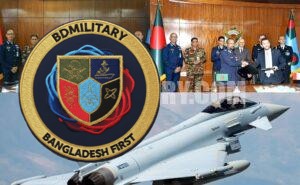

The signing of the Letter of Intent (LOI) between the Bangladesh Air Force (BAF) and Italy’s Leonardo S.p.A. on 9 December 2025 for the procurement of the Eurofighter Typhoon represents a watershed moment in Bangladesh’s defence modernisation journey. This development signals not only a technological leap for the Air Force but also a major strategic and geopolitical repositioning for the country.
The LOI was signed at Air Headquarters, Dhaka, in the presence of the Chief of Air Staff, Air Chief Marshal Hasan Mahmood Khan, and the Italian Ambassador to Bangladesh, Antonio Alessandro, alongside senior officials from the Armed Forces Division and representatives of the Italian defence industry.
From BDMilitary’s perspective, this step reflects a rare convergence of strategic intent, procurement ambition, and technical transformation. The team’s three senior analysts — Amit Bhattacharya, Khaled Ahmed, and M. Z. Rahman — assess the development from acquisition, geopolitical, and technical standpoints respectively.
Procurement and Acquisition Perspective
Amit Bhattacharya’s Analysis
Amit Bhattacharya views the LOI primarily through the lens of defence procurement policy and acquisition discipline. In his assessment, the decision to pursue the Eurofighter Typhoon reflects a clear shift in Bangladesh’s acquisition philosophy—from cost-driven purchases towards capability-driven procurement.
He notes that the Typhoon programme is not a low-cost option and therefore indicates a deliberate willingness by the state to invest in premium capability for long-term strategic returns. According to him, the LOI structure allows Bangladesh to formalise intent while preserving room for negotiation on pricing, offsets, weapon packages, and support arrangements.
Bhattacharya emphasises that for the acquisition to succeed, three pillars must be secured within the final contract:
- Life-cycle cost transparency, not merely the flyaway price.
- Technology transfer and training, particularly for maintenance crews and engineers.
- Guaranteed long-term logistics support, ensuring fleet availability during crises.
He also stresses that the procurement process must remain institutionally insulated from short-term political pressures. In his view, indecision or policy reversal at this stage could result in wasted opportunity and reputational damage at the international level.
According to Bhattacharya, the Typhoon programme will only be strategically justified if it is treated as a 30–40 year capability investment rather than as a short-term prestige purchase.
Geopolitical and Security Implications
Khaled Ahmed’s Strategic View
Khaled Ahmed analyses the LOI primarily through the lens of regional geopolitics and national security. He believes the signing carries consequences far beyond the Air Force itself, redefining Bangladesh’s strategic posture within South Asia and the wider Indo-Pacific region.
In his assessment, the Eurofighter Typhoon places Bangladesh among a small group of nations operating one of Europe’s most advanced combat aircraft. This alters the regional balance of air power and strengthens Bangladesh’s deterrence posture at a time when air dominance is increasingly decisive in modern warfare.
Ahmed notes that defence procurement today is inseparable from geopolitics. By moving towards a major European defence consortium, Bangladesh is subtly diversifying its strategic partnerships beyond traditional suppliers. This diversification enhances diplomatic leverage and reduces strategic dependency.
From a security standpoint, he argues that the Typhoon significantly raises the threshold of any potential hostile calculus against Bangladesh. Air superiority platforms of this class act not merely as weapons of war, but as instruments of strategic deterrence.
However, Ahmed also cautions that such a move will attract regional scrutiny. He stresses the importance of transparent communication of Bangladesh’s defensive doctrine to ensure that the acquisition is viewed as stabilising rather than provocative.
In his view, the LOI reflects Bangladesh’s transition from a reactive to a proactive security posture — one focused on deterrence through credible capability.
Technical and Operational Assessment
M. Z. Rahman’s Technical Evaluation
M. Z. Rahman evaluates the development from a purely technical and operational standpoint. He considers the Eurofighter Typhoon to be a generational leap over the aircraft currently operated by the Bangladesh Air Force.
He highlights the Typhoon’s key strengths: advanced multi-mode radar, sensor fusion, network-centric warfare capability, electronic warfare systems, and high thrust-to-weight ratio, which together provide exceptional situational awareness and combat effectiveness.
From a technical perspective, Rahman particularly emphasises three operational advantages:
- Beyond-visual-range air combat capability, allowing early engagement of adversaries.
- True multi-role flexibility, enabling rapid switching between air superiority, ground attack, and maritime strike missions.
- High survivability in contested airspace, enabled by sophisticated electronic countermeasures.
However, Rahman cautions that the Typhoon is a complex platform that demands an equally advanced support ecosystem. He stresses that the aircraft’s effectiveness will depend on the availability of simulators, hardened maintenance infrastructure, trained avionics specialists, and continuous software and systems upgrades.
He also notes that weapons integration will be a decisive factor. Without access to a modern suite of air-to-air and air-to-ground munitions, the platform’s true potential cannot be realised.
In his technical assessment, the Typhoon will only deliver strategic value if Bangladesh invests as heavily in sustainment as in acquisition.
BDMilitary’s Institutional View
Collectively, the BDMilitary team views the LOI as one of the most consequential defence decisions taken by Bangladesh in recent decades. It reflects maturity in defence planning and a willingness to invest in long-term national security.
The team identifies three overarching imperatives for success:
- Strategic consistency in policy execution.
- Financial discipline and transparency in procurement.
- Institutional capacity-building in training, maintenance, and operations.
Failure in any one of these domains could undermine the entire programme, regardless of the aircraft’s inherent excellence.
Concluding Remarks
The Letter of Intent between the Bangladesh Air Force and Leonardo S.p.A. for the Eurofighter Typhoon is, in BDMilitary’s judgement, a defining moment in the evolution of Bangladesh’s air power.
Amit Bhattacharya sees it as a test of Bangladesh’s procurement discipline and long-term acquisition planning. Khaled Ahmed views it as a powerful geopolitical signal and a major enhancement of national deterrence. M. Z. Rahman assesses it as a transformative upgrade in technical and operational capability.
All three agree on one fundamental point: the Typhoon programme will shape Bangladesh’s air power and strategic posture for decades to come. Its success, however, will depend not on intent alone, but on disciplined execution, sustained investment, and unwavering national commitment.
For BDMilitary, this LOI marks not the conclusion of a process, but the beginning of a decisive era in Bangladesh’s pursuit of credible, modern air power.
As an institution, we thank and congratulate Air Chief Marshal Hasan Mahmood Khan BBP, OSP, GUP, nswc, psc and his Team on this momentous occasion.

Ayesha Farid is a regional security specialist focusing on South Asia, with over a decade of experience analysing inter-state tensions, cross-border insurgency, and regional power dynamics. She has worked with leading policy think tanks and academic institutions, offering nuanced insights into the complex security challenges shaping the subcontinent. Ayesha’s expertise spans military doctrines, border disputes, and regional cooperation frameworks, making her a vital contributor to BDMilitary’s coverage of South Asian strategic affairs. She leads the Geopolitics & Diplomacy section at BDMilitary. Ayesha holds a dual master’s degree — a Master in International Relations from the IE School of Politics, Economics & Global Affairs, Spain, and a Master of Public Policy from the Munk School of Global Affairs, University of Toronto, Canada — combining deep academic insight with practical policy expertise.