From the acquisition of 24 J-10CE fighters and the establishment of a UAV manufacturing facility in Bogra to future plans for MRSAM systems and fifth-generation aircraft, the Bangladesh Air Force appears poised for its most ambitious transformation since independence.
“The J-10CE is not merely replacing an aircraft fleet; it is introducing an entirely new level of capability while serving as the foundation of a broader transformation encompassing UAVs, indigenous manufacturing, air defence modernisation and future fifth-generation aviation.”
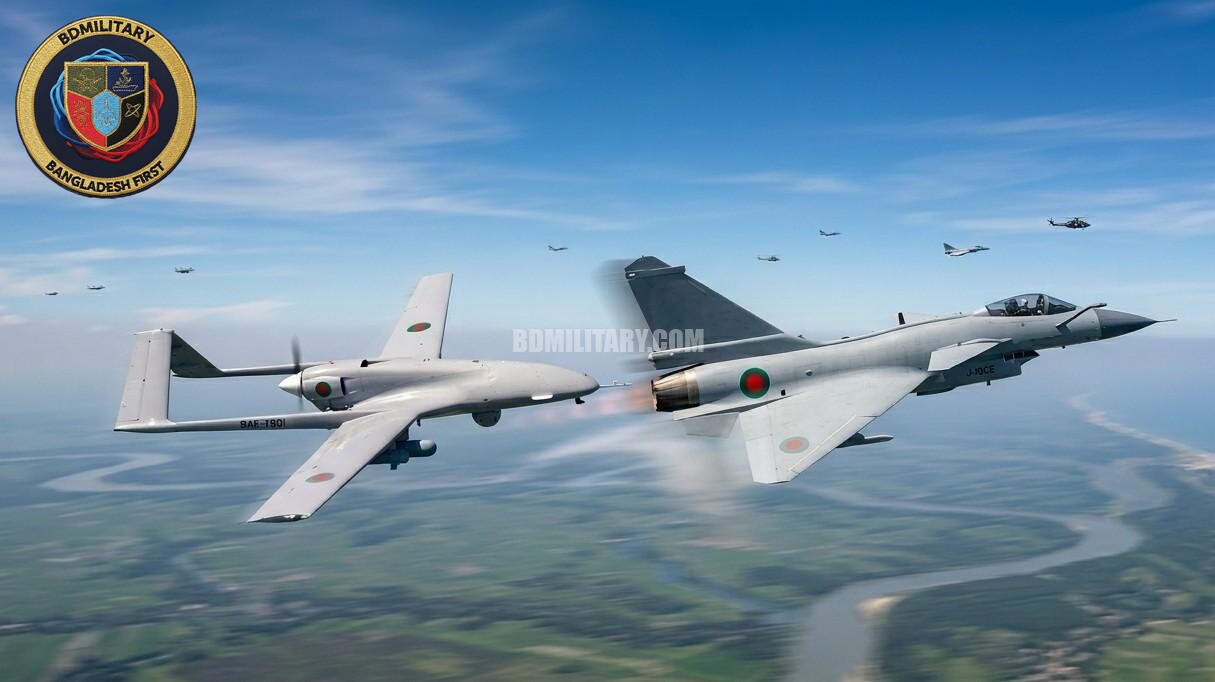
The Bangladesh Air Force (BAF) stands on the threshold of what could become the most significant transformation programme in its history. At the centre of this emerging vision is the reported acquisition of 24 highly customised Chengdu J-10CE multirole fighters from China, accompanied by the establishment of a UAV manufacturing facility in Bogra through technology transfer from China Electronics Technology Group Corporation (CETC).
According to defence industry sources, the fighter acquisition will be conducted through a government-to-government agreement between Bangladesh and China and could be worth in excess of US$2 billion. The package is expected to include pilot and ground crew training, spare parts support, maintenance infrastructure, technical assistance and long-term logistical support.
The agreement is reportedly expected to be signed in August 2026 and would mark a decisive shift in the trajectory of Bangladesh’s air power modernisation. Beyond the acquisition of advanced combat aircraft, the programme is expected to introduce significant technology transfer arrangements aimed at developing indigenous aerospace and defence manufacturing capabilities.
Yet the significance of these developments extends far beyond the acquisition of a new fighter aircraft. Taken together with planned investments in indigenous defence manufacturing, future air defence systems, expanded international partnerships and long-term fifth-generation fighter ambitions, the programme points towards a comprehensive restructuring of Bangladesh’s air power capabilities.
If realised, the initiatives would represent a shift from a force primarily focused on territorial air defence towards one built around networked warfare, indigenous production, persistent ISR capabilities and layered deterrence.
A New Backbone for the Bangladesh Air Force
The Chengdu J-10CE is widely regarded as one of the most capable fourth-generation-plus fighters currently available on the export market. Equipped with an Active Electronically Scanned Array (AESA) radar, advanced electronic warfare systems, modern data links and compatibility with long-range PL-15 beyond-visual-range missiles, the aircraft represents a substantial leap in capability compared with aircraft currently operated by the Bangladesh Air Force.
The fighter is expected to become the backbone of future BAF combat aviation, providing capabilities in air superiority, interception, maritime strike, precision attack and air defence.
Bangladeshi pilots, engineers and support personnel are expected to undergo training in China in successive batches, while Chinese technical personnel may remain in Bangladesh during the induction and operationalisation phases to assist with maintenance, logistics and training.
The programme is also expected to create the foundation for deeper defence-industrial cooperation between Bangladesh and China, with future phases reportedly involving local production of selected components, aerial munitions and aerospace consumables.
Not a Replacement for the F-7BG and F-7BG1
Contrary to widespread speculation, the J-10CE is not expected to replace the Bangladesh Air Force’s F-7BG and F-7BG1 fleets.
Sources familiar with BAF force planning indicate that the acquisition is primarily intended to address capability gaps associated with the ageing F-7MB fleet.
Despite frequent criticism from outside observers, the F-7BG and F-7BG1 remain capable aircraft within their intended operational roles. Equipped with improved avionics, radar systems and modern weapons integration compared with earlier F-7 variants, they continue to provide valuable point-defence, interception and sovereignty protection capabilities.
The aircraft are expected to remain in service alongside the J-10CE for the foreseeable future.
Rather than replacing existing assets, the J-10CE introduces an entirely new level of capability and enables the Bangladesh Air Force to undertake missions that were previously beyond its reach. This approach allows the BAF to maximise the service life of proven assets while simultaneously introducing a high-end multirole combat capability.
Building a Modern Air Combat Ecosystem
Importantly, the J-10CE acquisition should not be viewed in isolation.
Sources familiar with long-term Bangladesh Air Force planning indicate that the fighter programme forms part of a broader effort to develop an integrated air combat ecosystem broadly similar to the force structure adopted by the Pakistan Air Force over the past two decades.
Under this approach, modern multirole fighters would operate alongside airborne early warning and control (AEW&C) aircraft, advanced ground-based air defence systems, unmanned aerial systems and networked command-and-control infrastructure.
Defence observers note that the Pakistan Air Force’s success in integrating platforms such as the JF-17, J-10C, Saab Erieye AEW&C aircraft and long-range air-to-air missile capabilities has attracted considerable attention throughout the region. Bangladesh appears increasingly interested in adopting elements of a similar model adapted to its own operational requirements and strategic environment.
Future Bangladesh Air Force modernisation efforts are therefore expected to extend beyond combat aircraft procurement alone.
Among the capabilities reportedly under consideration are Airborne Early Warning and Control (AEW&C) aircraft sourced from China. Such platforms would significantly enhance Bangladesh’s ability to detect, track and coordinate responses against aerial threats at extended ranges.
By providing a comprehensive airborne surveillance picture, AEW&C aircraft would allow the J-10CE fleet to exploit its full potential, improving situational awareness, extending radar coverage beyond ground-based systems and enhancing command-and-control capabilities during both peacetime and wartime operations.
The introduction of AEW&C assets would also represent a major step towards network-centric warfare, enabling fighters, air defence systems, UAVs and command centres to operate as components of a single integrated battlespace.
When viewed alongside the planned UAV manufacturing programme, future MRSAM acquisitions and long-term ambitions for fifth-generation fighters, a clearer picture begins to emerge. Rather than pursuing isolated procurements, the Bangladesh Air Force appears to be constructing the foundations of a modern integrated air power architecture.
The emerging force structure could ultimately consist of:
- J-10CE fighters as the backbone of combat aviation
- Potential JF-17 aircraft as complementary multirole fighters
- Chinese AEW&C aircraft providing airborne surveillance and battle management
- CETC XY-1 and future UAVs delivering persistent ISR and strike capabilities
- MRSAM and advanced air defence systems creating a layered defensive shield
- Indigenous production of drones, munitions and aerospace components via Bogra
- Future fifth-generation fighters such as the J-35 after 2040
Viewed through this lens, the reported J-10CE acquisition represents the opening phase of a much larger transformation programme aimed at creating an integrated, networked and technologically advanced air force.
Bogra UAV Factory Signals a New Era of Indigenous Defence Manufacturing
Equally significant is the planned UAV manufacturing and assembly facility in Bogra, which will reportedly be established with technology transfer support from CETC.
The facility is expected to assemble and eventually manufacture advanced unmanned aerial systems, munitions and related components domestically. Industry sources indicate that the project will focus on platforms such as the CETC XY-1 MALE UAV, capable of conducting intelligence, surveillance and reconnaissance missions as well as precision strike operations.
The project represents one of the most ambitious defence-industrial initiatives ever undertaken by Bangladesh. In addition to UAV assembly, future phases are expected to include local production of munitions, subsystems and selected aerospace components.
Sources familiar with the programme indicate that Bangladesh is ultimately seeking to acquire the capability to manufacture selected fighter aircraft components and aerial consumables domestically, reducing long-term dependence on foreign suppliers while building a sustainable aerospace industry.
Transforming Bangladesh’s ISR and Strike Capabilities
The strategic value of the UAV programme extends far beyond industrial development.
Platforms such as the CETC XY-1 would significantly enhance Bangladesh’s intelligence, surveillance and reconnaissance capabilities across critical operational theatres, including the country’s extensive land borders, the Chittagong Hill Tracts and the maritime domain in the Bay of Bengal.
Persistent UAV coverage would allow the armed forces to monitor border activity, track emerging threats, conduct maritime surveillance and provide real-time targeting information to commanders. Combined with precision-strike capabilities, the systems would provide Bangladesh with a highly flexible and cost-effective means of responding to security challenges.
The maritime dimension is particularly significant. UAVs operating from Bangladeshi territory could provide continuous surveillance of the country’s Exclusive Economic Zone, offshore resources and critical sea lines of communication, greatly improving maritime domain awareness.
Beyond their operational value, systems such as the XY-1 would strengthen Bangladesh’s deterrence posture by providing persistent situational awareness and precision engagement capabilities across both land and maritime domains.
Together, the J-10CE and UAV ecosystem would establish a modern high-low force structure within the Bangladesh Air Force, combining high-end air combat capability with persistent, lower-cost surveillance and strike systems.
Growing Defence Cooperation with Pakistan
The developments also come amid expanding defence engagement between Bangladesh and Pakistan.
Recent reports indicate that the Pakistan Air Force has provided a JF-17 simulator to the Bangladesh Air Force, a move widely interpreted by defence observers as a precursor to deeper cooperation surrounding the JF-17 Thunder programme.
Jointly developed by Pakistan and China, the JF-17 shares substantial industrial involvement from Chinese defence companies. The simulator transfer is viewed by many analysts as an effort to familiarise Bangladeshi personnel with the platform and potentially pave the way for future procurement discussions.
Tarique Rahman’s China Visit Highlights Strategic Shift
The reported defence agreements coincide with Prime Minister Tarique Rahman’s first official visit to China since assuming office on 17 February 2026.
The visit, conducted from 24 to 26 June 2026, has attracted considerable attention because of the breadth of engagements reportedly scheduled with China’s leadership.
According to diplomatic sources, the Bangladeshi Prime Minister is expected to meet President Xi Jinping, Premier Li Qiang and other senior Chinese leaders during the visit.
Such a level of engagement would be highly unusual and is widely interpreted as reflecting both Beijing’s desire to elevate relations with Bangladesh and Dhaka’s intention to deepen ties across government, defence, economic and political domains.
The discussions are expected to cover defence cooperation, technology transfer, industrial investment, infrastructure development, trade, connectivity and broader strategic coordination.
Strategic Implications Across South Asia
China has long been Bangladesh’s largest defence supplier, providing fighter aircraft, naval vessels, air defence systems, armoured vehicles and military training.
The addition of advanced fighters and indigenous UAV production capabilities would elevate the relationship towards a deeper technology-transfer and industrial cooperation model.
At the same time, Bangladesh’s growing engagement with Türkiye and Pakistan signals an increasingly diversified defence procurement strategy focused on capability development and industrial partnerships.
The introduction of the J-10CE has already drawn significant attention among regional defence observers. Analysts note that a modern fourth-generation-plus fighter equipped with AESA radar and long-range PL-15 missiles would substantially enhance Bangladesh’s air combat capability.
Looking Beyond the J-10CE
While the J-10CE acquisition represents a major milestone, it is only the first step in a longer-term force development strategy.
Future planning reportedly includes the acquisition of Medium-Range Surface-to-Air Missile (MRSAM) systems to complement the existing FM-90 SHORAD network, creating a layered national air defence architecture capable of countering modern aerial threats.
At present, Bangladesh’s ground-based air defence capability remains primarily limited to short-range systems, particularly FM-90 variants, which are effective in point defence roles but lack broader area coverage.
Beyond air defence, long-term planning is expected to include the eventual introduction of fifth-generation fighter aircraft, potentially the J-35 after 2040.
The long-term vision emerging from current planning appears to centre on five pillars:
- J-10CE fighters as the backbone of combat aviation
- CETC XY-1 and future UAV platforms for ISR and strike
- Indigenous aerospace and munitions production in Bogra
- Layered air defence architecture built around MRSAM systems
- Fifth-generation fighter capability post-2040
A Defining Moment for the Bangladesh Air Force
If the reported agreements are finalised, they will represent far more than a routine procurement programme.
The combination of advanced fighter aircraft, UAV production, technology transfer, industrial development, future air defence acquisitions, AEW&C integration and long-term fifth-generation ambitions would amount to a comprehensive reset of Bangladesh’s air power capabilities.
For the first time, Bangladesh would not only be acquiring advanced military hardware but also laying the foundations for a domestic aerospace and air defence ecosystem.
The anticipated signing of the J-10CE agreement in August 2026 may ultimately be remembered not simply as the purchase of a new fighter aircraft, but as the moment Bangladesh began laying the foundations of a networked, modern and increasingly self-reliant air force capable of meeting the demands of the mid-21st century.

M.Z. Rahman is a distinguished defence and aerospace industry veteran turned strategist, with over two decades of experience in regional security, military modernisation, and strategic policy. Holding a Master of Arts in International Relations and Security Studies from Waikato University, New Zealand, he has contributed extensively to leading think tanks and defence journals worldwide. As Chief Editor of BDMilitary, Rahman drives the editorial vision, delivering authoritative, rigorously researched insights that reflect the latest trends in defence and geopolitics. His work integrates industry expertise with strategic foresight, establishing him as a respected voice in global defence strategy.