Dhaka’s response to a more difficult relationship with India should be diplomatic diversification, credible deterrence and the international defence of its sovereign rights
Bangladesh’s relationship with India is entering one of its most consequential periods in decades. Political distrust, unresolved water-sharing questions, recurring border controversies and competing perceptions of sovereignty have combined to create an increasingly difficult bilateral environment.
Dhaka should resist the temptation to respond emotionally.
A country of nearly 180 million people, occupying one of the most strategically important positions in the Indo-Pacific, does not strengthen itself through rhetorical escalation. It strengthens itself by accumulating diplomatic influence, economic resilience, military capability and international partnerships.
Bangladesh therefore requires neither confrontation with India nor dependence upon it. It requires strategic autonomy.
The objective should be straightforward: friendship where possible, cooperation where beneficial, resistance where necessary and dependence on no single power.
Do Not Allow India To Dictate Bangladesh’s Strategic Choices
India will remain Bangladesh’s largest neighbour and an unavoidable strategic reality. Geography cannot be changed, nor should Bangladesh seek a permanently adversarial relationship with New Delhi.
India is an important trading partner, transit neighbour and regional power. Stable relations are therefore in Bangladesh’s national interest.
But constructive relations cannot mean accepting an unequal relationship.
Dhaka should make clear that cooperation must rest upon sovereign equality, reciprocity and respect for Bangladesh’s independent political and strategic choices.
This requires patience. Provocation should not automatically produce counter-provocation. Diplomatic disputes should be answered through institutions, international engagement and the methodical strengthening of Bangladesh’s bargaining position.
Strategic restraint is not weakness when it is accompanied by growing national power.
Build A Much Wider Diplomatic Network
Bangladesh’s most effective response to excessive pressure from any single country is diversification.
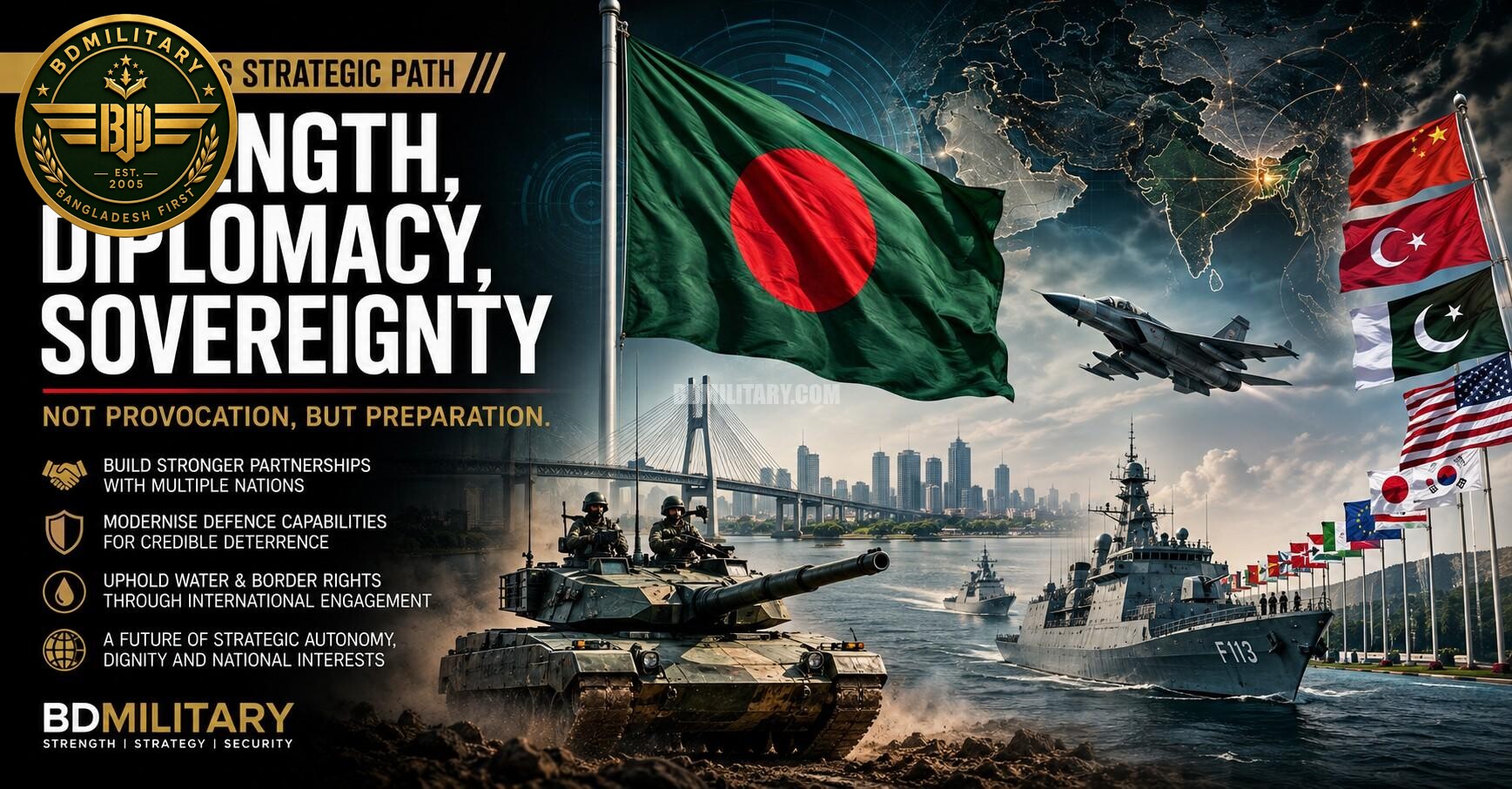
Relations with China, Türkiye, Pakistan and the United States should therefore be expanded alongside stronger relationships with Japan, South Korea, Indonesia, Malaysia, Saudi Arabia, the United Arab Emirates, the European Union, the United Kingdom and other partners.
Crucially, these relationships should not be constructed as an anti-India coalition.
That would merely replace strategic autonomy with bloc politics.
Instead, Bangladesh should pursue different partnerships for different national requirements. China can remain an important infrastructure, industrial, commercial and defence partner. Türkiye offers considerable potential in defence technology and industrial collaboration. The United States can provide investment, technology, maritime cooperation, education and access to advanced defence capabilities. Japan and South Korea offer major opportunities in infrastructure, manufacturing, shipbuilding and advanced industry.
Pakistan, meanwhile, represents a relationship that can be developed pragmatically where contemporary Bangladeshi interests are served, without allowing history or present-day geopolitics to dictate unrealistic expectations.
This is what a genuinely multi-vector foreign policy looks like.
Bangladesh should have enough relationships that no foreign capital can reasonably believe Dhaka has nowhere else to turn.
Defence Modernisation Must Become A National Priority
Diplomacy is considerably more effective when backed by credible national capability.
Bangladesh does not need military parity with India. Attempting to achieve it would be economically irrational and strategically unnecessary.
It does, however, require credible deterrence.
The purpose of Bangladeshi military modernisation should be to make coercion prohibitively difficult and ensure that violations of the country’s sovereignty carry unacceptable political and operational costs.
That requires moving beyond an equipment-centric understanding of military modernisation.
Bangladesh needs integrated air defence, modern combat aviation, long-range surveillance, unmanned systems, electronic warfare, cyber capabilities, precision strike systems, modern artillery, stronger mechanised formations and substantially improved intelligence, surveillance and reconnaissance.
At sea, Bangladesh must possess the ability to maintain persistent awareness of its maritime domain and protect its economic interests in the Bay of Bengal.
Submarines, capable surface combatants, maritime patrol aircraft, unmanned platforms, coastal surveillance and anti-access capabilities should form parts of a coherent maritime strategy rather than exist as isolated procurement programmes.
Above all, Bangladesh requires integration.
Radars, aircraft, missiles, drones, naval vessels, ground formations, satellites and command centres become substantially more valuable when connected through resilient communications and a common command-and-control architecture.
The objective should not be to build the region’s largest military.
It should be to build a force that cannot easily be intimidated, surprised or neutralised.
Bangladesh Must Build Its Own Defence Industry
Procurement alone cannot produce strategic independence.
A country dependent entirely upon foreign suppliers for ammunition, maintenance, spare parts and critical technologies remains vulnerable regardless of how sophisticated its imported equipment may appear.
Bangladesh should therefore treat defence industrialisation as part of national economic policy.
Partnerships with Türkiye, China, the United States, South Korea, European manufacturers and other willing suppliers should increasingly incorporate technology transfer, licensed production, maintenance capability and local manufacturing.
Priority areas could include ammunition, small arms, artillery systems, unmanned aircraft, communications equipment, electronic warfare systems, military vehicles, naval construction and eventually more sophisticated missile and aerospace technologies where economically and technologically feasible.
Bangladesh already possesses an industrial base capable of supporting considerably greater ambitions.
The long-term objective should be simple: buy what Bangladesh must, manufacture what Bangladesh can and progressively reduce critical external dependencies.
Water Security Must Become International Diplomacy
Perhaps nowhere is Bangladesh’s vulnerability to geography clearer than water.
As a lower-riparian country situated downstream of major transboundary river systems, Bangladesh cannot afford to treat water diplomacy merely as another component of bilateral relations.
Water is a national-security issue.
Dhaka should continue pursuing negotiated solutions with India, but bilateral diplomacy need not be the only diplomatic instrument available.
Bangladesh should strengthen the technical and legal foundations of its position through internationally recognised principles governing transboundary watercourses, environmental protection and equitable utilisation.
It should develop comprehensive hydrological evidence, environmental-impact assessments and internationally credible research supporting its positions.
Where appropriate and legally available, Bangladesh can raise water-security concerns through relevant multilateral diplomatic and environmental forums.
Internationalisation should not mean theatrical confrontation. It should mean ensuring that Bangladesh’s case is understood beyond Dhaka and New Delhi.
A technically rigorous argument supported by hydrological data, environmental science and international law will ultimately carry greater weight than nationalist rhetoric.
Border Rights Require The Same Discipline
The Bangladesh–India frontier should likewise be managed through law, documentation and persistent diplomacy.
Every significant border incident should be investigated and documented. Established bilateral mechanisms should remain the first avenue for resolution, while serious unresolved matters can be raised through appropriate diplomatic and international channels where warranted.
Bangladesh should simultaneously continue modernising border surveillance.
Unmanned aerial systems, electro-optical sensors, secure communications, modern observation posts and improved intelligence coordination can provide better situational awareness without requiring unnecessary militarisation of the frontier.
The objective is not escalation.
It is ensuring that Bangladesh possesses the information, institutional capacity and diplomatic leverage necessary to defend its territory and citizens.
The Bay Of Bengal Changes Bangladesh’s Strategic Position
Bangladesh must also stop viewing itself exclusively through the geography of the Indian subcontinent.
Its southern frontier opens directly onto the Bay of Bengal and, beyond it, the wider Indo-Pacific.
That geography creates enormous strategic possibilities.
The Bay connects Bangladesh with Southeast Asia, the Indian Ocean and some of the world’s most important maritime trading routes. Chattogram, Mongla and emerging port and logistics infrastructure can progressively transform Bangladesh from a geographic endpoint into a regional economic gateway.
This provides Dhaka with diplomatic options that previous generations did not possess.
Relations with ASEAN states, Japan, South Korea, Australia, Gulf countries, Europe and the United States can all be developed around maritime commerce, energy, infrastructure and security.
Bangladesh should think increasingly as both a South Asian and an Indo-Pacific state.
Economic Power Ultimately Determines Strategic Power
There is an important limitation to every discussion about military or diplomatic strategy.
None of it can be sustained without economic strength.
Bangladesh’s greatest strategic asset is ultimately not a missile, fighter aircraft or warship. It is the productive capacity of the country itself.
Export diversification, energy security, infrastructure, technological development, education, manufacturing and financial stability therefore belong within the national-security conversation.
A richer Bangladesh can maintain stronger armed forces, absorb diplomatic pressure more effectively and negotiate with larger states from a position of greater confidence.
Defence modernisation and economic development should consequently reinforce rather than compete with one another.
Strategic Autonomy, Not Strategic Alignment
Bangladesh faces a choice, but it is not a choice between India and China, India and Pakistan, or Washington and Beijing.
That framing itself should be rejected.
Bangladesh’s choice is between dependency and strategic autonomy.
Dhaka should be willing to cooperate with India whenever interests converge and equally willing to disagree when fundamental national interests diverge. It should deepen relations with China without becoming strategically dependent upon Beijing. It should expand engagement with Washington without becoming an instrument of American regional competition. It should develop defence cooperation with Türkiye and other partners while retaining sovereign control over procurement and doctrine.
That balance will sometimes frustrate larger powers.
It is nevertheless precisely what an independent foreign policy is supposed to accomplish.
Bangladesh Should Become Harder To Pressure
The most effective response to external pressure is not anger.
It is capability.
Bangladesh should therefore answer an increasingly complicated regional environment by becoming diplomatically better connected, economically more resilient, militarily more capable and institutionally more confident.
It should defend its water interests through science, diplomacy and international law. It should protect its borders through surveillance, preparedness and persistent diplomatic engagement. It should modernise its armed forces sufficiently to establish credible deterrence while avoiding an economically destructive arms race.
And it should cultivate meaningful relationships across Asia, Europe, the Middle East and North America so that no bilateral dispute can isolate the country.
Bangladesh does not need to become anti-India to become more independent of India.
Nor does it need hostility to demonstrate sovereignty.
The stronger strategy is considerably more ambitious: build a Bangladesh whose economic weight, diplomatic reach and defensive capabilities make coercion increasingly ineffective.
For Dhaka, that would represent something far more consequential than winning a war of words.
It would represent strategic maturity.

Khaled Ahmed is a seasoned former intelligence analyst and military expert from the Netherlands, bringing over 15 years of specialised experience in operational intelligence, threat analysis, and strategic defence planning. Having served in high-level, classified roles within Dutch military intelligence, he possesses rare expertise in European security architecture, NATO doctrine, and asymmetric warfare. Khaled’s deep operational insight and international perspective enable him to deliver precision-driven intelligence analysis and forward-looking strategic forecasts. A trusted contributor to high-level risk assessments and security briefings, he offers readers clarity on complex defence and security challenges. Khaled leads the National Security and Fact Analysis sections at BDMilitary. He holds a Master’s degree in International Relations from the University of Groningen, The Netherlands, and is fluent in Dutch, French, and Arabic — combining linguistic dexterity with operational expertise to analyse security issues across cultures and regions.