Executive Assessment
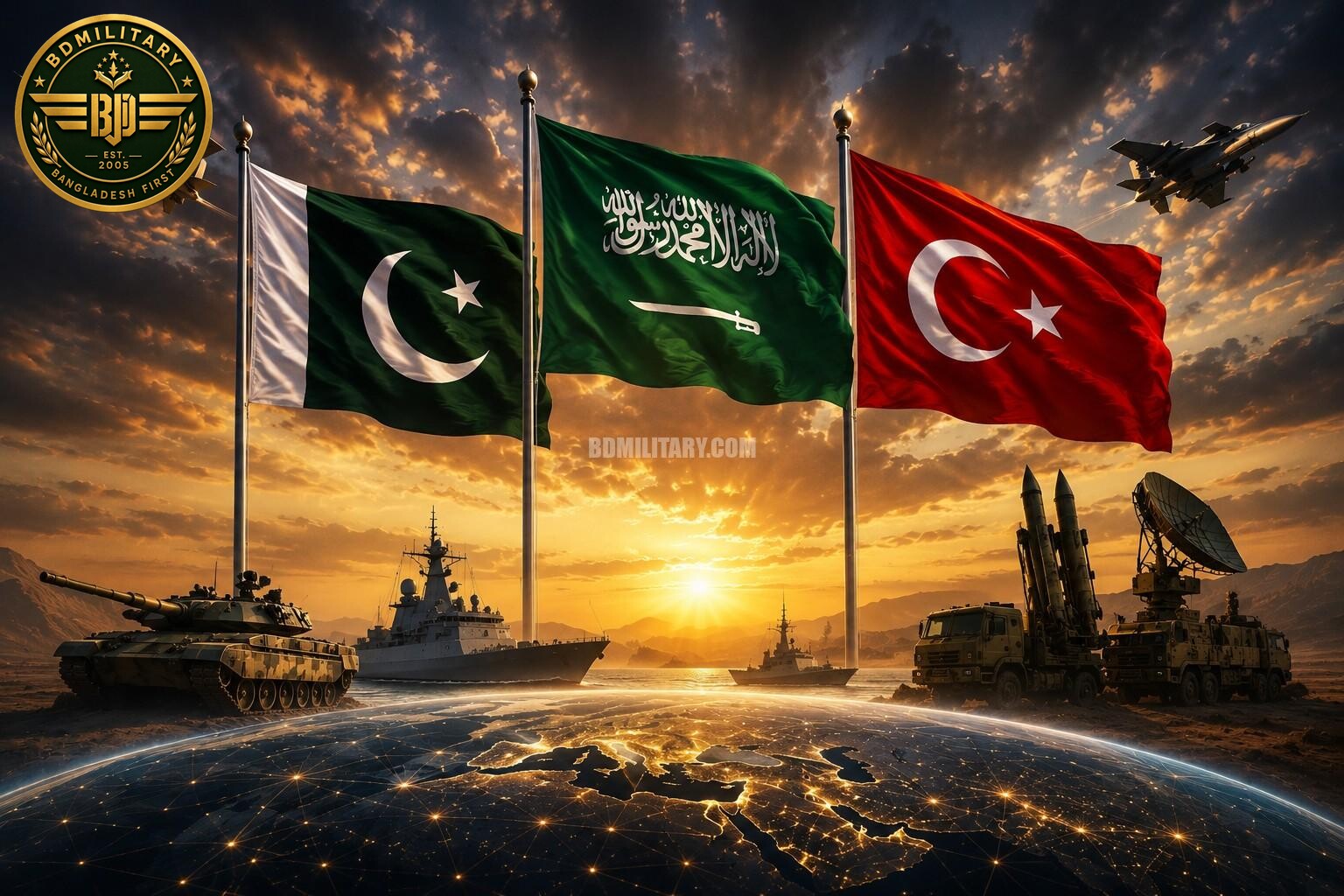
The Mecca Joint Defence Agreement between Pakistan, Saudi Arabia and Türkiye should not be described uncritically as a “Muslim NATO” or “Sunni NATO”. While the agreement establishes a collective-defence principle under which an armed attack against one member is to be regarded as an attack against all three, it does not currently possess the institutional depth, integrated command arrangements, common force planning or established military procedures associated with NATO. Turkish officials themselves have described the arrangement as complementary to existing alliances rather than a replacement for them.
The more useful interpretation is that the agreement represents an emerging regional security and strategic hedging mechanism. Its immediate value lies less in creating a unified expeditionary military force and more in strengthening deterrence, political coordination, defence-industrial cooperation and the strategic autonomy of its three members.
The agreement is particularly significant because each participant brings a different strategic asset. Saudi Arabia contributes financial resources, geography, energy importance and access to the Gulf and Red Sea. Pakistan contributes military mass, strategic depth, extensive conventional military experience and a nuclear deterrent. Türkiye contributes a sophisticated and increasingly competitive defence industry, operational experience and NATO interoperability.
The central question is therefore not whether the three states can collectively defeat an adversary in a conventional war. It is whether they can convince an adversary that an attack on one member will generate sufficient coordinated political, military and economic consequences to make aggression unattractive.
That is a much lower threshold than NATO-style military integration, and potentially a more realistic objective.
Overall Risk Rating
| Risk Area | Rating | Assessment |
|---|---|---|
| Strategic Significance | High | Represents a meaningful development in regional security architecture |
| Immediate Military Threat To Iran | Low–Moderate | The pact is officially defensive and does not identify Iran as an adversary |
| Probability Of Direct Pakistani War With Iran | Low | Geography, bilateral interests and escalation risks strongly constrain Islamabad |
| Probability Of Direct Turkish War With Iran | Low–Moderate | Türkiye has major interests in avoiding uncontrolled regional escalation |
| Saudi Strategic Benefit | High | Provides additional deterrence and strategic options |
| Turkish Defence-Industrial Opportunity | High | Creates significant opportunities for defence exports and joint production |
| Pakistan’s Strategic Benefit | High | Strengthens Islamabad’s position in the Gulf and increases its diplomatic relevance |
| US Acceptance Of The Arrangement | Moderate–High | Potentially compatible with Washington’s interest in greater regional burden-sharing |
| US Enthusiasm For The Arrangement | Uncertain | There is insufficient evidence to conclude that Washington actively encouraged it |
| Chinese Strategic Acceptance | Moderate–High | A more multipolar regional order can benefit Beijing, provided the pact does not become anti-Iranian or anti-Chinese |
| Risk Of Iranian Countermeasures | Moderate–High | Tehran could interpret the arrangement as an emerging containment mechanism |
| Probability Of NATO-Style Integration | Low–Moderate | Significant institutional, doctrinal and strategic obstacles remain |
| Probability Of Greater Intelligence Cooperation | High | Politically and operationally easier than full military integration |
| Probability Of Defence-Industrial Cooperation | High | Strong economic and strategic incentives exist |
| Long-Term Alliance Effectiveness | Uncertain | Depends on implementation, exercises, command arrangements and behaviour during a crisis |
1. The “Muslim NATO” Description Is Misleading
The “Muslim NATO” analogy is understandable because the pact contains a collective-defence provision that resembles the basic logic of NATO Article 5. Turkish Foreign Minister Hakan Fidan has even described the provision as technically equivalent to Article 5.
However, an Article 5-like political commitment does not automatically create a NATO-like military organisation.
NATO is the product of decades of institutional development. It possesses permanent political and military structures, integrated command arrangements, common planning procedures, interoperability standards, established exercises and extensive mechanisms for force generation and collective operations.
The Mecca agreement is at the beginning of that process. Türkiye has outlined plans for political and military coordination mechanisms, joint exercises and deeper cooperation in areas including unmanned systems, electronic warfare and artificial intelligence, but these mechanisms still have to be developed and tested.
The three countries also have substantially different strategic priorities.
Saudi Arabia’s overriding concerns include territorial defence, protection of energy infrastructure, missile and drone threats and maritime security.
Pakistan remains primarily focused on India, its western borders, the Arabian Sea and maintaining manageable relations with Iran.
Türkiye operates across a much broader strategic environment encompassing NATO, Russia, the Black Sea, Syria, Iraq, the Caucasus, the Eastern Mediterranean and Iran.
Religion provides political and cultural common ground, but it is not sufficient to explain the strategic rationale of the agreement.
The more accurate description is therefore:
A regional collective-defence and strategic hedging arrangement rather than a “Muslim NATO”.
2. Strategic Ambiguity May Be The Pact’s Greatest Strength
The most important characteristic of the agreement may be its deliberate ambiguity.
The members have committed themselves politically to collective defence without publicly defining every possible military response to an attack.
This creates room for graduated responses.
An attack on Saudi Arabia, for example, does not necessarily mean Pakistan immediately sending combat formations against the attacker. The response could range from intelligence sharing and air-defence assistance to naval deployments, logistics, ammunition, military advisers, cyber support or, under extreme circumstances, direct combat operations.
This flexibility is particularly important for Pakistan and Türkiye.
It allows both states to strengthen Saudi deterrence without automatically accepting an unlimited obligation to fight every future conflict involving Riyadh.
That ambiguity may actually make the arrangement more politically sustainable than a rigid automatic-war mechanism.
3. Pakistan Is The Critical Constraint
Pakistan is probably the most important factor preventing the pact from becoming a straightforward anti-Iran military alliance.
Pakistan shares a substantial land border with Iran and has powerful incentives to prevent a prolonged confrontation with Tehran.
Islamabad therefore has little interest in entering a major conventional war with Iran simply because Saudi Arabia and Iran enter into confrontation.
This does not mean Pakistan would remain passive following an attack on Saudi Arabia.
Pakistan has a long history of military cooperation with Saudi Arabia, and its armed forces already have extensive experience operating and training in the Kingdom.
The more plausible Pakistani response would depend upon the nature and scale of the attack.
| Scenario | Likely Pakistani Response |
|---|---|
| Limited missile or drone attack | Intelligence, air-defence and diplomatic support |
| Sustained attacks on Saudi infrastructure | Additional military assistance, air-defence assets and personnel |
| Major attack on Saudi territory | Potential deployment of significant military forces |
| Attempted invasion of Saudi Arabia | Much greater probability of direct military intervention |
| Saudi-Iranian regional war | Strong pressure for de-escalation while maintaining Saudi support |
| Iranian attack directly involving Pakistani territory | Major escalation and potentially direct Pakistani military action |
The critical distinction is between defending Saudi Arabia and invading Iran.
Pakistan could plausibly do the former without doing the latter.
That makes the pact considerably more credible as a deterrence mechanism than as an instrument for offensive war against Iran.
4. Türkiye Has Little Incentive To Create A Second NATO
Türkiye’s NATO membership is another fundamental constraint on the “Muslim NATO” interpretation.
Ankara already possesses a formal collective-defence guarantee through NATO. It therefore has little strategic incentive to construct a competing organisation that duplicates NATO or creates potentially conflicting obligations.
The current arrangement makes more sense as an additional regional layer of strategic influence.
Türkiye can strengthen its relationship with Saudi Arabia and Pakistan while simultaneously expanding its defence-industrial presence across the Gulf and South Asia.
This is particularly important because Türkiye has developed significant capabilities in unmanned systems, missiles, electronic warfare, armoured vehicles, naval systems and other areas.
The agreement specifically envisages deeper cooperation in defence industries, technology and advanced military capabilities.
The economic component should therefore not be underestimated.
For Ankara, the pact potentially provides:
| Turkish Objective | Potential Benefit |
|---|---|
| Defence exports | Larger Saudi and Pakistani markets |
| Joint production | Access to Saudi capital and Pakistani industrial capacity |
| Technology cooperation | Broader development partnerships |
| Strategic influence | Greater Turkish presence in the Gulf and South Asia |
| Political leverage | Stronger regional diplomatic position |
| NATO-compatible interoperability | Additional opportunities for multinational military cooperation |
Türkiye therefore gains considerable strategic benefit without necessarily accepting the responsibilities of a traditional military bloc.
5. Saudi Arabia Is The Principal Strategic Beneficiary
Saudi Arabia has arguably the strongest immediate incentive to establish the arrangement.
Riyadh is not necessarily seeking to replace the United States.
It is seeking additional security options.
That distinction is critical.
Saudi Arabia can maintain its relationship with Washington while simultaneously strengthening its military relationship with Türkiye and Pakistan.
The pact therefore represents strategic hedging.
It sends a message to Washington that Saudi Arabia has alternatives while simultaneously signalling to potential adversaries that Riyadh is no longer entirely dependent on a single external security provider.
It also provides Saudi Arabia with access to two complementary military ecosystems.
Türkiye provides advanced defence technology and a rapidly expanding defence industry.
Pakistan provides a large military establishment, extensive operational experience and a nuclear deterrent.
Saudi Arabia provides financial resources, strategic geography and access to the Gulf market.
The combination is potentially powerful even without the creation of a unified military command.
6. The Iran Question
Iran is the most important external variable affecting the future of the pact.
The agreement has been publicly described as defensive and not directed against a specific country. Pakistan’s foreign minister has also described it as purely defensive and open to other countries meeting its criteria.
Nevertheless, Tehran is likely to examine the arrangement through a different lens.
Iran could reasonably conclude that the three members have created an additional layer of regional deterrence against Iranian military pressure.
That creates a paradox.
The pact may reduce the probability of war by strengthening deterrence, while simultaneously increasing the consequences of a future crisis.
If Iran believes that attacking Saudi Arabia could trigger Pakistani or Turkish involvement, it may become more cautious.
Conversely, if Tehran interprets the pact as an emerging containment coalition, it could respond through missile deployments, proxy activity, maritime pressure, cyber operations or political influence.
The principal danger is therefore not necessarily an intentional decision by the three members to attack Iran.
It is miscalculation.
7. The United States: Strategic Acceptance Rather Than Automatic Sponsorship
The proposition that Washington may quietly appreciate the arrangement is plausible, but it should be treated as an assessment rather than an established fact.
There are several reasons why the United States could ultimately view the pact positively.
Washington has long encouraged regional partners to assume greater responsibility for their own security.
A stronger Saudi, Turkish and Pakistani security relationship could potentially improve regional deterrence and reduce the requirement for the United States to provide every layer of security itself.
The arrangement also does not currently seek to replace NATO or establish an explicitly anti-American bloc.
Recent analysis has identified precisely this possibility: the pact could reinforce rather than necessarily undermine certain US strategic objectives by encouraging regional burden-sharing.
However, Washington would have legitimate concerns if the agreement evolved into an explicitly anti-US, anti-Israeli or anti-Western military coalition.
The most defensible assessment is therefore:
The United States is more likely to pursue conditional acceptance and strategic hedging than outright opposition, provided the arrangement remains defensive and compatible with existing regional security structures.
There is currently insufficient evidence to claim that Washington secretly designed or actively encouraged the pact.
8. China May Also See Strategic Advantages
China has a similarly complicated calculation.
Beijing maintains important relationships with Pakistan, Saudi Arabia, Türkiye and Iran.
A more multipolar Middle Eastern security structure could therefore benefit China by reducing the region’s exclusive dependence on Washington.
Recent analysis has specifically identified the possibility that the pact could contribute to a more multipolar Gulf security order.
China’s preferred outcome, however, would probably not be the creation of an explicitly anti-Iran military bloc.
Beijing has substantial economic and strategic interests in Iran and would not benefit from a major regional war.
The most likely Chinese preference is therefore:
greater regional autonomy + greater stability + continued Chinese access = positive
while:
Saudi-Türkiye-Pakistan military coalition explicitly aimed at Iran or China = negative.
The distinction is important.
China may therefore appreciate the multipolarisation created by the pact without necessarily supporting every possible strategic consequence of it.
9. Defence Industry May Become More Important Than Collective Warfighting
The defence-industrial dimension could ultimately become the most durable component of the agreement.
The three countries possess highly complementary capabilities.
| Country | Principal Strategic Contribution |
|---|---|
| Saudi Arabia | Capital, defence procurement, strategic geography and Gulf market |
| Türkiye | Defence technology, UAVs, missiles, electronics, armoured and naval systems |
| Pakistan | Large military establishment, operational experience, defence manufacturing and strategic deterrence |
This creates the possibility of a Saudi capital + Turkish technology + Pakistani military-industrial cooperation model.
The agreement’s emphasis on joint development, production, technology transfer, unmanned systems, electronic warfare and artificial intelligence reinforces this interpretation.
If this develops successfully, the pact could become strategically significant even if its collective-defence provisions are rarely activated.
10. Principal Risks
Alliance Credibility
Risk: High
The greatest challenge will be transforming political declarations into credible military capability.
If one member is attacked and the others provide only diplomatic support, the credibility of the pact could suffer.
Conversely, if members respond militarily to relatively minor incidents, the arrangement could become trapped in escalation.
Iranian Miscalculation
Risk: High
Iran could interpret the pact as a containment mechanism even if the three members do not intend it to be one.
This could produce countermeasures that gradually transform a defensive arrangement into a more openly confrontational security bloc.
Divergent National Interests
Risk: High
Saudi Arabia, Pakistan and Türkiye do not have identical interests concerning Iran, Israel, the United States, Russia, China or India.
These differences will become particularly important during a major crisis.
Pakistan–Iran Escalation
Risk: High
Pakistan has unusually strong incentives to avoid a major war with Iran.
Any situation forcing Islamabad to choose between its Saudi commitments and its relationship with Tehran would represent the alliance’s most serious internal stress test.
Turkish Strategic Overstretch
Risk: Moderate
Türkiye already operates across several strategically demanding theatres.
An additional formal security commitment could become burdensome if the pact develops into a highly demanding operational alliance.
Sectarian Framing
Risk: Moderate–High
Describing the pact as a “Sunni NATO” could become a self-fulfilling strategic problem.
The more explicitly the arrangement is framed as a Sunni bloc, the easier it becomes for Iran and its partners to portray it as a sectarian containment coalition.
Expectations Exceeding Capabilities
Risk: High
The three states possess substantial military capabilities, but they do not yet possess a unified military system.
Pakistan operates a largely Chinese-origin and mixed inventory, Saudi Arabia relies heavily on US and Western systems, while Türkiye increasingly fields indigenous systems alongside NATO-standard equipment.
Interoperability therefore remains a major challenge.
11. Probability Assessment
| Possible Development | Probability | Assessment |
|---|---|---|
| Regular joint exercises | High | Politically easy and operationally useful |
| Intelligence sharing | High | Low-risk and strategically valuable |
| Air and missile-defence cooperation | Moderate–High | Particularly relevant to Saudi Arabia |
| Defence-industrial cooperation | High | Strong commercial incentives |
| Turkish defence exports increase | Very High | Consistent with Ankara’s existing strategy |
| Saudi investment in Pakistani/Turkish defence industry | High | Strong financial and strategic rationale |
| Permanent integrated command | Low–Moderate | Requires substantial institutional development |
| Pakistani direct combat against Iran | Low | Major geographic and strategic constraints |
| Turkish direct combat against Iran | Low–Moderate | Ankara has strong incentives to retain strategic flexibility |
| Explicit anti-Iran military bloc | Low–Moderate | Possible through escalation, but inconsistent with current public positioning |
| Expansion to additional states | Moderate | Egypt has already been discussed as a potential participant |
| NATO-style military integration | Low | Divergent interests and existing alliances make this difficult |
| Genuine collective deterrence | Moderate–High | Achievable if mechanisms and exercises develop |
| Long-term strategic durability | Moderate | Dependent on crisis performance and institutionalisation |
12. Strategic Assessment
The Mecca Joint Defence Agreement is therefore best understood as a strategic hedging mechanism rather than a new Islamic military alliance.
Each member is attempting to solve a different strategic problem.
Saudi Arabia wants additional security options without abandoning Washington.
Pakistan wants to strengthen its position in the Gulf without being dragged into a direct war with Iran.
Türkiye wants to expand its regional influence and defence-industrial market while maintaining its position inside NATO.
The three objectives are sufficiently compatible to support cooperation, but not sufficiently identical to produce a fully integrated military alliance.
This explains why the pact’s ambiguity is so important.
It allows the three governments to claim collective deterrence while retaining national discretion over the form and scale of military intervention.
13. The Real Test Of The Alliance
The credibility of the agreement will ultimately be determined by behaviour rather than declarations.
The most important indicators to monitor are the establishment of permanent coordination mechanisms, the frequency and sophistication of joint exercises, intelligence-sharing arrangements, integrated air and missile-defence projects, defence-industrial agreements and the creation of common operational procedures.
The most revealing test, however, will be a real crisis.
If Saudi Arabia is attacked and Pakistan and Türkiye provide meaningful military assistance, the pact will acquire substantial credibility.
If the response is limited to diplomatic declarations, its collective-defence provision may increasingly be viewed as political signalling.
This is why the coming years are more important than the signing ceremony itself.
Conclusion
The “Muslim NATO” narrative is attractive but analytically inadequate.
The Mecca Joint Defence Agreement does contain an Article 5-like collective-defence commitment, but that alone does not make it equivalent to NATO. The absence of integrated command structures, common force planning, established interoperability mechanisms and automatic military response procedures remains significant.
The agreement is better understood as an emerging regional security architecture built around deterrence, strategic ambiguity, defence-industrial cooperation and geopolitical hedging.
Its most important achievement may therefore not be the creation of a force capable of fighting a major regional war.
It may be the creation of sufficient uncertainty in the calculations of potential adversaries.
For Iran, the calculation becomes more complicated because an attack on Saudi Arabia could potentially involve Pakistan and Türkiye.
For Saudi Arabia, the arrangement provides additional strategic options.
For Pakistan, it strengthens its regional role while allowing considerable discretion over military involvement.
For Türkiye, it expands political influence and opens additional defence-industrial opportunities without replacing NATO.
For the United States, the arrangement could potentially support regional burden-sharing, although there is insufficient evidence to conclude that Washington actively sponsored it.
For China, a more multipolar regional security environment could be advantageous, provided the pact does not evolve into an explicitly anti-Iran or anti-Chinese coalition. Recent assessments already identify the pact as part of a wider movement towards a more multipolar Gulf security order.
The most important conclusion is therefore straightforward:
This is not a “Muslim NATO”. It is a flexible strategic triangle whose effectiveness will depend on whether political solidarity can eventually be converted into credible military interoperability and deterrence.
Its future cannot be determined from the signing ceremony alone.
The real test will come when one member faces a serious military crisis and the other two must decide how far they are actually prepared to go.
Until then, the Mecca pact should be regarded as strategically significant, militarily promising, but operationally unproven.

Khaled Ahmed is a seasoned former intelligence analyst and military expert from the Netherlands, bringing over 15 years of specialised experience in operational intelligence, threat analysis, and strategic defence planning. Having served in high-level, classified roles within Dutch military intelligence, he possesses rare expertise in European security architecture, NATO doctrine, and asymmetric warfare. Khaled’s deep operational insight and international perspective enable him to deliver precision-driven intelligence analysis and forward-looking strategic forecasts. A trusted contributor to high-level risk assessments and security briefings, he offers readers clarity on complex defence and security challenges. Khaled leads the National Security and Fact Analysis sections at BDMilitary. He holds a Master’s degree in International Relations from the University of Groningen, The Netherlands, and is fluent in Dutch, French, and Arabic — combining linguistic dexterity with operational expertise to analyse security issues across cultures and regions.