The Bangladesh Army appears to have received another batch of Turkish-made Otokar Cobra-I light armoured vehicles, with newly surfaced imagery showing the vehicles being transported and subsequently operated on Bangladeshi roads.
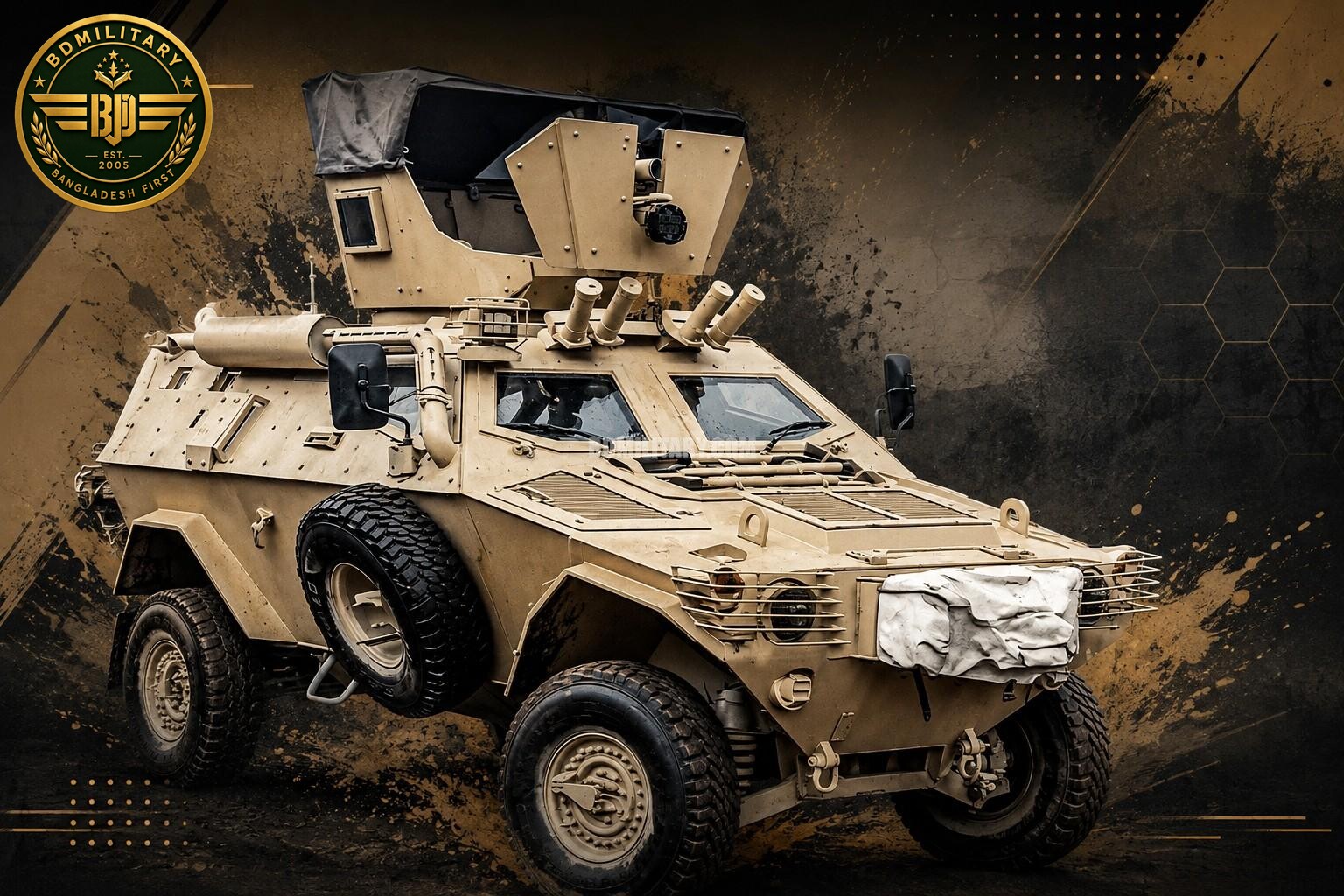
The latest vehicles were spotted by social media users earlier this week. Unlike the predominantly green camouflage associated with many of the Bangladesh Army’s existing Cobra-I vehicles, the newly observed batch features a distinctive tan colour scheme, suggesting that the vehicles may have been configured for a specific operational requirement or deployment environment.
The imagery also provides an important indication that the latest delivery is not limited to the standard Armoured Personnel Carrier (APC) configuration. At least one vehicle appears to be configured as an Armoured Recovery Vehicle (ARV), giving the Bangladesh Army an additional protected recovery capability alongside its troop-carrying Cobra-I fleet.
Continued Expansion Of The Cobra Fleet
The latest delivery follows earlier Cobra-I acquisitions from Türkiye. In July 2025, the Bangladesh Army received a further consignment of Cobra-I vehicles, with the reported delivery comprising 25 vehicles, including 18 APCs as well as command-and-control, electronic warfare/jammer and recovery configurations.
Bangladesh has operated Otokar Cobra vehicles for more than a decade, with the platform used in a variety of military, security and United Nations peacekeeping roles. The Cobra family has also become one of the more recognisable components of the Bangladesh Army’s wheeled protected mobility fleet.
The exact number of vehicles in the newly observed delivery has not been publicly disclosed. The available imagery therefore does not support a firm assessment of the size of the latest batch.
APC And Recovery Configurations
The Cobra-I is a modular 4×4 tactical armoured vehicle designed to accommodate a range of mission configurations. Otokar describes the platform as suitable for personnel carriage, reconnaissance and surveillance, command and control, internal security, ambulance and medical evacuation, weapons platforms and NBC reconnaissance missions.
The apparent presence of an ARV configuration is particularly significant. A protected recovery vehicle can accompany armoured and mechanised formations, providing the ability to recover damaged or immobilised vehicles while reducing the exposure of recovery crews. It can also support routine towing, maintenance and logistical operations in areas where an unprotected recovery truck would be vulnerable.
The recovery configuration seen in the recent imagery appears to incorporate dedicated recovery equipment rather than the standard personnel-carrier arrangement. BDMilitary assesses the vehicle as an ARV based on its external configuration, although the precise designation and equipment fit have not been officially confirmed.
A Proven 4×4 Platform
The Cobra-I remains a relatively compact and highly mobile platform. Otokar’s current Cobra documentation lists a gross vehicle weight of approximately 6.7 tonnes, a maximum crew capacity of up to nine personnel, a 190 hp turbocharged diesel engine, automatic transmission and permanent four-wheel drive. The vehicle has a maximum road speed of approximately 100 km/h and a stated range of up to 600 km, depending on configuration.
Its independent suspension, central tyre-inflation system and run-flat tyres contribute to its ability to operate across difficult terrain. Otokar also highlights the platform’s modular construction, allowing a common vehicle architecture to be adapted for different military missions.
Strengthening Protected Mobility
The continued acquisition of Cobra-I vehicles points towards the Bangladesh Army’s ongoing effort to expand and diversify its protected mobility capabilities. Rather than relying exclusively on larger wheeled and tracked armoured personnel carriers, the Cobra provides a smaller platform that can be employed for patrol, convoy security, reconnaissance, internal security, command and support functions.
The introduction of additional recovery vehicles is equally relevant. As Bangladesh expands its inventory of wheeled armoured platforms, dedicated recovery assets become increasingly important for maintaining operational availability and supporting mechanised units.
The latest tan-coloured vehicles therefore represent more than simply an additional batch of personnel carriers. If the ARV identification is confirmed, the delivery would demonstrate a broader approach to fleet support, with the Cobra-I platform being employed for both frontline mobility and battlefield sustainment.
For now, the number of vehicles delivered, their exact configuration breakdown and their intended unit assignment remain undisclosed. However, the imagery provides clear evidence of a further Cobra-I presence in Bangladesh and indicates that the country’s long-running procurement relationship with Otokar continues

Amit Bhattacharya is a leading defence procurement expert with deep expertise in modern weapon systems and military hardware acquisition. Over more than a decade, he has collaborated with top defence contractors and strategic research institutions, delivering incisive analysis on procurement frameworks, capability development, and technology integration for armed forces worldwide. Amit bridges the gap between operational requirements and industrial capacity, providing authoritative evaluations of modernisation programmes, defence budgets, and acquisition reforms in both established and emerging defence markets. He leads the Defence Procurement and Defence Industry sections at BDMilitary, shaping strategic discourse on defence innovation. Amit earned his Master of Policy and Governance (MPAG) from the University of Canterbury, New Zealand, complementing his practical expertise with advanced policy and governance insight.