
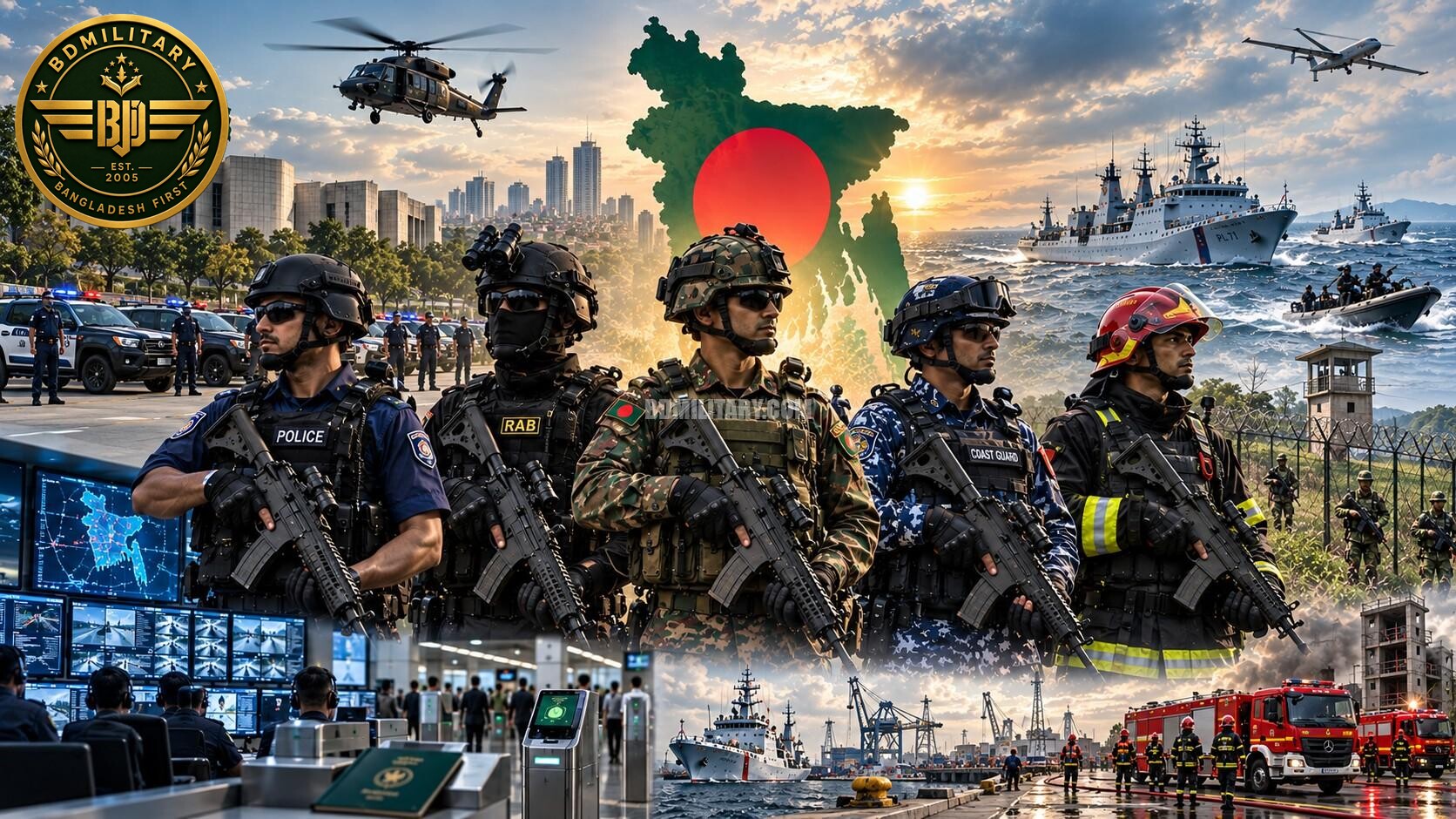
Bangladesh’s Ministry of Home Affairs is implementing 25 development projects during the 2026–27 fiscal year aimed at modernising the country’s internal security architecture, strengthening law-enforcement infrastructure, improving border management, expanding maritime capabilities and upgrading emergency-response services.
The programme covers eight major agencies and departments, including Bangladesh Police, Rapid Action Battalion (RAB), Border Guard Bangladesh (BGB), Bangladesh Coast Guard, the Department of Immigration and Passports, Department of Narcotics Control, Department of Prisons, and Fire Service and Civil Defence.
Project information compiled by Planning Wing-1 of the Ministry of Home Affairs indicates that the portfolio combines large-scale infrastructure development with technology-focused security capabilities. The projects cover police facilities, counter-terrorism and international crime prevention, cybercrime investigation, e-passports and automated border control, border outposts, maritime logistics and vessels, drug rehabilitation, prison infrastructure and fire-service facilities.
Major Police Infrastructure Expansion
The largest project in the portfolio is the Construction of Administrative-cum-Barrack Buildings for Police Stations in Different Parts of the Country, with an estimated cost of Tk16,240.45 crore. The project is scheduled for completion by June 2027.
A separate Tk7,075.49 crore programme is focused on expanding specialised police infrastructure. It includes the construction of police stations, outposts, investigation centres, camps, river-police centres, railway-police facilities, tourist-police centres and highway-police stations. The project is scheduled to continue until September 2028.
Together, the two schemes represent a substantial expansion of the physical footprint of Bangladesh’s police services, potentially improving geographic coverage, staff accommodation and access to investigative facilities.
The government is also strengthening specialised law-enforcement capabilities. The Counter-Terrorism and International Crime Prevention Centre of Bangladesh Police project has an estimated cost of Tk3,537.43 crore.
Meanwhile, a separate Tk1,149.70 crore equipment-procurement programme is intended to enhance the operational capabilities of the Dhaka Metropolitan Police.
Cybercrime And Digital Investigation
Technology-enabled crime has emerged as a distinct priority within the Home Ministry’s development programme.
The Safer Cyberspace for Digital Bangladesh: Enhancing National & Regional Digital Investigation Capacity of Bangladesh Police project has an estimated cost of Tk590.87 crore, financed through government funding and project assistance.
The initiative is intended to strengthen police capabilities in investigating cybercrime and other technology-enabled offences, including digital forensics and the handling of increasingly complex electronic evidence.
The investment reflects the changing nature of Bangladesh’s internal-security environment, where cyber-enabled fraud, online criminal networks, extremist activity and identity-related offences increasingly intersect with conventional law enforcement.
RAB Headquarters Development
The portfolio also includes major infrastructure investment for the Rapid Action Battalion (RAB).
Construction of a new RAB headquarters has an estimated cost of Tk5,456.54 crore, with implementation scheduled to continue until December 2028.
The project forms part of the broader effort to upgrade specialised national security and law-enforcement infrastructure.
Strengthening Border Security
Border management is another major component of the programme.
The Border Guard Bangladesh (BGB) is scheduled to construct 73 modern border outposts under a project estimated at Tk2,365.50 crore.
A separate Tk2,230.24 crore project will develop infrastructure for the 63 BGB Battalion in Gazipur.
The investment comes as Bangladesh continues to face cross-border challenges involving smuggling, trafficking, irregular movement and other forms of transnational crime. Modernised border facilities are expected to provide improved accommodation, communications and operational support for BGB personnel.
Coast Guard Expansion And Fleet Renewal
Maritime security represents one of the largest areas of planned expenditure.
A Tk7,576.22 crore project will develop logistics and maintenance facilities for the Bangladesh Coast Guard, while a separate vessel-replacement programme is estimated at Tk23,148.29 crore.
The scale of the vessel programme makes it one of the most significant individual components of the Home Affairs development portfolio.
For the Coast Guard, improved logistics, maintenance and fleet availability are particularly important for sustained operations across Bangladesh’s extensive maritime domain and coastal waterways. The projects could enhance the service’s ability to conduct maritime law enforcement, anti-smuggling operations, search and rescue, and other emergency missions.
E-Passports And Automated Border Control
Bangladesh is also continuing its transition towards more technology-driven immigration management.
The revised e-Passport and Automated Border Control project has an estimated value of Tk9,038.36 crore and is scheduled to run until June 2028.
The programme is intended to expand biometric passport and automated border-control capabilities, potentially improving passenger processing, identity verification and border-management efficiency.
The move towards automated immigration systems also forms part of a broader transition from conventional document-based border management towards integrated biometric and digital identity systems.
Drug Rehabilitation And Prison Infrastructure
The development programme extends beyond policing and border security.
A Tk1,413.15 crore initiative will establish or upgrade drug rehabilitation centres across seven divisions.
The portfolio also includes development projects for the Department of Prisons, reflecting the government’s wider focus on corrections infrastructure and prison capacity.
Fire And Emergency-Response Capability
Emergency response is another component of the Home Ministry’s modernisation agenda.
A project involving the construction or reconstruction of 20 fire stations has an estimated cost of Tk650.96 crore.
The investment is intended to improve the geographic coverage and operational infrastructure of Fire Service and Civil Defence, strengthening the country’s capacity to respond to fires, industrial accidents, urban emergencies and other disasters.
Development Spending Within A Larger Home Affairs Budget
The 25 projects form part of the wider FY2026–27 Home Affairs budget allocation of Tk31,099 crore.
Of this amount, approximately Tk2,460 crore has been allocated for development expenditure, while Tk28,639 crore is earmarked for operating expenditure.
The total approved or estimated value of several projects is substantially higher than the ministry’s annual development allocation because many of the schemes are multi-year projects extending into 2027 and 2028. Their financing is therefore expected to be spread across successive fiscal years rather than being funded entirely from the current year’s development budget.
From Infrastructure To Integrated Security
The project portfolio indicates a gradual evolution in Bangladesh’s internal-security priorities.
Traditional investments in police stations, barracks and other physical infrastructure remain prominent, but they are increasingly being accompanied by cyber-forensics capabilities, biometric identification, automated border control, modern border outposts, maritime fleet renewal and emergency-response infrastructure.
This reflects a security environment in which threats increasingly cross institutional boundaries.
Human trafficking, drug smuggling, cybercrime, illegal migration, maritime crime and disaster response cannot always be addressed effectively by individual agencies operating independently.
The success of the programme will therefore depend not only on completing buildings and acquiring equipment, but also on developing trained personnel, sustainable maintenance arrangements, interoperable communications and effective operating procedures.
BDMilitary Assessment
The 25-project programme represents a significant attempt to modernise Bangladesh’s internal-security architecture, moving beyond conventional law-enforcement infrastructure towards a more technology-enabled and interconnected security system.
The scale of several individual projects—particularly the police infrastructure, Coast Guard vessel replacement, e-passport and automated border-control programmes—indicates that the government is pursuing modernisation across multiple layers of national security and public safety.
However, large capital projects alone will not necessarily translate into improved security outcomes.
The principal challenge will be implementation and integration. Police, RAB, BGB, Coast Guard, Immigration, Prisons and Fire Service have different mandates, command structures and operational requirements, yet many of the threats they confront overlap.
Greater interoperability, common data standards, coordinated command and information-sharing mechanisms could allow these investments to function as elements of a wider national security ecosystem rather than as isolated projects.
At the same time, the growing use of biometric and digital systems will require strong safeguards for data security, privacy and responsible access.
Ultimately, the effectiveness of the FY2026–27 programme should be measured not simply by the number of buildings completed or equipment acquired, but by whether the investments produce faster emergency response, stronger border security, more effective cybercrime investigation, improved maritime law enforcement and safer communities.
For Bangladesh, the next stage of internal-security modernisation will therefore depend as much on institutional coordination, training, maintenance and accountability as on capital expenditure.

Amit Bhattacharya is a leading defence procurement expert with deep expertise in modern weapon systems and military hardware acquisition. Over more than a decade, he has collaborated with top defence contractors and strategic research institutions, delivering incisive analysis on procurement frameworks, capability development, and technology integration for armed forces worldwide. Amit bridges the gap between operational requirements and industrial capacity, providing authoritative evaluations of modernisation programmes, defence budgets, and acquisition reforms in both established and emerging defence markets. He leads the Defence Procurement and Defence Industry sections at BDMilitary, shaping strategic discourse on defence innovation. Amit earned his Master of Policy and Governance (MPAG) from the University of Canterbury, New Zealand, complementing his practical expertise with advanced policy and governance insight.