More than twelve years after it first emerged, an alleged Bangladesh Ministry of Foreign Affairs (MoFA) document entitled Military Aid from India and Deployment at Satkhira continues to resurface across social media, political forums and online discussion groups. The document is frequently cited as evidence that the Awami League government sought Indian military assistance during the political unrest preceding the 5 January 2014 general election. Despite its persistence in public discourse, however, the document remains one of the least understood and most controversial pieces of alleged evidence from Bangladesh’s recent political history.
The central issue is not whether the contents appear plausible, but whether the document itself can be authenticated. More than a decade after it first appeared, no independent forensic examination has been conducted, no original electronic version has entered the public domain, and no official archive has produced a verifiable copy. Consequently, neither its authenticity nor the alleged military operation it describes can be regarded as established fact.
To understand why the document continues to attract attention, it is necessary to consider the political environment in which it emerged. During the latter half of 2013, Bangladesh experienced one of its most volatile periods since the restoration of parliamentary democracy. The opposition Bangladesh Nationalist Party (BNP) and its allies were demanding the reinstatement of a neutral caretaker government to oversee national elections, while the Awami League administration maintained that the election would proceed under the amended constitutional framework. The political deadlock resulted in nationwide strikes, violent confrontations and sustained unrest, particularly in districts bordering India. Satkhira became one of the principal flashpoints, witnessing repeated clashes between protesters and security forces.
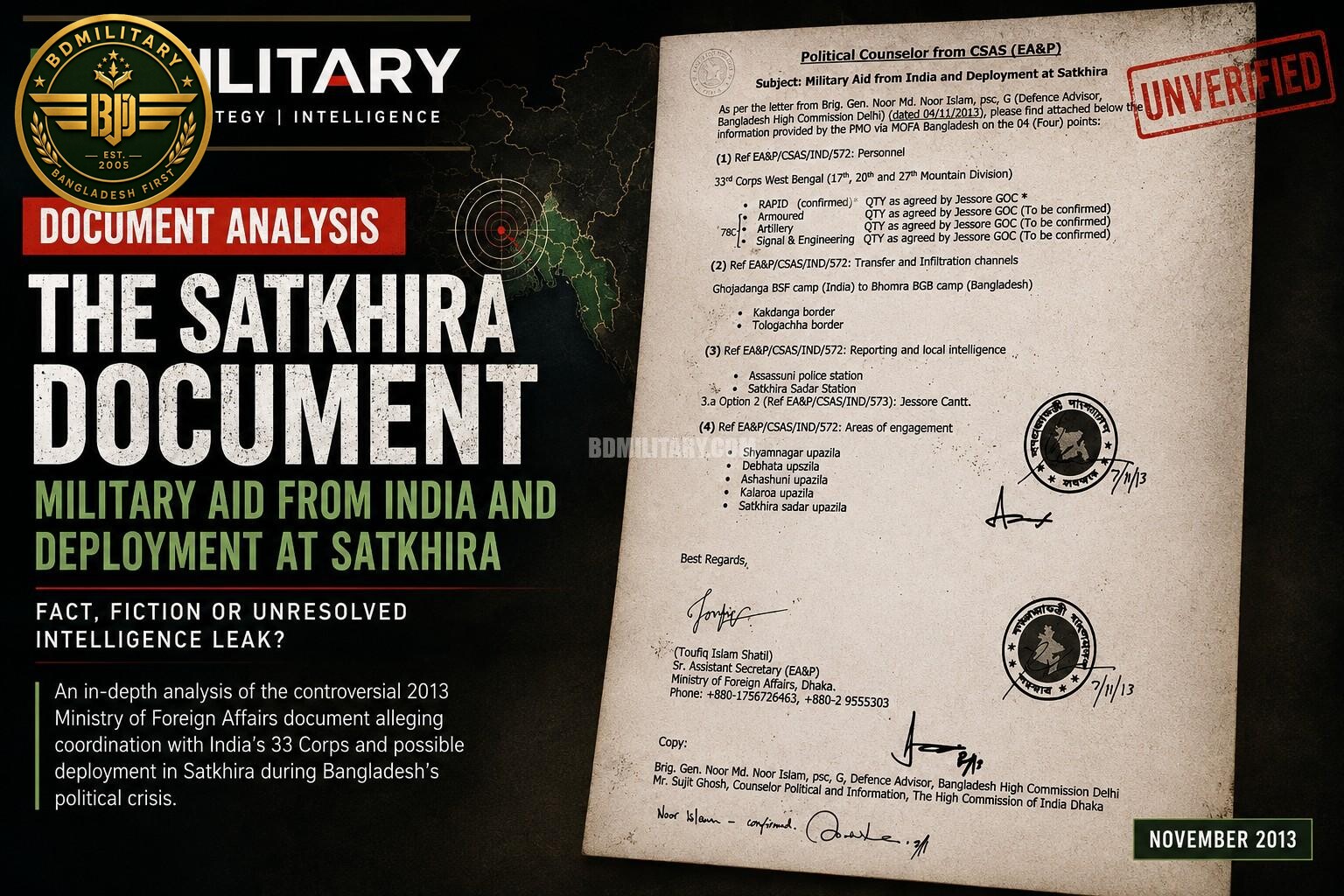
It was against this backdrop that the alleged MoFA correspondence first appeared. The document purports to describe communications between the Ministry of Foreign Affairs in Dhaka and the Bangladesh High Commission in New Delhi regarding possible Indian military assistance. It references India’s 33 Corps, including the 17th, 20th and 27th Mountain Divisions, and mentions RAPID, armoured, artillery and engineering units. It also identifies Bhomra as a possible crossing point, names several upazilas within Satkhira District as areas of engagement, and refers to intelligence reporting and liaison with Jessore Cantonment.
At first glance, several aspects of the document appear credible. The officials named within it were genuine office holders at the time, and the diplomatic terminology, reference numbering and routing procedures broadly resemble those employed by the Ministry of Foreign Affairs. Likewise, the Indian military formations mentioned are real units under the Indian Army’s Eastern Command, while the geographical locations identified correspond with the border region between Bangladesh and India’s West Bengal state. These details suggest that whoever prepared the document possessed a sound understanding of both diplomatic procedures and regional military geography.
Nevertheless, familiarity with official terminology should not be mistaken for proof of authenticity. Documents of this nature can be fabricated using publicly available information, particularly when the names of serving officials and military formations are already known. The presence of accurate administrative details therefore increases plausibility but does not establish provenance.
Several features of the document also warrant careful scrutiny. Perhaps the most notable is its title, Military Aid from India and Deployment at Satkhira. Communications concerning highly sensitive military cooperation between sovereign states are rarely expressed in such direct language, particularly within routine diplomatic correspondence. Matters involving foreign military assistance would ordinarily be handled through highly classified channels involving the Prime Minister’s Office, the Armed Forces Division, Bangladesh Army Headquarters and the Directorate General of Forces Intelligence, rather than standard diplomatic exchanges. Similarly, the inclusion of alleged infiltration routes and operational areas within a diplomatic communication is unusual, as operational planning is normally compartmentalised and distributed separately from diplomatic reporting.
The controversy surrounding the document intensified after Daily Inqilab published a report in January 2014 alleging that Indian military personnel had participated in joint security operations in Satkhira. The government immediately rejected the allegations, describing the report as fabricated. Detectives subsequently raided the newspaper’s offices, arrested several journalists, seized computer equipment and temporarily shut down its printing operations. The newspaper later issued a public apology, acknowledging that greater care should have been exercised before publishing such a sensitive report. Subsequent reporting indicated that the story had relied heavily on documents and claims already circulating on social media rather than independently verified official sources.
The government’s rejection of the allegations does not, in itself, prove that the document was fabricated. Governments routinely deny sensitive disclosures regardless of whether they are accurate. Equally, the publication of the document by a newspaper does not establish its authenticity. From an intelligence assessment perspective, both the government’s denial and the newspaper’s subsequent apology must be treated as pieces of evidence rather than definitive conclusions.
The most significant weakness in claims that the document represents proof of Indian military intervention is the absence of corroborating evidence. Had elements of India’s 33 Corps entered Bangladesh in battalion or brigade strength, it would be reasonable to expect multiple independent indicators to have emerged over the past twelve years. These might include satellite imagery, military logistics records, operational diaries, identifiable photographs, veterans’ accounts, foreign intelligence reporting or credible eyewitness testimony. None of these have entered the public domain in a form that can be independently verified.
This absence of evidence does not conclusively disprove the allegations. Intelligence operations are, by their nature, designed to minimise visibility. However, sustained deployment of conventional combat formations is considerably more difficult to conceal than the activities of a small number of liaison officers or intelligence personnel. If regular units from 33 Corps had crossed into Bangladesh in the manner suggested by some online narratives, it is reasonable to expect that at least some verifiable evidence would have surfaced during the intervening years. To date, none has.
It is equally important to distinguish between contingency planning and operational execution. Military organisations routinely develop plans for scenarios that never materialise. If the document is genuine, it may simply record discussions regarding possible responses to deteriorating security conditions rather than evidence that those plans were ever implemented. Planning documents frequently explore a range of contingencies, many of which remain hypothetical.
Another possibility, although similarly unsupported by public evidence, is that the document may relate to intelligence liaison or limited cross-border security cooperation rather than the deployment of conventional military formations. Intelligence agencies and border security organisations throughout South Asia have historically maintained varying degrees of cooperation on issues including insurgency, terrorism and transnational crime. Such cooperation, however, differs fundamentally from claims of conventional military intervention and should not be conflated without compelling evidence.
From an intelligence analysis standpoint, the Satkhira document should therefore be classified as an unverified alleged leak of uncertain provenance. It contains genuine names, real military formations and geographically plausible references, all of which merit careful examination. Yet these characteristics alone are insufficient to establish authenticity. More importantly, no independent evidence has emerged to demonstrate that the alleged military deployment described in the document was ever carried out.
For defence analysts, historians and researchers, the responsible approach is neither to dismiss the document outright nor to present it as conclusive proof of Indian military intervention. Rather, it should be regarded as a document whose authenticity remains unresolved pending the emergence of original records, forensic authentication or corroborating operational evidence.
More than a decade after its first appearance, the Satkhira document remains an intriguing but inconclusive piece of Bangladesh’s contemporary political and security history. It raises legitimate questions about the nature of security cooperation between neighbouring states during periods of political instability, while simultaneously illustrating the dangers of drawing definitive conclusions from unverified material. Until stronger evidence becomes available, the document belongs not in the category of established historical fact, but among those unresolved intelligence claims that continue to warrant careful scrutiny and objective research.
References
Ahmed, H. (2014). Inqilab says sorry for Satkhira report. The Daily Star, 21 January 2014.
Ahmed, H. (2014). A let-down for journalism. The Daily Star, 22 January 2014.
Government of Bangladesh, Ministry of Foreign Affairs. (2014). Official statements regarding reports of alleged Indian military deployment in Satkhira.
Human Rights Watch. (2014). Blood on the Streets: The Use of Excessive Force During Political Unrest in Bangladesh.
International Crisis Group. (2014). Mapping Bangladesh’s Political Crisis. Asia Report No. 264.
United States Department of State. (2014). Country Reports on Human Rights Practices: Bangladesh.
Wikipedia contributors. 2013–2014 Satkhira clashes.
Wikipedia contributors. Daily Inqilab.
Wikipedia contributors. Toufiq Islam Shatil.
Editorial Note
BDMilitary has not independently verified the authenticity of the document analysed in this article. The assessment presented here is based solely on open-source information, historical reporting and publicly available records. The article should not be interpreted as confirmation that the document is authentic, nor as proof that it is fabricated. Rather, it represents an objective defence and security analysis of one of the most widely debated alleged intelligence documents associated with Bangladesh’s 2013–2014 political crisis. Until independently verifiable evidence, authenticated records or credible primary sources emerge, the document’s provenance and any alleged operational significance remain unresolved.

Ayesha Farid is a regional security specialist focusing on South Asia, with over a decade of experience analysing inter-state tensions, cross-border insurgency, and regional power dynamics. She has worked with leading policy think tanks and academic institutions, offering nuanced insights into the complex security challenges shaping the subcontinent. Ayesha’s expertise spans military doctrines, border disputes, and regional cooperation frameworks, making her a vital contributor to BDMilitary’s coverage of South Asian strategic affairs. She leads the Geopolitics & Diplomacy section at BDMilitary. Ayesha holds a dual master’s degree — a Master in International Relations from the IE School of Politics, Economics & Global Affairs, Spain, and a Master of Public Policy from the Munk School of Global Affairs, University of Toronto, Canada — combining deep academic insight with practical policy expertise.