Dhaka and Washington discuss progress on the proposed security agreement as military training, naval exercises, defence cooperation and regional security assume greater importance in bilateral relations
Bangladesh and the United States have discussed progress on the proposed General Security of Military Information Agreement (GSOMIA) as the two countries seek to deepen bilateral defence cooperation across military training, exercises, maritime security and other areas of mutual interest.
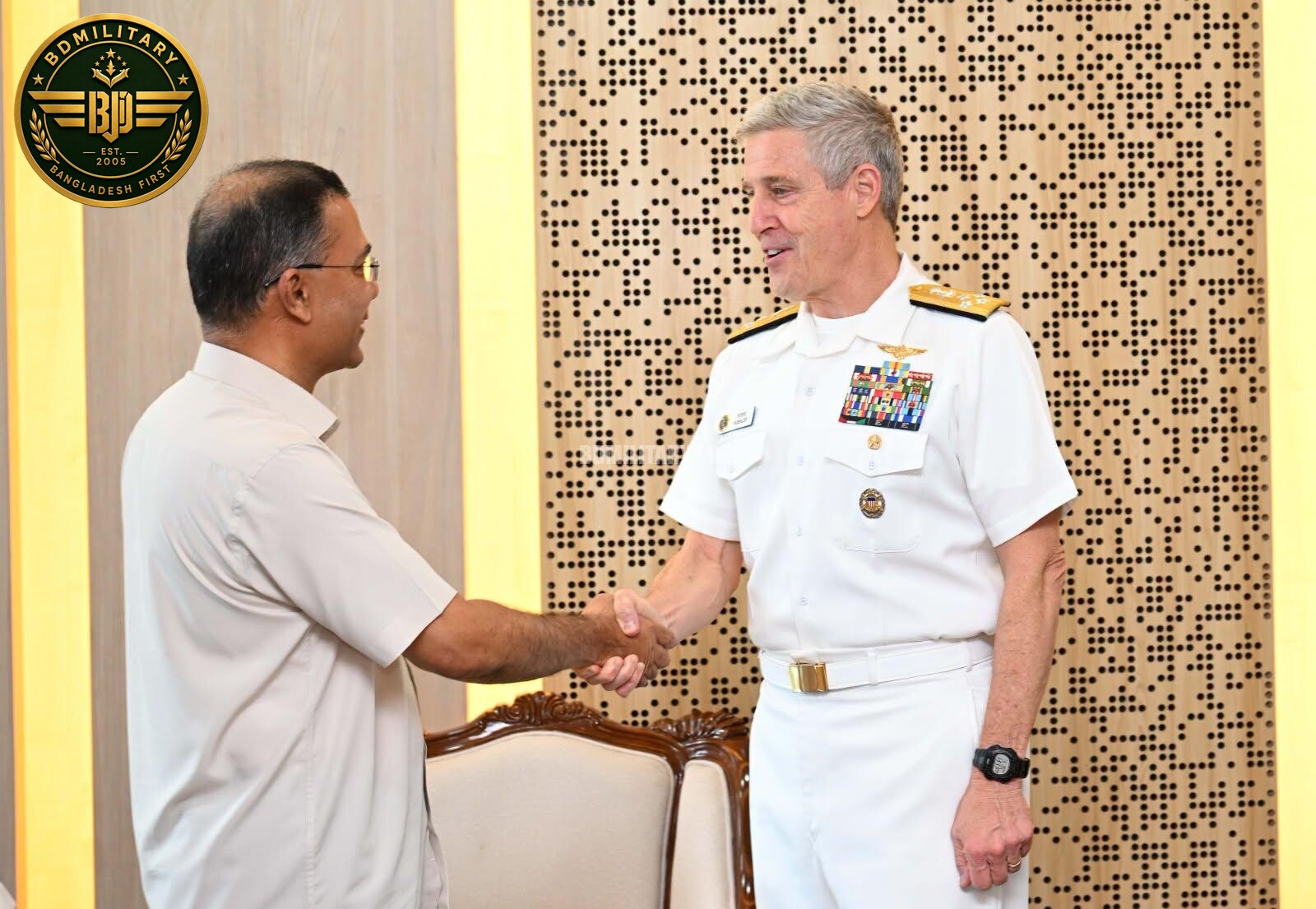
The proposed agreement featured in talks between Prime Minister Tarique Rahman and Commander of the US Pacific Fleet Admiral Stephen Koehler in Dhaka on 4 August.
The meeting covered defence cooperation, humanitarian assistance and disaster response, military exercises and regional security, with both sides reaffirming their interest in strengthening bilateral relations.
According to the Prime Minister’s Office, the two sides discussed progress concerning GSOMIA and the mutual understanding between Bangladesh and the United States on the proposed agreement.
No announcement was made that GSOMIA had been signed, nor was a date announced for its conclusion.
The Bangladesh side said it attaches considerable importance to its relationship with the United States and is keen to deepen bilateral ties through wider and more forward-looking cooperation.
Admiral Koehler said Bangladesh and the United States have numerous opportunities to work together and expressed hope that relations between the two countries would continue to strengthen.
Proposed GSOMIA Could Support Deeper Defence Cooperation
GSOMIA is intended to establish procedures for protecting classified military information exchanged between participating governments.
If eventually concluded between Bangladesh and the United States, the agreement would provide an information-security framework under which sensitive military information could be exchanged and appropriately protected.
This could become increasingly relevant if bilateral defence cooperation expands into areas involving sensitive technologies, technical information, communications systems or more sophisticated US-origin military equipment.
GSOMIA should not, however, be interpreted as a military alliance or mutual defence treaty. It does not by itself oblige either country to provide military assistance to the other.
Instead, it provides the security architecture required for governments to handle classified defence information according to mutually accepted standards.
For Bangladesh, such an arrangement could potentially support broader engagement with the US defence establishment and defence industry, particularly where future programmes require access to protected technical or operational information.
The latest discussions indicate that the proposed agreement remains part of the bilateral defence agenda, although its conclusion has not yet been announced.
ACSA Remains A Separate Potential Framework
Another mechanism that has previously featured in discussions surrounding closer Bangladesh-US defence cooperation is an Acquisition and Cross-Servicing Agreement (ACSA).
ACSA serves a different purpose from GSOMIA.
While GSOMIA concerns the protection of classified military information, an ACSA provides a mechanism through which participating armed forces can obtain and provide agreed logistical support, supplies and services during authorised activities.
Depending on the arrangement, these can include fuel, transportation, food, accommodation, supplies and other logistical support associated with exercises, training and agreed military activities.
If Bangladesh and the United States were eventually to establish both frameworks, they could complement each other by providing separate information-security and logistical mechanisms for bilateral military engagement.
However, no conclusion of an ACSA was announced during the 4 August meeting.
The distinction is important: neither GSOMIA nor ACSA should be considered a military alliance or a commitment by Bangladesh to participate in US military operations.
Defence Trade Could Become An Important Area
The developing relationship could also create opportunities for expanded bilateral defence trade.
Bangladesh has traditionally sourced the majority of its major military platforms from suppliers outside the United States. Nevertheless, Dhaka and Washington already have an established defence-transfer and security-assistance relationship.
US-origin equipment supplied to Bangladesh over the years has included former US Coast Guard Hamilton-class cutters, mine-resistant ambush-protected vehicles and equipment supporting maritime security and other military capabilities.
Bangladesh has also engaged with the United States through Foreign Military Sales and other security-assistance mechanisms.
GSOMIA could become particularly relevant should Bangladesh seek US systems involving classified technical information, protected communications, sensors, surveillance equipment or other sensitive technologies.
It would not automatically provide Bangladesh with access to such equipment. Individual procurements would remain subject to separate negotiations, US export-control requirements, technology-release decisions and Bangladesh’s own defence procurement procedures.
No specific new US weapons acquisition was announced following the meeting between Prime Minister Rahman and Admiral Koehler.
Nevertheless, the establishment of appropriate information-security arrangements could provide an institutional foundation for a broader defence trade relationship should both governments decide to pursue one.
Training And Exercises Remain Central
Military training and exercises are among the most established elements of Bangladesh-US defence relations.
Admiral Koehler highlighted Bangladesh’s participation in bilateral and multinational naval exercises during his meeting with the Prime Minister.
He said the next Cooperation Afloat Readiness and Training (CARAT) exercise will be held in Bangladesh in November.
CARAT provides an established mechanism for the Bangladesh Navy and US forces to conduct professional exchanges and develop maritime skills and interoperability.
Bangladesh’s participation in such exercises also provides opportunities for personnel to gain experience working alongside US and other partner forces in multinational environments.
Admiral Koehler additionally referred to Bangladesh’s participation in the Sea Vision Exercise in Singapore.
He expressed hope that Bangladesh would regularly participate in the Rim of the Pacific (RIMPAC) exercise and associated training programmes in the future.
Greater Bangladeshi participation in RIMPAC and related programmes could expand professional military engagement between the two countries and provide additional exposure to multinational maritime operations, command and control, communications and operational procedures.
Training therefore represents an area in which Bangladesh-US defence relations can expand irrespective of major defence procurement decisions.
Regional Security And The Bay Of Bengal
Regional security was another significant component of the discussions.
Bangladesh occupies a strategically important position at the northern end of the Bay of Bengal, between South and Southeast Asia and close to major Indian Ocean maritime routes.
The country’s geographic position makes maritime security, disaster response and the protection of sea lines of communication increasingly important areas for bilateral cooperation.
Bangladesh-US military engagement already encompasses maritime security, professional military training, exercises, peacekeeping capacity building and humanitarian assistance and disaster response.
For Bangladesh, deeper engagement with the United States offers opportunities to improve military training, develop specialised capabilities and diversify international defence partnerships while maintaining strategic autonomy.
For the United States, Bangladesh is an important Bay of Bengal state with a large professional military and a longstanding record of participation in United Nations peacekeeping operations.
Admiral Koehler praised Bangladesh’s contribution to UN peacekeeping operations in Africa during the meeting.
Prime Minister Rahman said Bangladesh has always stood for peace across the world.
Humanitarian Assistance Remains A Longstanding Link
The meeting also highlighted the longstanding humanitarian dimension of Bangladesh-US military relations.
Prime Minister Rahman recalled Operation Sea Angel, the US-led humanitarian relief operation mounted following the devastating 1991 cyclone in Bangladesh.
The operation involved US military personnel, aircraft and naval assets supporting relief efforts following one of the country’s worst natural disasters.
The Prime Minister expressed appreciation for the longstanding cooperation between Bangladesh and the United States in humanitarian assistance and disaster response.
Humanitarian assistance and disaster response remain particularly relevant to bilateral military cooperation given Bangladesh’s vulnerability to cyclones, flooding and other natural disasters.
These missions also provide opportunities for the two countries’ armed forces to improve coordination, logistics, communications and interoperability without creating formal alliance obligations.
A More Structured Bilateral Defence Relationship
The 4 August meeting demonstrates that defence and security cooperation is becoming an increasingly important component of Bangladesh-US bilateral relations.
The proposed GSOMIA is particularly significant because it could establish the information-security framework necessary for more sensitive forms of military and technological cooperation.
An ACSA, if separately pursued and eventually concluded, could provide a complementary mechanism for logistical support associated with agreed military activities.
Alongside these institutional mechanisms, military training, CARAT exercises, potential participation in RIMPAC, maritime security cooperation, humanitarian assistance and possible future defence trade provide multiple avenues through which relations could develop.
The direction of the relationship nevertheless remains bilateral and does not amount to the establishment of a military alliance.
For Dhaka, closer defence engagement with Washington could provide access to additional training, technology, professional military exchanges and potential procurement opportunities while allowing Bangladesh to maintain its strategic autonomy and diversified international defence relationships.
For Washington, stronger ties with Dhaka would deepen defence engagement with an important Bay of Bengal state and an established partner in maritime security, humanitarian operations and international peacekeeping.
The discussion of GSOMIA therefore represents one component of a wider process rather than the conclusion of a new defence pact.
Its significance will ultimately depend on whether the proposed agreement is concluded and how Bangladesh and the United States subsequently choose to develop their bilateral defence relationship.
Prime Minister’s Foreign Affairs Adviser Humaiun Kobir, Defence Adviser Brig Gen (Retd) Dr AKM Shamsul Islam, US Ambassador to Bangladesh Brent T. Christensen, Bangladesh Ambassador to the United States Tareq Md Ariful Islam, the Director General of the North America Wing at the Ministry of Foreign Affairs and other senior officials attended the meeting.

Ayesha Farid is a regional security specialist focusing on South Asia, with over a decade of experience analysing inter-state tensions, cross-border insurgency, and regional power dynamics. She has worked with leading policy think tanks and academic institutions, offering nuanced insights into the complex security challenges shaping the subcontinent. Ayesha’s expertise spans military doctrines, border disputes, and regional cooperation frameworks, making her a vital contributor to BDMilitary’s coverage of South Asian strategic affairs. She leads the Geopolitics & Diplomacy section at BDMilitary. Ayesha holds a dual master’s degree — a Master in International Relations from the IE School of Politics, Economics & Global Affairs, Spain, and a Master of Public Policy from the Munk School of Global Affairs, University of Toronto, Canada — combining deep academic insight with practical policy expertise.