Bangladesh’s reported move towards acquiring up to 24 Chinese J-10CE multirole fighters could provide the Bangladesh Air Force with its first sizeable modern AESA-equipped fighter fleet and establish the training, weapons, maintenance and sustainment infrastructure required for a generational transformation of the country’s combat-aircraft capability.
Bangladesh is advancing plans to acquire the Chinese-built Chengdu J-10CE multirole fighter, potentially marking one of the most consequential combat-aircraft modernisation programmes undertaken by the Bangladesh Air Force (BAF).
The programme has evolved since it first emerged publicly.
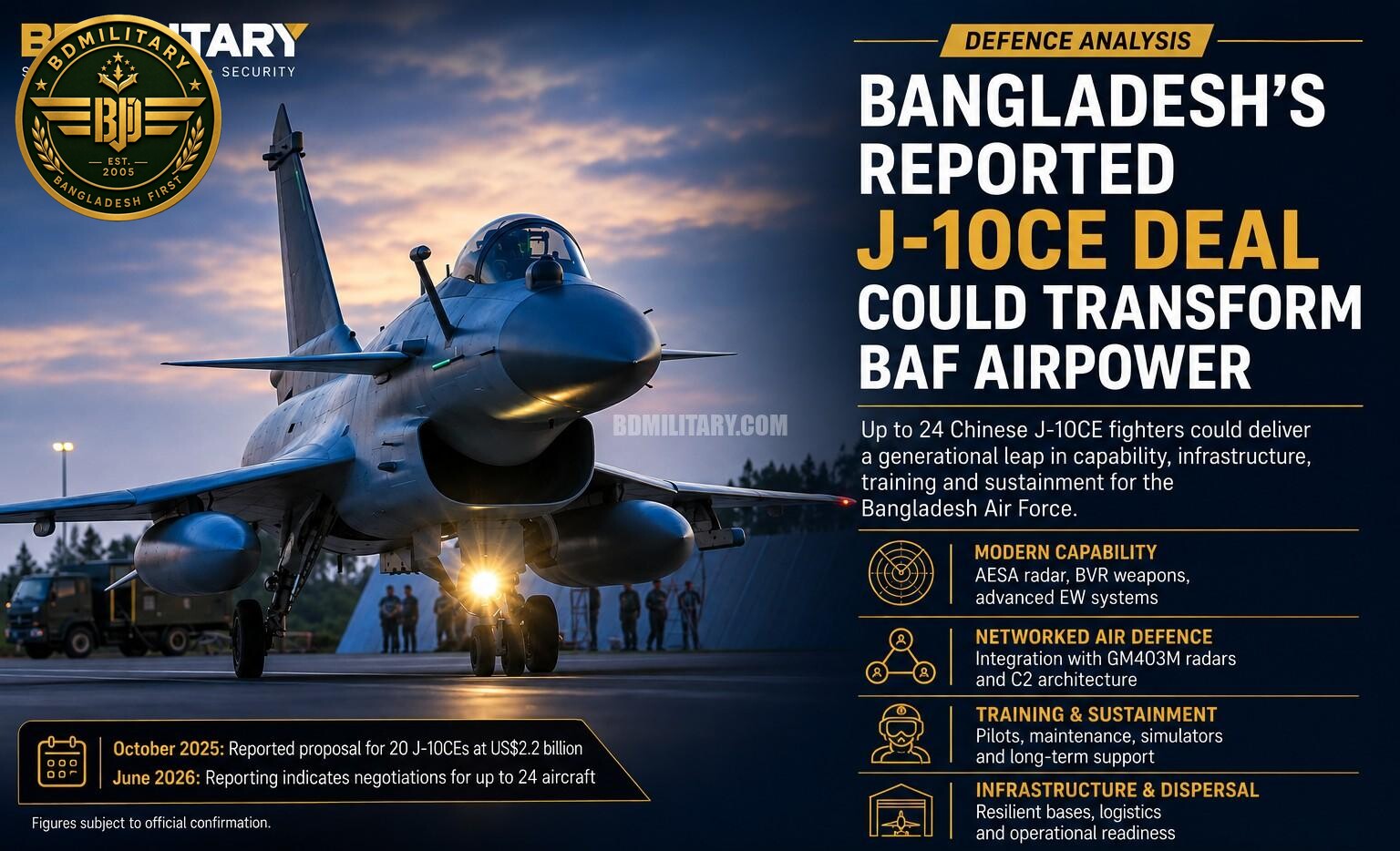
In October 2025, The Business Standard, citing official documents, reported that Bangladesh was preparing to acquire 20 J-10CE fighters at an estimated programme cost of US$2.2 billion. The proposed package included the aircraft, training, equipment, freight, maintenance-related provisions, infrastructure and other associated expenditure, with payments projected across ten fiscal years to FY2035–36.
More recent reporting in June 2026 indicates that Bangladesh could pursue up to 24 J-10CEs, suggesting that the scope of the programme may have subsequently expanded.
Until a final contract and configuration are officially disclosed, however, the exact aircraft quantity, weapons package and final programme value should be regarded as subject to negotiation.
What is already clear is that the significance of the programme extends considerably beyond the number of fighters involved.
For Bangladesh, the J-10CE could provide the foundation for a new combat-aircraft ecosystem encompassing modern sensors, weapons, electronic warfare, training, mission planning, maintenance and long-term sustainment.
A Generational Transition
The BAF’s current fighter force remains centred on Chinese-origin F-7 variants and upgraded MiG-29 aircraft.
The J-10CE would represent a substantial technological transition from these platforms, particularly in sensors, avionics, electronic warfare and beyond-visual-range air combat.
The export-oriented J-10CE is associated with modern active electronically scanned array radar technology, digital avionics, electronic warfare systems and compatibility with China’s contemporary air-to-air and precision-guided weapon families.
For the BAF, however, the real transformation would not come from individual specifications.
It would come from transitioning towards a fighter force increasingly built around advanced sensors, electronic warfare, secure communications, networked situational awareness and beyond-visual-range engagement.
What 24 Fighters Would Mean for Bangladesh
A force of up to 24 J-10CEs would constitute a meaningful frontline capability for Bangladesh, although the number available for combat operations at any particular moment would necessarily be lower.
Aircraft must rotate through scheduled maintenance, servicing, training and upgrade cycles. Some would also be required for pilot conversion and continuation training.
The operational objective should therefore be sustained sortie generation and readiness rather than simply achieving a headline fleet number.
Twenty-four aircraft would nevertheless provide sufficient mass to establish a substantial frontline J-10CE element while retaining aircraft for training and maintenance rotation.
More importantly, the initial acquisition would establish expensive supporting infrastructure — including simulators, specialised maintenance facilities, ground-support equipment, weapons infrastructure and technical training systems — capable of supporting subsequent expansion.
The first 24 aircraft could therefore represent a foundation rather than necessarily the endpoint of Bangladesh’s fighter modernisation.
AESA Radar and BVR Air Combat
One of the most important advances would occur in the sensor and beyond-visual-range domains.
A modern AESA-equipped fighter can provide significant advantages in target detection and tracking, reliability, simultaneous target management and electronic counter-countermeasures compared with older mechanically scanned radar architectures.
The J-10CE has also been demonstrated and marketed with modern Chinese air-to-air weapons, including the PL-10 short-range missile and PL-15-series beyond-visual-range missile.
Bangladesh’s actual weapons package has not been publicly confirmed and should therefore be distinguished from weapons available for integration with the aircraft.
This distinction is important.
The operational effectiveness of a modern fighter fleet depends heavily upon its weapons inventory, pilot proficiency, electronic warfare support, maintenance capacity and the availability of replacement missiles and components.
Aircraft numbers alone provide only a partial indication of combat capability.
Towards Networked Air Defence
The J-10CE’s value would increase substantially if integrated into Bangladesh’s expanding national air-surveillance and command-and-control architecture.
The BAF has already strengthened this infrastructure through the introduction of Thales Ground Master 403M long-range air-surveillance radars, including systems commissioned at Mirpur and Bogura in 2025.
Modern fighters operating alongside long-range ground surveillance can benefit from a considerably broader recognised air picture than that available from their onboard sensors alone.
The next challenge for Bangladesh will therefore be integration.
Secure datalinks, command-and-control networks and compatible identification and communications systems will determine how effectively fighters, ground-based radars and other sensors can operate as components of a coherent national air-defence system.
Over the longer term, an airborne early-warning and control capability could further strengthen this architecture.
Electronic Warfare: The Less Visible Transformation
Another major change would occur in electronic warfare.
Modern air combat increasingly depends upon detecting, identifying and responding to hostile electromagnetic emissions. Radar warning, electronic support measures, countermeasures and electronic attack consequently play an increasingly important role in aircraft survivability and tactical effectiveness.
Introducing the J-10CE could provide the BAF with an opportunity to substantially expand its institutional expertise in this field.
However, electronic warfare capability cannot simply be purchased with the aircraft.
Bangladesh would need to develop specialist personnel, mission-data management, threat libraries, electronic warfare training and procedures for continuously updating defensive systems as potential threats evolve.
These investments may ultimately prove as important as the fighter’s radar or aerodynamic performance.
Sustainment Will Determine Success
The less visible element of the programme may ultimately be the most important: sustainment.
Modern combat aircraft require continuous investment throughout their service lives. Engines require inspection and overhaul; radar and avionics components require maintenance; software requires updating; weapons require servicing; and pilots require sufficient flying hours to maintain operational proficiency.
Bangladesh will consequently need a dependable supply chain and progressively greater domestic maintenance capability.
An effective acquisition programme should include technical training, specialised tooling, diagnostic and test equipment, simulators, spare engines and components, and clearly defined arrangements for deeper-level maintenance.
The greater the proportion of these capabilities established inside Bangladesh, the greater the BAF’s ability to maintain aircraft availability without excessive dependence on overseas support.
Infrastructure and Dispersal
Introducing the J-10CE would also require investment at the airbases selected to operate the aircraft.
Modern fighter infrastructure encompasses far more than runways and shelters. It includes secure weapons storage, maintenance hangars, engine-support facilities, mission-planning centres, communications infrastructure, simulators and specialised ground-support equipment.
Bangladesh should also consider dispersal and force survivability as part of the programme.
A relatively small, high-value fighter fleet concentrated at one operating location would create an avoidable vulnerability.
Developing the ability to disperse, refuel, rearm and regenerate sorties from multiple operating locations would significantly increase the resilience of the force and maximise the strategic value of the investment.
Training: From Flying Fighters to Employing Airpower
Pilot and ground-crew proficiency will ultimately determine whether Bangladesh extracts the full capability offered by the aircraft.
Transitioning from the F-7 and MiG-29 era towards a modern digital fighter requires more than aircraft conversion.
Pilots will need extensive training in BVR tactics, electronic warfare, sensor management, networked operations, precision strike and complex multi-aircraft engagements.
Ground personnel will simultaneously require advanced training in radar, avionics, engines, electronic systems, weapons and software-based diagnostics.
High-fidelity simulators and mission-training systems will be particularly important, allowing the BAF to conduct sophisticated tactical training without placing unnecessary flying-hour demands on the operational fleet.
Building Technical Sovereignty
Bangladesh has decades of experience operating Chinese-origin military aircraft, providing the BAF with an established institutional relationship with China’s aviation industry.
The J-10CE would nevertheless represent a substantially deeper technological commitment.
Modern fighter programmes create long-term relationships involving software, weapons, spare parts, maintenance, mission planning, training and future upgrades.
Bangladesh should therefore seek the maximum practical degree of domestic maintenance capability, technical knowledge transfer and sustainment autonomy within any final agreement.
The objective should not simply be to operate an advanced fighter.
It should be to develop the national expertise required to sustain that capability over several decades.
BDMilitary Assessment
The reported J-10CE programme should ultimately be judged not by whether Bangladesh acquires 20 or 24 aircraft, but by the combat capability generated from the investment.
A successful programme would deliver more than modern fighters.
It would produce high aircraft availability, proficient aircrew, adequate weapons stocks, resilient operating infrastructure, integrated surveillance and command networks, mature electronic warfare capability and an increasingly self-sufficient domestic maintenance system.
A fleet of up to 24 J-10CEs could significantly strengthen Bangladesh’s air-defence capability. But the aircraft themselves would represent only the visible component of a much larger transformation.
If Bangladesh combines the fighters with the necessary weapons, sensors, training, infrastructure and sustainment architecture, the programme could mark the transition from a combat-aircraft force built largely around legacy platforms towards a modern, networked and sustainable national airpower capability.
For Bangladesh, the real strategic return will therefore not be measured by the number of J-10CEs parked on the flight line.
It will be measured by how effectively Bangladesh can independently generate, sustain and employ modern combat airpower.
References and Further Reading
The Business Standard — 7 October 2025
Bangladesh plans $2.2b purchase of 20 Chinese J-10 fighter jets
https://www.tbsnews.net/bangladesh/bangladesh-plans-22b-purchase-20-chinese-j-10-fighter-jets-1254511
The Business Standard — 7 October 2025
Everything you need to know about China’s J-10CE fighter jet
https://www.tbsnews.net/infograph/everything-you-need-know-about-chinas-j-10ce-fighter-jet-1255006
Moneycontrol — 23 June 2026
Bangladesh plans to buy 24 Chinese J-10CE fighter jets, deal likely by August
https://www.moneycontrol.com/world/bangladesh-plans-to-buy-24-chinese-j-10ce-fighter-jets-deal-likely-by-august-article-13956075.html
BDMilitary — 16 April 2025
Bangladesh Air Force inducts Thales Ground Master 403M radars
https://www.bdmilitary.com/defence-news/defence-acquisitions/bangladesh-air-force-inducts-thales-ground-master-403m-radars/324/
BDMilitary — 18 June 2025
Bangladesh Air Force Commissions Second GM 403-M Air Defence Radar in Bogura
https://www.bdmilitary.com/doctrine-capabilities/capabilities/bangladesh-air-force-commissions-second-gm-403-m-air-defence-radar-in-bogura/2218/

Amit Bhattacharya is a leading defence procurement expert with deep expertise in modern weapon systems and military hardware acquisition. Over more than a decade, he has collaborated with top defence contractors and strategic research institutions, delivering incisive analysis on procurement frameworks, capability development, and technology integration for armed forces worldwide. Amit bridges the gap between operational requirements and industrial capacity, providing authoritative evaluations of modernisation programmes, defence budgets, and acquisition reforms in both established and emerging defence markets. He leads the Defence Procurement and Defence Industry sections at BDMilitary, shaping strategic discourse on defence innovation. Amit earned his Master of Policy and Governance (MPAG) from the University of Canterbury, New Zealand, complementing his practical expertise with advanced policy and governance insight.