Bangladesh’s next major fighter acquisition could shape the Bangladesh Air Force (BAF) for the next three to four decades. The decision will extend far beyond aircraft performance: it will determine weapons access, training and sustainment arrangements, operational sovereignty, industrial partnerships and potentially the direction of Bangladesh’s aerospace sector.
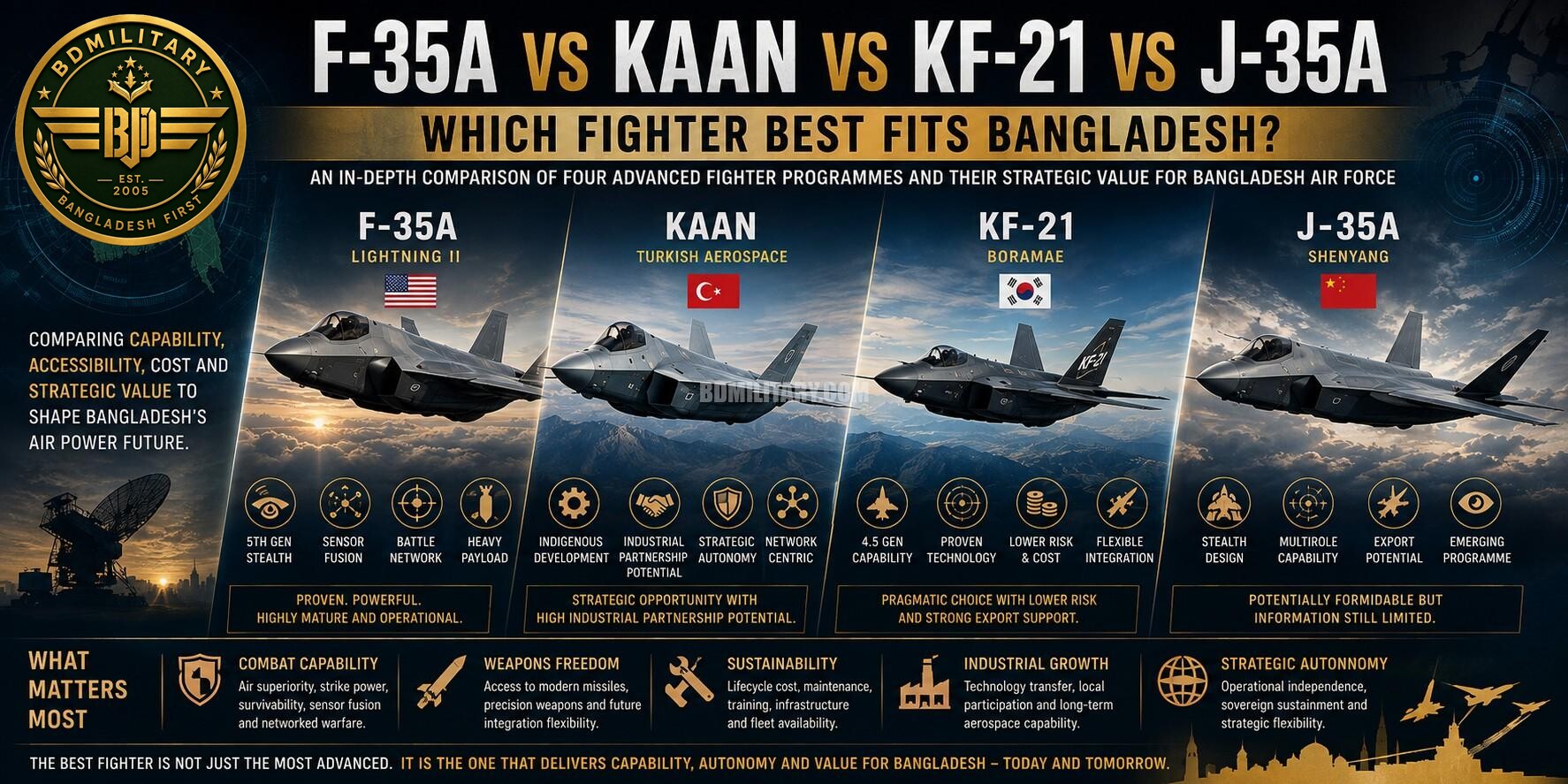
Four aircraft illustrate the strategic choices particularly well: the US F-35A Lightning II, Türkiye’s KAAN, South Korea’s KF-21 Boramae, and China’s J-35A.
They are not equivalent programmes. The F-35A is a mature operational fifth-generation fighter. The KF-21 is an advanced 4.5-generation aircraft moving towards operational service. KAAN is a fifth-generation programme still undergoing development and flight testing. The J-35A is China’s emerging second stealth-fighter family, but comparatively little authoritative information is publicly available regarding its detailed performance and potential export configuration.
The central question for Dhaka is therefore not which fighter has the most impressive specifications. It is which programme provides the strongest combination of combat capability, affordability, availability, weapons access, sovereign sustainment, strategic flexibility and industrial cooperation.
Bangladesh’s Requirement
Bangladesh’s geography places particular demands on combat aviation.
Limited strategic depth and the concentration of major population centres, military facilities and economic infrastructure require rapid-reaction air defence, strong beyond-visual-range capability and resilient command-and-control networks.
The Bay of Bengal adds a maritime dimension. Future fighters should contribute to maritime surveillance and strike operations while exchanging targeting and situational-awareness data with ground, naval and airborne sensors.
Survivability is also becoming increasingly dependent on more than speed and manoeuvrability. AESA radars, electronic warfare, datalinks, sensor fusion, long-range weapons and reduced observability are increasingly decisive.
Yet capability must remain sustainable.
Aircraft that cannot be maintained in sufficient numbers or flown at high sortie rates provide limited deterrent value regardless of their technical sophistication. Bangladesh must therefore assess the complete combat system and its lifecycle cost rather than simply compare aircraft performance.
F-35A: The Capability Benchmark
The F-35A Lightning II is the clear technological and operational benchmark in this comparison.
The aircraft combines very-low-observable design with the AN/APG-81 AESA radar, electro-optical sensors, advanced electronic warfare and extensive sensor fusion. Rather than presenting the pilot with separate sensor outputs, the F-35 integrates information into a consolidated tactical picture and can distribute that information across a wider combat network.
Its first flight took place in December 2006. The F-35A has a maximum speed of Mach 1.6, while published Royal Australian Air Force data cite an internal-fuel combat radius of approximately 1,093 km and maximum weapons payload of about 8,160 kg using internal and external stations.
Its greatest advantage over the other aircraft considered here is maturity. The F-35 is already operated by multiple air forces and supported by an extensive international training, logistics and upgrade ecosystem.
For Bangladesh, however, the central issue is accessibility.
F-35 exports are closely controlled by Washington and normally associated with close US defence relationships, demanding security arrangements and substantial supporting infrastructure. Acquisition would therefore involve political, financial and information-security considerations extending well beyond the aircraft itself.
Bangladesh would also have comparatively limited freedom over technology transfer, modification and independent weapons integration.
BDMilitary assessment: Best proven combat capability, but currently the least straightforward option for Bangladesh to acquire and operate with substantial strategic autonomy.
KAAN: The Strategic Opportunity
Türkiye’s KAAN represents the most ambitious long-term proposition.
Developed by Turkish Aerospace, KAAN conducted its maiden flight on 21 February 2024. Development aircraft have used two General Electric F110 engines, while Türkiye intends ultimately to field an indigenous propulsion solution.
The programme is intended to deliver low observability, internal weapons carriage, advanced sensors, electronic warfare and network-centric combat capability.
However, KAAN remains developmental.
Many performance and cost figures circulating publicly remain programme objectives or estimates rather than demonstrated operational specifications. Any assessment must therefore recognise substantial development, schedule and cost risk.
KAAN nevertheless has particular strategic relevance for Bangladesh.
Türkiye has increasingly combined defence exports with training, local support and industrial cooperation. If Ankara were prepared to extend that approach to KAAN, Bangladesh could potentially negotiate local maintenance, engineering participation, weapons cooperation and involvement of its emerging defence-industrial sector.
That could transform the acquisition from a fighter purchase into a long-term aerospace partnership.
KAAN’s attraction therefore rests not on claims that it already surpasses established fighters, but on what Bangladesh might gain from participation in a developing fifth-generation ecosystem.
BDMilitary assessment: Most strategically attractive long-term candidate, provided the programme matures successfully and Türkiye offers meaningful industrial participation and operational sovereignty.
KF-21 Boramae: The Pragmatic Choice
The KF-21 Boramae occupies the middle ground between conventional advanced fighters and fully developed fifth-generation platforms.
The aircraft first flew on 19 July 2022. Powered by two GE F414 engines, it incorporates an indigenous South Korean AESA radar, modern avionics, electronic warfare capability and reduced-signature design features.
The initial KF-21 configuration is generally described as a 4.5-generation fighter, rather than a full very-low-observable fifth-generation aircraft.
For Bangladesh, that need not be a decisive disadvantage.
A fighter combining modern sensors, effective electronic warfare, advanced beyond-visual-range weapons and high operational availability would represent a major increase in capability. Full-spectrum stealth may be less important than maintaining a sufficiently large, well-armed and consistently serviceable fleet.
The KF-21 also benefits from South Korea’s increasingly mature defence-export ecosystem and is substantially further along in development than KAAN.
This makes it potentially the strongest compromise between capability, programme risk, affordability and political accessibility.
BDMilitary assessment: The strongest lower-risk and pragmatic candidate for Bangladesh.
J-35A: A Contender with Too Many Unknowns
China’s J-35A could eventually become a significant option for Bangladesh.
Its configuration incorporates characteristics associated with fifth-generation fighters, including low-observable shaping and internal weapons carriage. China’s public presentation of the aircraft confirms substantial progress in the programme.
However, authoritative public information regarding its radar performance, electronic warfare capability, radar signature, combat radius, payload, engine performance, acquisition cost and potential export configuration remains limited.
Detailed figures circulating in open sources should therefore be treated cautiously.
China nevertheless has one major advantage: an established defence relationship with Bangladesh. Existing procurement, training and sustainment links could potentially make a future Chinese fighter comparatively accessible.
The strategic question is whether Bangladesh should deepen its dependence on the Chinese combat-air ecosystem or use its next fighter acquisition to diversify towards another major partner.
BDMilitary assessment: Potentially highly capable and possibly accessible, but currently the contender with the greatest information uncertainty.
Weapons Matter as Much as the Aircraft
Fighter comparisons frequently underestimate the importance of weapons.
Bangladesh should evaluate each aircraft as part of a complete combat system incorporating long-range air-to-air missiles, short-range weapons, anti-ship missiles, stand-off precision strike, electronic warfare, targeting systems and secure datalinks.
Weapons integration freedom deserves particular attention.
Over a service life potentially exceeding 30 years, the ability to integrate new weapons without excessive political or technical restrictions could become a significant strategic advantage.
A theoretically superior aircraft constrained by weapons access may ultimately provide less operational value than a somewhat less sophisticated platform supported by a flexible and affordable weapons ecosystem.
Lifecycle Cost, Not Headline Price
Published fighter unit prices are frequently misleading because they may exclude weapons, training, infrastructure, spare engines and long-term support.
For developmental aircraft, future export prices are even less certain.
Bangladesh should therefore compare total lifecycle cost and achievable fleet availability.
A smaller fleet of extremely sophisticated fighters may not necessarily generate greater combat power than a larger fleet of slightly less advanced aircraft capable of sustaining higher sortie rates.
For the BAF, availability, maintainability and weapons stocks should carry substantial weight alongside stealth, radar performance and aerodynamic capability.
The Industrial Dimension
Bangladesh should not treat its future fighter requirement simply as an acquisition of 16 or 24 aircraft.
A programme of this scale should contribute to a broader national aerospace strategy.
Dhaka should seek depot-level maintenance capability, pilot and engineering training, simulation infrastructure, avionics support, component production and progressively greater involvement by Bangladeshi engineers.
The objective should be to ensure that major defence expenditure generates technical capability inside Bangladesh rather than creating decades of dependence on an overseas supplier.
This consideration strengthens the cases for KAAN and KF-21 in different ways.
South Korea could potentially offer partnership with an established and increasingly successful aerospace industry around a comparatively mature aircraft.
Türkiye could potentially offer greater participation in a developing fifth-generation ecosystem, but with correspondingly greater programme risk.
The quality of the industrial package could ultimately be as important as relatively small differences in aircraft performance.
Strategic Autonomy
Every fighter choice carries geopolitical consequences.
An F-35 acquisition would align Bangladesh more closely with the US defence ecosystem. J-35A would reinforce an already significant Chinese defence relationship. KF-21 would deepen cooperation with South Korea, while KAAN could establish Türkiye as a major long-term aerospace partner.
Bangladesh should therefore examine not merely who is willing to sell an aircraft, but what degree of operational sovereignty remains after delivery.
Access to spare parts, software, weapons, upgrades and maintenance during periods of international tension must form part of the evaluation.
The best fighter for Bangladesh is ultimately one that can still be maintained, armed, upgraded and flown when it is most needed.
KAAN or KF-21?
For Bangladesh, the most consequential long-term comparison may ultimately be between KAAN and KF-21.
The distinction is relatively straightforward.
KF-21 is the lower-risk option. It is further along in development, incorporates proven propulsion technology and offers a modern sensor and weapons architecture without requiring Bangladesh to assume the same level of programme risk associated with an emerging fifth-generation fighter.
KAAN is the higher-potential strategic option. If Türkiye successfully matures the aircraft and offers substantial technology transfer, local sustainment, weapons flexibility and industrial participation, the programme could provide Bangladesh with benefits extending far beyond the fighter fleet.
Bangladesh does not necessarily need to decide between them immediately.
Allowing both programmes to mature further would provide considerably better information regarding performance, export pricing, delivery schedules, weapons integration and industrial cooperation.
BDMilitary Assessment — August 2026
For Bangladesh specifically, BDMilitary assesses the four programmes as follows:
KAAN — 8.8/10
Most strategically attractive long-term candidate.
KF-21 Boramae — 8.5/10
Strongest pragmatic and lower-risk candidate.
F-35A Lightning II — 7.3/10
Highest proven combat capability, but difficult accessibility and comparatively limited scope for sovereign industrial participation.
J-35A — 7.0/10
Potentially formidable and possibly accessible, but too many critical variables remain uncertain.
These are BDMilitary editorial suitability assessments, not technical performance scores. They consider combat capability, programme maturity, acquisition feasibility, lifecycle implications, weapons access, strategic autonomy and potential industrial cooperation.
If the comparison were based solely on demonstrated combat capability today, the F-35A would rank first by a substantial margin.
Conclusion: Buy a Capability, Not Just a Fighter
There is currently no objectively superior choice for the Bangladesh Air Force across every criterion.
The F-35A is the capability benchmark. Its stealth, sensor fusion and operational maturity remain unmatched within this group, but accessibility and sovereignty considerations reduce its practicality for Bangladesh.
The KF-21 is the pragmatic choice. It offers perhaps the strongest current balance of modern combat capability, programme maturity and manageable acquisition risk.
The J-35A is the contender to watch. China’s established defence relationship with Bangladesh could make it relevant, but greater transparency regarding capability, cost and export availability is required before a confident assessment can be made.
The KAAN is the strategic long-term opportunity.
That judgement is conditional. KAAN must demonstrate that its ambitious objectives can be translated into a mature, reliable and economically sustainable operational fighter.
If Türkiye succeeds — and if Ankara offers Bangladesh meaningful technology transfer, weapons flexibility, local sustainment and industrial participation — KAAN could provide something potentially more valuable than another imported fighter.
It could provide Bangladesh with an entry point into a next-generation aerospace ecosystem.
The eventual BAF decision should therefore not be driven by headline specifications or the label “fifth generation”.
It should be determined by which programme provides the strongest combination of combat effectiveness, affordability, availability, weapons freedom, sovereign sustainment and industrial development over the next 30 to 40 years.
For now, the strategic picture can be summarised simply:
F-35A — the capability benchmark.
KF-21 — the pragmatic choice.
KAAN — the strategic long-term opportunity.
J-35A — the contender to watch.
Bangladesh’s next fighter decision will determine more than what aircraft appears on the BAF flight line. Done correctly, it could help define the country’s air power, strategic partnerships and aerospace capabilities for a generation.
Editorial Note
Aircraft programmes evolve rapidly. Performance targets, production schedules, weapons integration, export conditions and costs can change substantially during development. BDMilitary’s assessment reflects publicly verifiable information available at the time of publication in August 2026.
Where manufacturer claims concern developmental capabilities, they are treated as programme objectives rather than independently demonstrated operational performance.

M.Z. Rahman is a distinguished defence and aerospace industry veteran turned strategist, with over two decades of experience in regional security, military modernisation, and strategic policy. Holding a Master of Arts in International Relations and Security Studies from Waikato University, New Zealand, he has contributed extensively to leading think tanks and defence journals worldwide. As Chief Editor of BDMilitary, Rahman drives the editorial vision, delivering authoritative, rigorously researched insights that reflect the latest trends in defence and geopolitics. His work integrates industry expertise with strategic foresight, establishing him as a respected voice in global defence strategy.