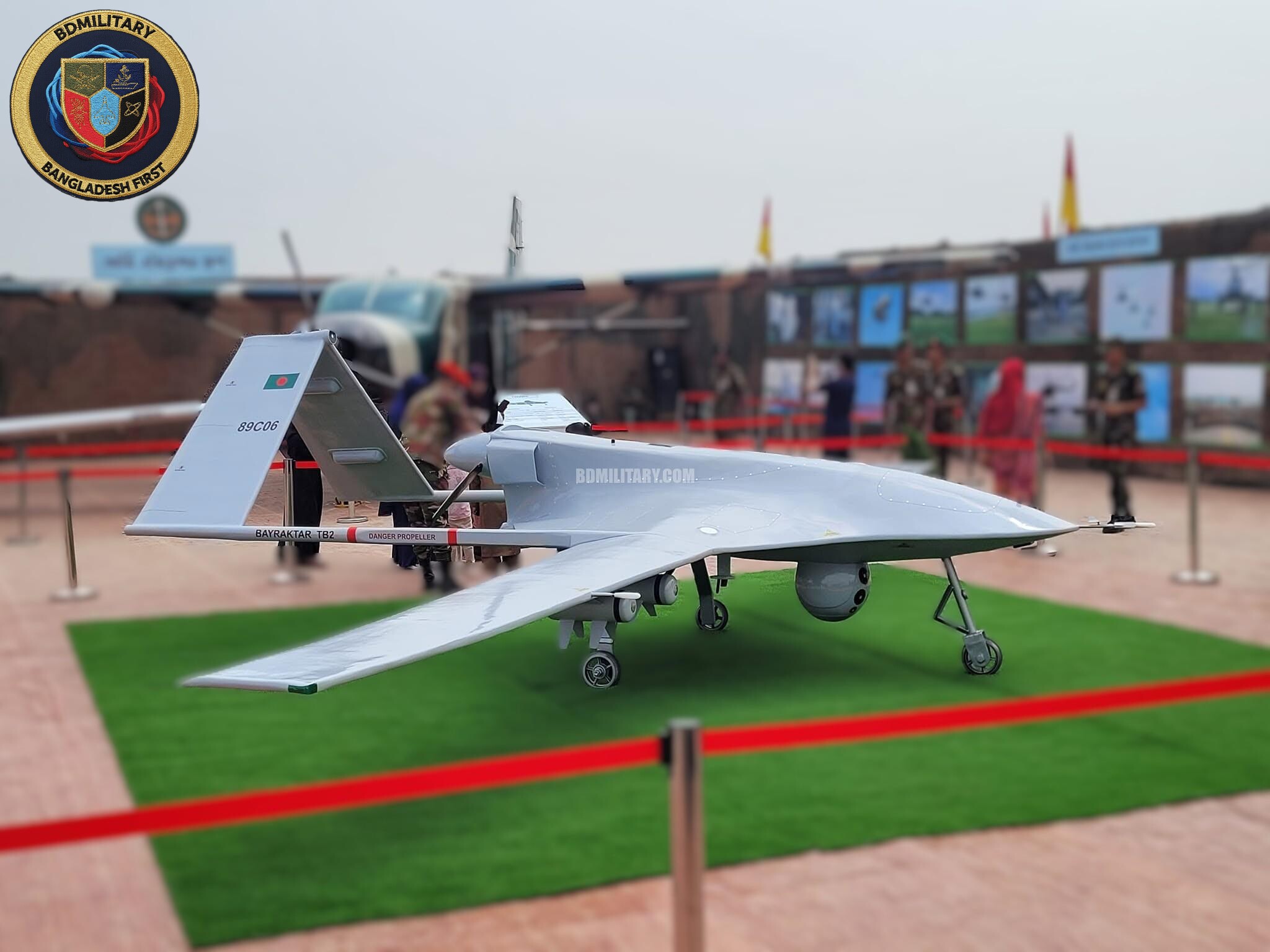
The Bangladesh Army is set to undertake one of the most significant force-structure reforms in its modernisation programme with the establishment of a dedicated UAV Regiment, elevating unmanned aerial systems to the same institutional status as the Infantry, Armour and Artillery branches.
The new regiment will consolidate the Army’s growing drone capabilities under a dedicated command structure and provide operational formations with organic reconnaissance, strike, loitering munition, electronic warfare and counter-UAV capabilities. The move reflects the rapidly evolving character of warfare, where unmanned systems have become indispensable for intelligence gathering, target acquisition, precision strike operations, force protection and battlefield coordination.
Recent conflicts in Ukraine, the Middle East and the South Caucasus have demonstrated that battlefield success increasingly depends upon the effective employment of drones and the ability to defeat enemy unmanned systems. The Bangladesh Army’s planned UAV Regiment seeks to address both requirements within a single integrated formation.
From Aviation Asset to Combat Arm
At present, Bangladesh Army UAV units operate under the Army Aviation Group, which has overseen the introduction and operation of various unmanned systems over the past decade.
Current structure:
Bangladesh Army
│
└── Army Aviation Group
    │
    ├── Helicopter Units
    ├── Fixed-Wing Aviation Assets
    └── UAV Elements
         ├── Reconnaissance Flights
         ├── Tactical UAV Detachments
         └── Training & Maintenance Sections
While suitable during the early stages of drone adoption, the growing scale and complexity of unmanned operations have created the need for a dedicated combat arm responsible for doctrine, force generation, training, procurement, maintenance and operational employment.
The establishment of a UAV Regiment will transform unmanned systems from a supporting aviation capability into a core battlefield function capable of influencing operations across all domains of land warfare.
Proposed UAV Regiment Structure
The future regiment is expected to combine reconnaissance, strike, loitering munition, electronic warfare and counter-UAV capabilities under a unified command. Such an arrangement would enable the Bangladesh Army to conduct the full spectrum of unmanned warfare operations while maintaining close integration with conventional manoeuvre forces.
Bangladesh Army
│
├── Infantry Regiment
├── Armoured Corps
├── Regiment of Artillery
├── Army Aviation Group
└── UAV Regiment
    │
    ├── Regimental Headquarters
    │
    ├── Reconnaissance UAV Battalion
    │   ├── Long-Endurance UAV Company
    │   ├── Tactical UAV Company
    │   └── Intelligence Exploitation Cell
    │
    ├── Strike UAV Battalion
    │   ├── Armed UAV Company A
    │   ├── Armed UAV Company B
    │   └── Precision Strike Section
    │
    ├── Loitering Munition Battalion
    │   ├── Tactical Loitering Company
    │   ├── Long-Range Loitering Company
    │   └── Target Acquisition Section
    │
    ├── Electronic Warfare Battalion
    │   ├── Signals Intelligence Company
    │   ├── Electronic Attack Company
    │   ├── Electronic Support Company
    │   └── Spectrum Operations Cell
    │
    ├── Counter-UAV Battalion
    │   ├── Detection & Surveillance Company
    │   ├── Electronic Countermeasures Company
    │   ├── Kinetic Intercept Company
    │   └── Technical Analysis Section
    │
    ├── UAV Training & Doctrine Battalion
    │
    └── Technical Support Battalion
        ├── Maintenance Company
        ├── Communications Company
        ├── Electronic Systems Company
        └── Logistics Company
Supporting Divisions and Brigades
The UAV Regiment will not operate solely as a strategic asset. Instead, its battalions and companies can be attached to divisions and brigades as operational requirements dictate.
A future divisional arrangement could resemble:
Infantry Division
│
├── Infantry Brigade
├── Infantry Brigade
├── Artillery Brigade
├── Armoured Elements
└── Attached UAV Task Group
     │
     ├── Reconnaissance UAV Company
     ├── Strike UAV Company
     ├── Loitering Munition Company
     ├── EW Detachment
     └── Counter-UAV Detachment
This structure would provide commanders with persistent battlefield surveillance, precision engagement capability, electronic warfare support and protection against hostile drone threats.
Indigenous Production Through Technology Transfer
A key pillar of the programme will be the development of a domestic unmanned systems industry through technology transfer partnerships with friendly nations.
The Bangladesh Army intends to support local production of a broad range of systems, including:
- Tactical reconnaissance drones
- Long-endurance surveillance UAVs
- Armed strike UAVs
- Loitering munitions
- Counter-UAV systems
- Electronic warfare equipment
- Electro-optical and infrared sensor payloads
- Ground control stations and communications systems
Domestic production will reduce dependence on foreign suppliers, strengthen supply-chain resilience and expand Bangladesh’s defence-industrial base. Technology transfer agreements are expected to facilitate local expertise in airframe manufacturing, avionics, propulsion systems, secure communications, sensor integration and precision-guided weapons.
Lessons from Modern Warfare
Recent conflicts have demonstrated that drones are no longer simply reconnaissance tools. They have become central to modern combat operations, performing missions that include intelligence gathering, artillery fire correction, precision strike operations, battle damage assessment, electronic warfare and force protection.
At the same time, the proliferation of unmanned systems has created an urgent requirement for effective counter-drone measures. Armies that fail to protect their forces from hostile drones risk suffering disproportionate losses on the modern battlefield.
The Bangladesh Army’s proposed UAV Regiment reflects these realities by integrating offensive and defensive unmanned capabilities within a single formation. By combining reconnaissance assets, armed UAVs, loitering munitions, electronic warfare units and counter-UAV forces, the regiment will be capable of both exploiting and controlling the unmanned battlespace.
A New Era of Unmanned Warfare
The creation of a dedicated UAV Regiment represents more than the introduction of new equipment; it signifies the emergence of a new combat arm within the Bangladesh Army.
The regiment will provide commanders with the ability to find, fix, track and engage targets while simultaneously disrupting enemy communications, protecting friendly formations from hostile drones and delivering real-time intelligence across the battlefield.
Supported by indigenous production and international technology transfer, the UAV Regiment is expected to become a cornerstone of the Bangladesh Army’s future combat capability. As warfare continues to evolve, unmanned systems will play an increasingly decisive role in military operations, and the establishment of a dedicated UAV Regiment positions the Bangladesh Army at the forefront of this transformation.

Khaled Ahmed is a seasoned former intelligence analyst and military expert from the Netherlands, bringing over 15 years of specialised experience in operational intelligence, threat analysis, and strategic defence planning. Having served in high-level, classified roles within Dutch military intelligence, he possesses rare expertise in European security architecture, NATO doctrine, and asymmetric warfare. Khaled’s deep operational insight and international perspective enable him to deliver precision-driven intelligence analysis and forward-looking strategic forecasts. A trusted contributor to high-level risk assessments and security briefings, he offers readers clarity on complex defence and security challenges. Khaled leads the National Security and Fact Analysis sections at BDMilitary. He holds a Master’s degree in International Relations from the University of Groningen, The Netherlands, and is fluent in Dutch, French, and Arabic — combining linguistic dexterity with operational expertise to analyse security issues across cultures and regions.