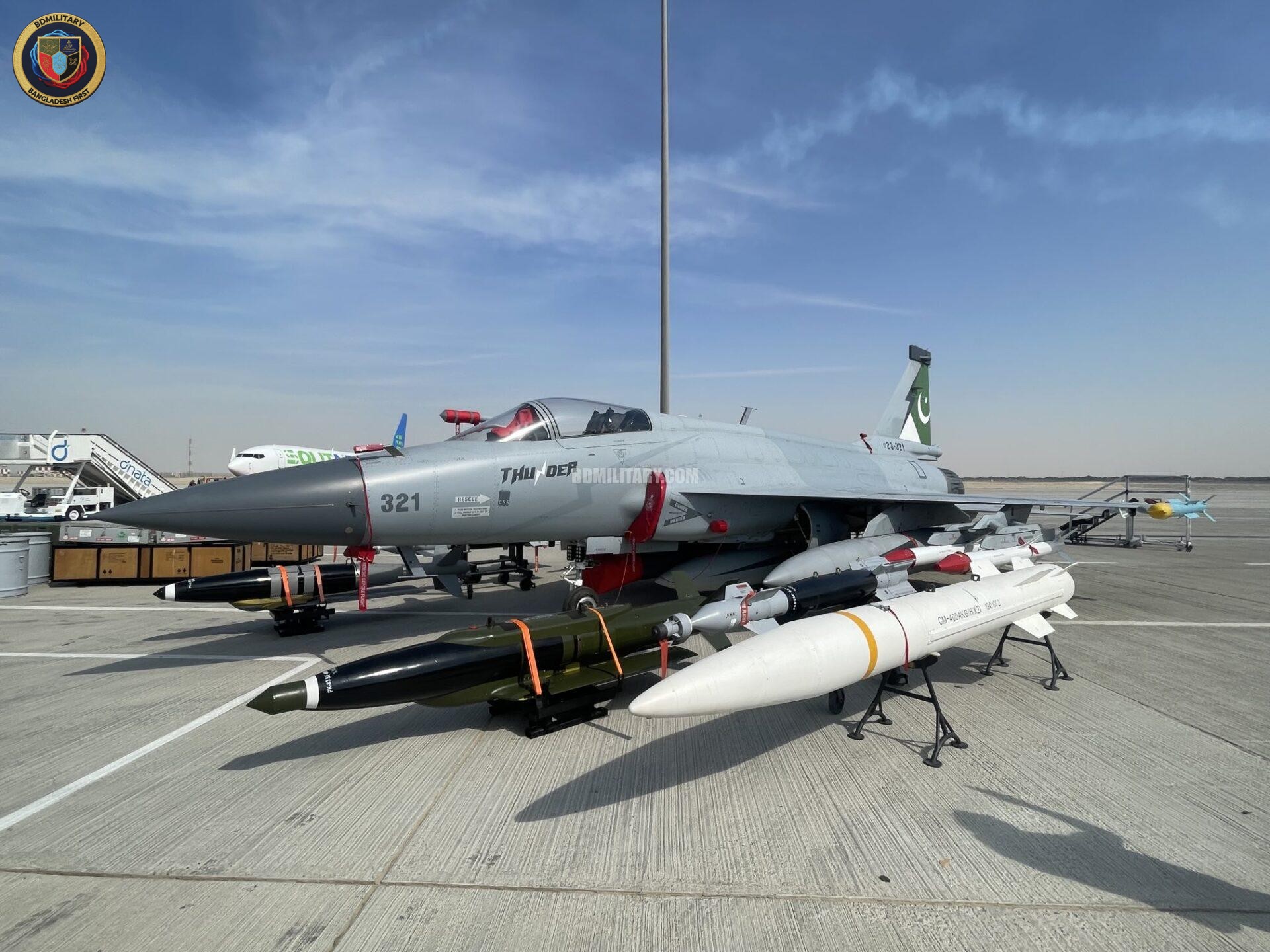
On 20 November 2025, the Pakistan Air Force (PAF) announced that an unspecified “friendly country” had signed a memorandum of understanding (MoU) to acquire the JF-17 Thunder fighter jet. The signing took place on the sidelines of the Dubai Airshow 2025 at Al Maktoum International Airport, where Pakistan showcased the newest JF-17 Block III alongside the Super Mushshak trainer. The announcement has fuelled intense speculation within regional defence circles, as the identity of the prospective customer was not disclosed. For Bangladesh, whose air force chief held direct talks with the PAF leadership during the event, the timing and context strongly suggest that Dhaka may be the unnamed signatory.
The JF-17 was a major attraction at the airshow, drawing delegations from across the Middle East, Africa, and Asia. According to Pakistani officials, the Block III variant in particular acquired strong interest due to its expanded mission systems, advanced avionics, and its combat record in Pakistan’s recent cross-border operations. For Pakistan, the airshow strengthened its case that the Thunder has transitioned from a cost-driven platform into a viable 4.5-generation multirole fighter for developing air forces. For Bangladesh, long linked with the JF-17 programme, the MoU may represent a discreet step toward long-awaited fighter modernisation as Dhaka typically avoids public announcements before contracts are finalised.
Evolution of the JF-17 Programme
The JF-17 Thunder, co-developed by Chengdu Aircraft Corporation and Pakistan Aeronautical Complex (PAC), began as a replacement for Pakistan’s ageing A-5C, F-7P/PG and Mirage III/V fleets. Tracing its origins to the 1990s Super-7 and FC-1 projects, the first prototype flew in 2003, followed by initial production airframes in 2007. The fighter formally entered service in 2010 and progressively became the backbone of the PAF, equipping several frontline units.
Production is split between China and Pakistan, with roughly 58 per cent of the airframe manufactured in Pakistan—including the forward fuselage, wings, and vertical stabiliser—while 42 per cent is produced in China. Final assembly is conducted at PAC Kamra, whose output capacity has risen sharply to support both PAF requirements and export orders.
The programme advanced from the baseline Block I, valued at roughly USD 15 million per unit, to Block II in 2013, which introduced composite materials, stronger electronic warfare (EW) capabilities, air-to-air refuelling (AAR), and improved avionics. The dual-seat JF-17B, first flown in 2017, added a dorsal spine and additional fuel, and entered production in both countries between 2018 and 2020.
Pakistan’s experience with Block I and II operations, including extensive combat use, ultimately shaped the more ambitious Block III.
JF-17 Block III: Design and Capabilities
The JF-17 Block III, also known as the JF-17C, represents the most significant leap in the fighter’s evolution. While retaining the established 14.3-metre airframe and 9.44-metre wingspan, the Block III incorporates additional composite materials, a chin hardpoint, and an airframe life of approximately 4,000 flight hours.
A major improvement is the Klimov RD-93MA afterburning turbofan, which provides around 91.2 kN of thrust and enables a top speed close to Mach 1.8. With a service ceiling of 16,900 metres, a combat radius of around 900 kilometres on internal fuel, and a ferry range exceeding 3,400 kilometres with drop tanks, the jet is designed for extended missions. Maximum take-off weight is now 13,500 kilograms, supporting an external stores payload of approximately 3,400 kilograms.
Internally, the cockpit is fitted with three portrait-format colour multifunction displays, a wide-angle HUD, hands-on-throttle-and-stick (HOTAS) controls, and the Martin-Baker PK16LE ejection seat. The software architecture, written in C++, is intentionally open to facilitate integration of additional sensors or weapons.
Perhaps the most transformative upgrade is the KLJ-7A active electronically scanned array (AESA) radar, which reportedly tracks fifteen targets simultaneously and engages four at once. Coupled with an enhanced radar warning receiver, an improved EW suite, missile approach warning system, and chaff/flare countermeasures, the Block III pushes the JF-17 into the modern multirole category. Pakistan and China have also fielded a helmet-mounted sight and display (HMSD) and are advancing the PFX Alpha programme for future upgrades.
Weapons integration is comprehensive. Short-range air combat is supported by PL-5E, PL-9C, and the latest PL-10E high off-boresight missile. For BVR engagements, the aircraft can carry PL-12/SD-10 and the PL-15E with a range of roughly 145 km. Strike roles are supported by guided and unguided munitions, CM-400AKG supersonic missiles, C-802AK anti-ship weapons, and the MAR-1 anti-radiation missile. Targeting pods include the Aselsan ASELPOD, with data link support to network aircraft during missions.
Combat Record and Operational Employment
Since 2014, the JF-17 has been used in operations against militant groups in Pakistan’s border regions, employing precision and unguided munitions. The fighter shot down an Iranian drone in 2017, participated in Pakistan’s 2019 retaliatory Operation Swift Retort, and supported cross-border strikes inside Afghanistan and Iran in 2024. In the 2025 conflict with India, Pakistan asserts that JF-17s armed with CM-400AKG missiles neutralised elements of an Indian S-400 battery at Adampur—although India disputes the claim.
Regardless, this consistent record of operational deployment has strengthened the JF-17’s exportability, demonstrating that the aircraft is not only economical but combat-proven in high-intensity environments.
Growing Export Momentum
Myanmar became the first export client, with an order for sixteen Block II units. Nigeria followed with three Block II airframes delivered in 2021. Azerbaijan signed a USD 1.6 billion agreement for Block III in February 2024, later expanded to a forty-jet, USD 4.6 billion package in 2025, making it the largest customer outside Pakistan. Iraq agreed to procure twelve Block III fighters in a package worth around USD 1.8 billion, alongside additional Mushshak trainers.
Bangladesh publicly signalled interest in acquiring the Block III in January 2025, and discussions with Pakistan have intensified since then. Dhaka’s need to replace its ageing F-7BG/MB fleet and to accelerate its “interim fighter” modernisation requirement makes it a natural candidate.
Strong Indicators Pointing to Bangladesh as the MoU Signatory
While the PAF did not name the state that signed the MoU at Dubai Airshow 2025, several factors strongly imply that Bangladesh may be the unnamed buyer.
First, Bangladesh rarely announces arms procurement decisions at airshows or in foreign capitals. Instead, the government typically finalises agreements discreetly before issuing controlled public disclosures months later, often without specifying quantities or configurations. This aligns closely with the nature of the PAF announcement, which confirmed the MoU but withheld the customer’s identity.
Second, during the airshow, Pakistan’s Chief of the Air Staff, Air Chief Marshal Zaheer Ahmed Baber Sidhu, held high-level talks with Bangladesh Air Force (BAF) Chief of Air Staff Air Chief Marshal Hassan Mahmood Khan. The timing of these talks—coinciding with the MoU announcement—suggests that negotiations were active at the highest levels.
Third, the BAF has been exploring options to field a cost-effective 4.5-generation fighter for its short-term force modernisation until the MRF (Medium-Range Fighter) project progresses. The JF-17 Block III falls directly into the capability and budget bracket that Dhaka has prioritised under Forces Goal 2030. Bangladesh’s long engagement with the JF-17 programme, including earlier feasibility studies, training exchanges, and data-sharing, reinforces this connection.
Fourth, the political context in late 2025 supports discreet defence acquisitions. Bangladesh’s interim government has been modernising its forces without highly publicised procurement narratives, particularly in the aviation sector, where strategic ambiguity is preferred.
Taken together, these factors make Bangladesh one of the most plausible candidates behind the MoU.
Implications for Bangladesh Air Power
If Dhaka is indeed the MoU signatory, the JF-17 Block III could serve as a bridging capability between Bangladesh’s legacy F-7BG/MB fighters and future high-end acquisitions. The jet offers an affordable path to AESA radar, modern BVR missiles, improved EW capabilities, and multi-role flexibility in both maritime and land strike missions—key requirements for Bangladesh’s strategic environment.
The Block III’s low operational cost, availability of industrial partnership opportunities, and the possibility of joint training with Pakistan could accelerate BAF fleet regeneration. Given Bangladesh’s growing interest in deepening defence ties with China, the JF-17 also fits the technological ecosystem already established within Bangladesh Navy and Army procurement channels.
Assessment
The JF-17 Thunder Block III emerged as a central attraction at the Dubai Airshow 2025, drawing international interest and culminating in the signing of a new MoU with an unnamed friendly state. Given the combination of strategic timing, the attendance of the Bangladesh Air Force chief at high-level engagements, and Bangladesh’s established practice of quietly concluding defence agreements before formal announcements, it is highly plausible that Dhaka is the undisclosed buyer.
Should Bangladesh ultimately proceed toward full acquisition, the JF-17 Block III would mark a significant step in modernising the country’s fighter fleet and strengthening its multirole air combat capacity, while deepening defence-industrial ties with Pakistan and China at a time of shifting regional dynamics.

Amit Bhattacharya is a leading defence procurement expert with deep expertise in modern weapon systems and military hardware acquisition. Over more than a decade, he has collaborated with top defence contractors and strategic research institutions, delivering incisive analysis on procurement frameworks, capability development, and technology integration for armed forces worldwide. Amit bridges the gap between operational requirements and industrial capacity, providing authoritative evaluations of modernisation programmes, defence budgets, and acquisition reforms in both established and emerging defence markets. He leads the Defence Procurement and Defence Industry sections at BDMilitary, shaping strategic discourse on defence innovation. Amit earned his Master of Policy and Governance (MPAG) from the University of Canterbury, New Zealand, complementing his practical expertise with advanced policy and governance insight.
