Identity of Türkiye’s reported first foreign SİPER customer remains undisclosed as Bangladesh expands defence cooperation with Ankara and pursues stronger air-defence capabilities
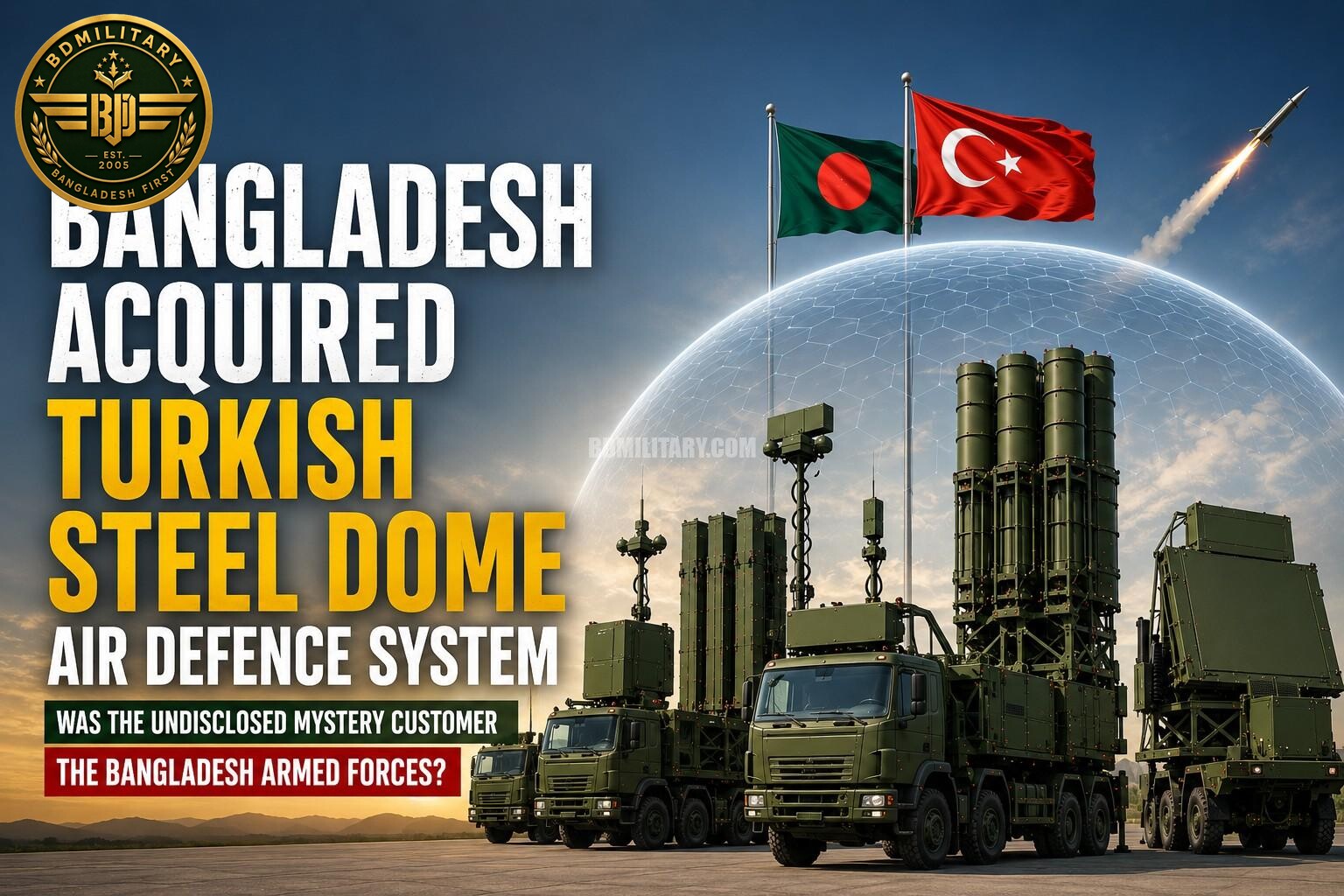
Bangladesh has emerged as a possible candidate for the unidentified foreign customer reportedly associated with Türkiye’s first export of the SİPER long-range surface-to-air missile system, although neither Dhaka nor Ankara has publicly confirmed the identity of the buyer.
Turkish reporting in May 2026 indicated that SİPER had secured its first international customer, with the recipient remaining undisclosed. The development represents an important export milestone for Türkiye’s expanding air-defence industry and has prompted speculation over the destination of the system.
No official statement reviewed by BDMilitary from the Bangladesh or Turkish governments, Türkiye’s Secretariat of Defence Industries (SSB), ASELSAN or ROKETSAN identifies Bangladesh as the recipient. Details of the reported export, including the number of systems, missile configuration, contract value and delivery schedule, have also not been publicly disclosed.
Nevertheless, Bangladesh warrants attention as a possible customer because the reported export coincides with a period of expanding Bangladesh–Türkiye defence relations and Dhaka’s broader efforts to strengthen its air-defence capabilities.
Official bilateral statements have identified defence industries, procurement, training and capacity building as areas of growing cooperation between the two countries.
If Bangladesh is ultimately confirmed as the SİPER customer, the acquisition would represent a substantial increase in the reach and sophistication of the country’s ground-based air-defence capability.
SİPER Provides The Long-Range Layer
SİPER is a long-range surface-to-air missile system developed through cooperation between ASELSAN, ROKETSAN and TÜBİTAK SAGE under the direction of Türkiye’s SSB.
According to the SSB, the system is intended to provide long-range air defence against targets including fighter aircraft, cruise missiles, unmanned aerial vehicles and helicopters.
SİPER has been developed as part of Türkiye’s effort to establish an indigenous high-altitude and long-range air-defence capability. The programme has progressed through testing, serial-production acceptance and entry into Turkish service.
The system is also an important component of Türkiye’s wider Çelik Kubbe, or Steel Dome, air-defence architecture.
However, SİPER and Steel Dome are not the same system.
SİPER is principally a long-range interceptor system and its associated sensors and command elements. Steel Dome is the much broader architecture intended to connect multiple air-defence weapons, radars, electro-optical sensors, electronic-warfare systems and command-and-control nodes.
This distinction would be important in assessing any potential Bangladeshi procurement.
Acquisition of SİPER would not by itself mean that Bangladesh had acquired the entire Turkish Steel Dome architecture. It could, however, provide a long-range component around which a broader integrated air-defence network could be developed.
Steel Dome Creates A Layered Defence
Steel Dome has been conceived as a networked system of systems rather than a single surface-to-air missile complex.
Türkiye is integrating multiple engagement layers into the architecture. These include short-range systems, the HİSAR family of surface-to-air missiles and SİPER at the longer-range end of the network.
The architecture also incorporates surveillance and fire-control radars, electronic-warfare equipment, electro-optical sensors, communications systems and command-and-control infrastructure.
The objective is to create a common air-defence picture in which information collected by different sensors can be distributed across the network and used by the most appropriate available weapon.
The operational sequence can broadly be described as detection, identification, tracking, threat evaluation, weapon assignment, engagement and post-engagement assessment.
This approach is substantially more capable than operating individual surface-to-air missile batteries as isolated units.
A radar positioned in one location can contribute targeting information to command elements and effectors deployed elsewhere. Multiple sensors can also provide overlapping coverage, increasing resilience if individual components are disrupted or destroyed.
For Bangladesh, this networked approach could eventually prove as important as the missile itself.
Multiple Systems Provide Successive Engagement Opportunities
Layering is central to modern integrated air defence.
Long-range systems are intended to engage suitable targets before they reach the most heavily defended areas. Medium-range systems provide another defensive layer, while short-range missiles and gun-based systems protect individual installations and the larger air-defence batteries themselves.
Counter-UAS systems add another layer against smaller unmanned threats.
An incoming aircraft or other aerial threat may therefore face several engagement opportunities rather than a single defensive line.
The approach also permits different weapons to be allocated according to the characteristics and importance of a target, helping prevent the unnecessary expenditure of high-value long-range interceptors against threats that can be defeated by shorter-range systems.
Türkiye has been expanding this architecture rapidly. ASELSAN said in 2026 that it expected to increase deliveries of Steel Dome-related products significantly, encompassing air-defence, radar, electronic-warfare and counter-UAS capabilities.
The scale of investment indicates that Steel Dome is intended to become a comprehensive national air-defence network rather than a collection of unrelated missile systems.
Potential Implications For Bangladesh
A SİPER-class capability would potentially address an important requirement for Bangladesh: extending air defence beyond individual military installations and strategic sites.
Bangladesh’s geography presents particular challenges for air-defence planners.
The country has a relatively compact territory, while major population centres, military facilities, airfields, ports, power-generation facilities and transport infrastructure are concentrated within comparatively short distances.
Modern combat aircraft and stand-off weapons can cover those distances rapidly, reducing reaction times available to defenders.
An effective long-range surveillance and engagement capability would provide greater defensive depth.
Depending on deployment patterns and the configuration eventually selected, long-range surface-to-air missile batteries could establish engagement zones extending well beyond the immediate vicinity of the facilities they protect.
This would begin shifting Bangladesh’s ground-based air defence from predominantly point defence towards area defence.
From Point Defence To Area Defence
Point air defence concentrates weapons around individual strategic locations.
An airbase, headquarters, bridge, port or power installation may have its own defensive systems, but those systems generally provide limited protection outside their immediate engagement areas.
Longer-range surface-to-air missiles change the geometry.
Appropriately positioned batteries can defend considerably larger areas and potentially establish overlapping engagement zones with neighbouring units.
This does not produce an impenetrable shield. Terrain, radar coverage, target altitude, electronic warfare, missile inventory, system readiness and numerous other operational factors determine the actual effectiveness of an air-defence network.
It does, however, force an attacking force to account for air defences across a substantially larger area.
For Bangladesh, this could improve the protection of strategic infrastructure while simultaneously increasing the difficulty of conducting hostile air operations over national territory.
Sensors Would Be Critical
Missile range alone would not determine the effectiveness of any prospective SİPER deployment.
Long-range interception requires correspondingly capable surveillance, target tracking, command-and-control and communications infrastructure.
Türkiye has invested heavily in active electronically scanned array radar technology through ASELSAN, including the ALP family of surveillance radars and specialised sensors supporting its air-defence network.
A prospective Bangladeshi acquisition involving both interceptors and modern Turkish radar systems would therefore be considerably more consequential than the acquisition of launchers alone.
The objective would be to detect targets as early as possible, maintain reliable tracks and distribute that information rapidly to the appropriate command and weapon systems.
Sensor coverage could also be supplemented by existing Bangladeshi military radars and other surveillance assets if suitable interoperability and command arrangements were established.
The resulting recognised air picture would allow commanders to make engagement decisions based on information collected across multiple sensors rather than relying upon individual battery radars.
Mobility Would Improve Survivability
Modern air-defence systems are themselves high-priority targets.
A capable opponent will generally attempt to locate and suppress surface-to-air missile batteries before conducting sustained operations inside defended airspace.
Electronic warfare, anti-radiation weapons, cruise missiles, unmanned systems, decoys and dedicated suppression-of-enemy-air-defence missions can all be employed against air-defence networks.
Mobility consequently becomes critical.
SİPER and many of the associated Turkish air-defence components are vehicle-mounted, allowing elements of the network to relocate and making their positions more difficult to predict.
Networking also allows sensors, command posts and launchers to be geographically dispersed rather than concentrated at a single site.
A distributed network is generally more difficult to neutralise because destroying one component does not necessarily eliminate the entire defensive sector.
For Bangladesh, adopting this type of architecture could improve both the capability and survivability of its air-defence network.
SİPER Could Strengthen Deterrence
The strategic value of a long-range air-defence capability extends beyond the number of aircraft or missiles that it could intercept during a conflict.
Its presence could contribute to deterrence by denial.
An adversary considering air operations against Bangladesh would need to calculate the probability of penetrating the country’s air defences while achieving its operational objectives at an acceptable cost.
A more capable integrated air-defence network complicates that calculation.
Mission planners would need to identify radar locations, determine missile engagement zones, locate mobile batteries, assess electronic-warfare requirements and allocate aircraft and weapons to suppress the defensive network.
Stand-off weapons might have to be expended against air-defence positions before higher-priority targets could be attacked.
Additional intelligence, surveillance, reconnaissance and electronic-warfare assets could be required.
Aircraft could be forced onto less favourable routes or profiles.
The resources required to conduct an air campaign would consequently increase.
So would operational uncertainty.
Deterrence Comes From Increasing Risk
No contemporary air-defence system can guarantee complete protection against a determined and technologically capable opponent.
The purpose of an integrated air-defence system is instead to reduce an attacker’s freedom of action and increase the resources, time and risk required to achieve its objectives.
This distinction is central to deterrence.
An attacker does not necessarily need to believe that every aircraft will be destroyed. It needs to believe that losses are credible and that suppression of the defensive network could be difficult, time-consuming and expensive.
Mobile long-range missile systems add further uncertainty because an adversary cannot assume that locations identified during peacetime will remain valid once hostilities begin.
Networked sensors create another problem. Destroying a particular radar may not eliminate the defensive picture if information continues to arrive from other sensors.
Layered weapons further complicate suppression operations because aircraft that evade one engagement zone may subsequently encounter another.
The cumulative effect is to raise the potential cost of an aerial attack.
For Bangladesh, this would constitute a significant improvement in conventional deterrence.
Ground-Based Air Defence Would Complement Fighters
A long-range surface-to-air missile capability would not remove the requirement for combat aircraft.
Ground-based air defence and fighter aircraft perform complementary functions.
Combat aircraft provide mobility and can rapidly concentrate defensive capability in different sectors. Fighters can intercept hostile aircraft beyond strategically important areas and perform defensive and offensive counter-air missions.
Surface-to-air missile systems provide persistent coverage over selected areas and can remain on alert for extended periods.
Combining both within an integrated command-and-control environment produces a substantially more complicated problem for an attacking force.
An adversary attempting to avoid surface-to-air missile engagement zones could expose its aircraft to defending fighters. Conversely, attempts to counter fighters could push aircraft towards ground-based air-defence coverage.
The effectiveness of both elements increases when they share surveillance and command information.
For Bangladesh, the longer-term significance of a SİPER acquisition would therefore depend partly on how effectively it could be integrated with existing and future sensors, shorter-range air-defence systems and combat aircraft.
Türkiye Continues To Expand Steel Dome
Türkiye is investing heavily in the expansion of its domestic air-defence architecture.
Reuters reported in May 2026 that ASELSAN expected to deliver more than 150 Steel Dome-related components during the year, representing a substantial increase in production.
The company has received major contracts covering air-defence systems and associated capabilities, while Türkiye continues serial production of HİSAR-family systems and expansion of SİPER.
The programme demonstrates Ankara’s intention to establish an increasingly indigenous multi-layered air and missile-defence network while simultaneously positioning Turkish systems for international export.
SİPER’s reported first foreign sale would therefore represent an important milestone in that strategy.
Identifying the customer would also provide an indication of Türkiye’s ability to penetrate the international market for long-range surface-to-air missile systems.
Bangladesh–Türkiye Defence Cooperation Expands
The possibility of Bangladesh being connected to the reported SİPER export must also be viewed against the wider bilateral relationship.
Dhaka and Ankara have progressively expanded military and defence-industrial contacts.
The October 2025 Bangladesh–Türkiye political consultations specifically recorded satisfaction with growing cooperation in defence industries, procurement, training and capacity building.
Further steps were taken in 2026 to institutionalise bilateral cooperation, including moves towards ministerial-level mechanisms covering defence and foreign affairs.
Türkiye has increasingly positioned itself as a supplier willing to combine equipment exports with training, industrial cooperation and technology partnerships.
For Bangladesh, diversification of defence suppliers can reduce dependence on individual sources while opening access to alternative technologies and industrial relationships.
Air defence represents one of the areas where Türkiye has made particularly rapid technological progress.
Customer Identity Remains Unconfirmed
Despite the circumstances surrounding the reported export, there is currently no publicly available authoritative evidence establishing Bangladesh as Türkiye’s undisclosed SİPER customer.
The distinction is important.
Confirmation that SİPER has reportedly secured an export customer does not establish the identity of that customer, and Bangladesh’s expanding defence relationship with Türkiye does not by itself prove that Dhaka has purchased the system.
Similarly, acquisition of SİPER would not necessarily constitute acquisition of the complete Steel Dome architecture.
The precise configuration of any export package would determine its operational significance.
If Bangladesh is ultimately identified as the customer, however, the acquisition could represent one of the most significant advances in the country’s ground-based air-defence capability.
A package combining long-range interceptors, modern surveillance radars, mobile command-and-control infrastructure and integration with shorter-range weapons could provide the foundations for a substantially more capable national integrated air-defence network.
Such a network would extend detection and engagement ranges, improve the protection of strategic infrastructure and increase the survivability of Bangladesh’s defensive systems.
Its most important effect, however, could be strategic.
A potential opponent contemplating air operations against Bangladesh would have to plan for a more complex, mobile and layered defensive environment, allocate additional resources to suppression missions and accept greater uncertainty over aircraft and weapon losses.
That would not make Bangladeshi airspace invulnerable.
It would make attacking it more difficult, more resource-intensive and potentially more costly.
For a country seeking to strengthen conventional deterrence, that is the principal strategic value of a modern integrated air-defence capability.
References
- Secretariat of Defence Industries (SSB), Türkiye. SİPER Project. Official programme information covering the system’s developers, role and intended target categories.
- Anadolu Agency, 30 July 2025. Turkish long-range air defence missile SİPER completes serial production acceptance tests. Reporting on SİPER serial-production acceptance testing and its position within Türkiye’s layered air-defence architecture.
- Anadolu Agency, 16 June 2026. Defence giant ASELSAN signs $905 million deal to strengthen Türkiye’s air defence. Reporting on Steel Dome and its multi-layered system-of-systems architecture.
- Anadolu Agency, 10 July 2026. Türkiye signs new serial production deals for HİSAR air defence systems. Reporting on the continued production of HİSAR-family systems within Türkiye’s layered air-defence structure.
- Reuters, 5 May 2026. Turkey’s ASELSAN to ramp up delivery of ‘Steel Dome’ parts in 2026. Reporting on ASELSAN’s plans to deliver more than 150 Steel Dome-related components during 2026 and associated investment.
- Republic of Türkiye Ministry of Foreign Affairs, 7 October 2025. Joint Statement Regarding the 4th Political Consultations between Türkiye and Bangladesh. Official statement covering cooperation in defence industries, procurement, training and capacity building.
- Bangladesh Sangbad Sangstha, 6 June 2026. Bangladesh, Türkiye to form minister-level joint committee on defence, foreign affairs. Reporting on further institutionalisation of bilateral defence cooperation.
- TURDEF, 4 January 2026. Türkiye’s Steel Dome Reinforced as SİPER-1 Enters Service. Reporting on SİPER-1 acceptance and operational introduction.
- Times of Islamabad, 12 May 2026. Turkey Completes SİPER Air Defense System Export to Undisclosed Buyer. Secondary reporting concerning the reported first export of SİPER to an unidentified foreign customer.

Amit Bhattacharya is a leading defence procurement expert with deep expertise in modern weapon systems and military hardware acquisition. Over more than a decade, he has collaborated with top defence contractors and strategic research institutions, delivering incisive analysis on procurement frameworks, capability development, and technology integration for armed forces worldwide. Amit bridges the gap between operational requirements and industrial capacity, providing authoritative evaluations of modernisation programmes, defence budgets, and acquisition reforms in both established and emerging defence markets. He leads the Defence Procurement and Defence Industry sections at BDMilitary, shaping strategic discourse on defence innovation. Amit earned his Master of Policy and Governance (MPAG) from the University of Canterbury, New Zealand, complementing his practical expertise with advanced policy and governance insight.