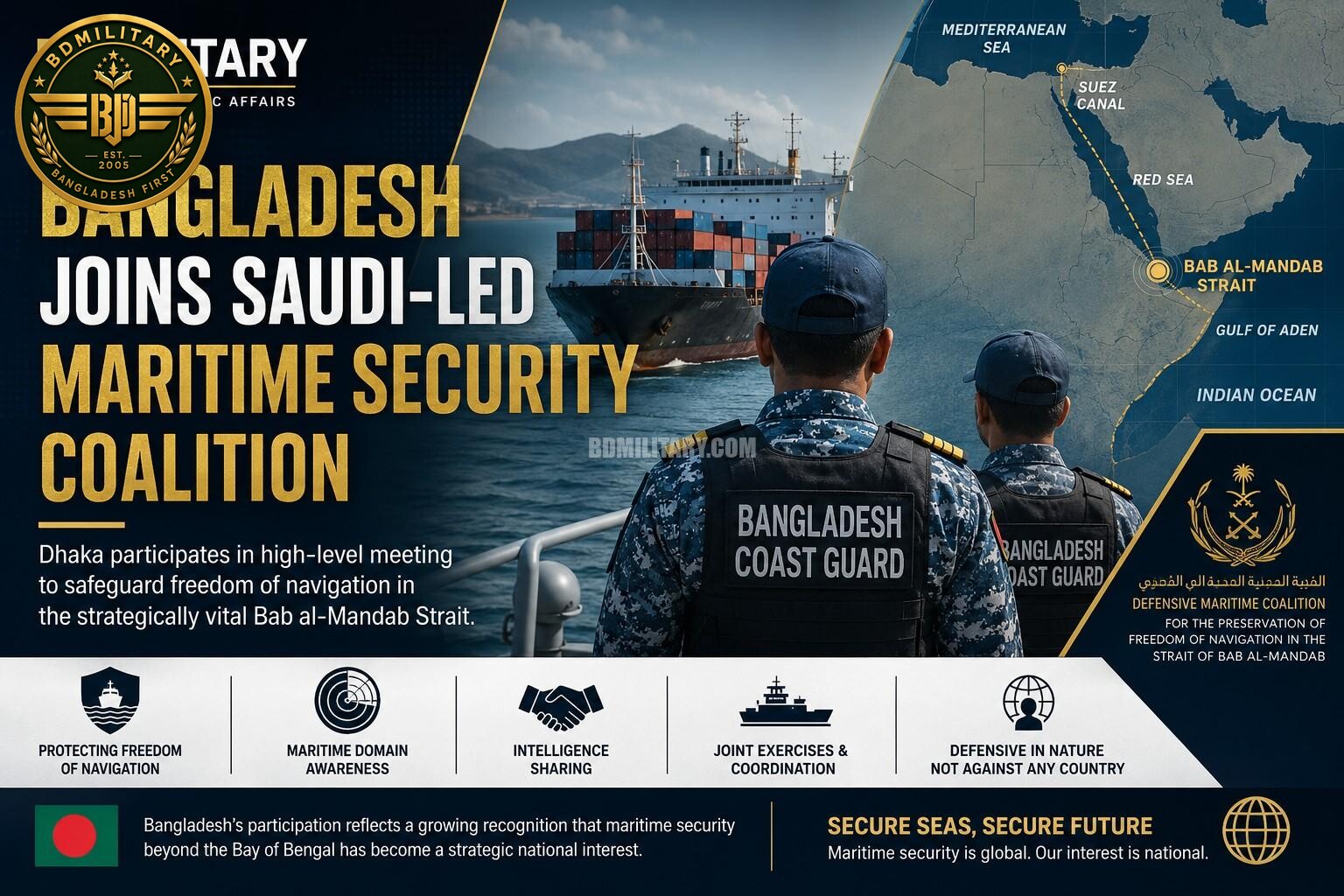
Dhaka’s participation reflects a growing recognition that maritime security beyond the Bay of Bengal has become a strategic national interest.
Bangladesh has taken a significant step in expanding its international maritime security engagement after approving the participation of a senior Armed Forces Division (AFD) delegation in the inaugural high-level meeting of the Defensive Maritime Coalition for the Preservation of Freedom of Navigation in the Strait of Bab al-Mandab, hosted by the Kingdom of Saudi Arabia.
The decision highlights Bangladesh’s increasing appreciation that security developments in the Red Sea directly affect its national economy, maritime trade and wider strategic interests. As an export-driven nation dependent upon uninterrupted sea lines of communication, Bangladesh has a vested interest in ensuring the stability of one of the world’s most critical maritime chokepoints.
According to an official approval issued by the Armed Forces Division on 28 July, Rear Admiral Mohammad Munibur Rahman, Director General of the Bangladesh Coast Guard, is leading the Bangladeshi delegation. He is accompanied by Commander Mohammad Hasin Reza, Director of Operations at Coast Guard Headquarters.
The delegation is attending the coalition meeting in Saudi Arabia from 29 July to 1 August, with the official visit extending until 3 August, including travel time.
The invitation was extended by the Royal Saudi Naval Forces through the Saudi Embassy in Dhaka and the Saudi Ministry of Defence.
Protecting One of the World’s Most Critical Maritime Chokepoints
The newly established coalition seeks to enhance multinational cooperation in safeguarding freedom of navigation through the Bab al-Mandab Strait, the narrow maritime corridor linking the Red Sea with the Gulf of Aden and the wider Indian Ocean.
The strait serves as the southern gateway to the Suez Canal, connecting Europe and Asia via one of the busiest commercial shipping routes in the world. It is estimated that around 10 to 12 per cent of global seaborne trade and a substantial proportion of international oil and liquefied natural gas shipments transit the waterway annually.
For Bangladesh, the significance of the Bab al-Mandab extends far beyond regional geopolitics.
Nearly all Bangladeshi exports destined for European markets—including ready-made garments, pharmaceuticals and manufactured goods—transit the Indian Ocean, Red Sea and Suez Canal before reaching Europe. Any disruption along this route increases freight costs, insurance premiums and delivery times, reducing the competitiveness of Bangladesh’s export sector.
The recent escalation of attacks against commercial vessels operating in the Red Sea has demonstrated how instability thousands of kilometres away can have immediate economic consequences for Bangladesh.
Numerous shipping companies have been forced to reroute vessels around the Cape of Good Hope, adding approximately two weeks to voyage times while significantly increasing fuel consumption and transportation costs.
A Defensive Maritime Coalition
Saudi Arabia has emphasised that the coalition is purely defensive and is not directed against any specific country.
Instead, the initiative seeks to strengthen regional maritime security through closer cooperation in:
- Maritime domain awareness
- Intelligence and information sharing
- Coordinated defensive maritime operations
- Joint naval and coast guard exercises
- Protection of commercial shipping
- Search and rescue cooperation
- Maritime law enforcement
- Capacity building among participating members
Unlike offensive military alliances, the coalition is designed to improve collective situational awareness and coordinate responses to threats affecting international shipping.
Coalition Membership
The founding coalition consists of thirteen participating countries:
- Saudi Arabia (Founding Member)
- Bangladesh
- Turkey
- Pakistan
- Egypt
- Jordan
- Kuwait
- Bahrain
- Qatar
- Djibouti
- Somalia
- Sudan
- Comoros
Yemen also participates in the initiative, while the European Union attended the inaugural meeting as an observer.
Notably, the United Arab Emirates and Oman have not joined the coalition at this stage.
Saudi Arabia will host the coalition headquarters and has indicated that membership will remain open to additional states following completion of their respective domestic approval procedures.
Why Bangladesh Matters
Although Bangladesh lies outside the Red Sea region, its participation should not be viewed as symbolic.
Bangladesh possesses one of South Asia’s largest merchant shipping sectors and continues to modernise both the Bangladesh Navy and Bangladesh Coast Guard. The country has also earned an international reputation through decades of participation in United Nations peacekeeping operations and multinational humanitarian missions.
Participation in the coalition provides Bangladesh with opportunities to expand professional cooperation with regional maritime security organisations while gaining greater exposure to modern maritime operational concepts.
Potential areas of future cooperation include:
- Maritime surveillance systems
- Automatic Identification System (AIS) integration
- Maritime intelligence fusion
- Counter-piracy operations
- Search and rescue coordination
- Maritime law enforcement
- Joint exercises
- Professional military education
- Coast Guard interoperability
Such engagement complements Bangladesh’s broader objective of strengthening maritime governance under its Blue Economy strategy.
Growing Bangladesh–Saudi Defence Relations
The latest visit also reflects steadily expanding defence engagement between Bangladesh and Saudi Arabia.
Only weeks earlier, Major General Kaisar Rashid Chowdhury, Director General of the Directorate General of Forces Intelligence (DGFI), conducted an official visit to Saudi Arabia.
Although the government has not formally linked the two visits, together they indicate increasingly active military-to-military engagement between Dhaka and Riyadh.
In recent years, bilateral defence cooperation has expanded through:
- High-level military exchanges
- Defence diplomacy
- Professional military education
- Security dialogue
- Intelligence cooperation
- Counter-terrorism engagement
- Maritime security collaboration
The latest coalition meeting broadens this cooperation into the maritime domain.
Distinct from Existing Maritime Coalitions
The Saudi-led initiative differs from several existing multinational maritime security frameworks operating in the region.
Unlike the Combined Maritime Forces (CMF) headquartered in Bahrain, the United States-led Operation Prosperity Guardian, or the European Union’s Operation ASPIDES, the new coalition places greater emphasis on regional ownership while focusing specifically on defensive cooperation among participating states.
Its primary objectives are to improve coordination, intelligence sharing and maritime security without creating an offensive military alliance.
For Bangladesh, participation does not imply involvement in combat operations. Rather, it represents engagement in cooperative maritime security mechanisms designed to protect international commerce and freedom of navigation.
Strategic Significance for Bangladesh
Bangladesh has traditionally maintained a balanced foreign policy centred on strategic autonomy and constructive engagement with all major powers.
Participation in the Saudi-led maritime coalition is consistent with that approach.
Rather than signalling alignment with any geopolitical bloc, Dhaka’s participation reflects a pragmatic recognition that global maritime security and Bangladesh’s national prosperity are increasingly interconnected.
The initiative also supports Bangladesh’s wider maritime ambitions.
The country has invested heavily in developing its Blue Economy, modernising the Bangladesh Coast Guard and expanding the capabilities of the Bangladesh Navy. As Bangladesh’s maritime interests continue to grow beyond the Bay of Bengal, participation in multinational maritime security initiatives offers valuable opportunities to enhance operational expertise, improve maritime domain awareness and strengthen defence diplomacy.
Assessment
Bangladesh’s decision to participate in the Saudi-led Defensive Maritime Coalition represents an important evolution in the country’s maritime security outlook.
While Bangladesh is unlikely to assume a frontline operational role in Red Sea security, its participation demonstrates an appreciation that safeguarding international sea lines of communication is essential to protecting national economic interests. For an export-oriented economy dependent upon uninterrupted maritime trade, instability in distant chokepoints such as the Bab al-Mandab Strait can have direct consequences for freight costs, supply chains and energy security.
Equally significant is the diplomatic dimension. The visit reflects strengthening defence ties with Saudi Arabia and reinforces Bangladesh’s commitment to constructive security cooperation with regional and international partners. It also provides the Bangladesh Coast Guard with opportunities to develop professional relationships, improve interoperability and gain exposure to contemporary maritime security practices.
As geopolitical competition intensifies across the Indian Ocean, Red Sea and wider Indo-Pacific, Bangladesh appears increasingly willing to participate in cooperative initiatives that enhance maritime stability without compromising its long-standing policy of strategic balance.
The decision therefore represents not only a diplomatic engagement but also a measured investment in Bangladesh’s long-term maritime security and economic resilience.
References
- Armed Forces Division, Government of Bangladesh. Official approval for the Bangladesh delegation to participate in the Defensive Maritime Coalition for the Preservation of Freedom of Navigation in the Strait of Bab al-Mandab, 28 July 2026.
- Saudi Ministry of Defence. Statement on the Defensive Maritime Coalition for the Preservation of Freedom of Navigation in the Strait of Bab al-Mandab, 2026.
- Gulf News. Saudi Arabia launches 13-country maritime security alliance to protect Red Sea shipping, 2026.
- International Energy Agency (IEA). World Oil Transit Chokepoints.
- United Nations Conference on Trade and Development (UNCTAD). Review of Maritime Transport.

Khaled Ahmed is a seasoned former intelligence analyst and military expert from the Netherlands, bringing over 15 years of specialised experience in operational intelligence, threat analysis, and strategic defence planning. Having served in high-level, classified roles within Dutch military intelligence, he possesses rare expertise in European security architecture, NATO doctrine, and asymmetric warfare. Khaled’s deep operational insight and international perspective enable him to deliver precision-driven intelligence analysis and forward-looking strategic forecasts. A trusted contributor to high-level risk assessments and security briefings, he offers readers clarity on complex defence and security challenges. Khaled leads the National Security and Fact Analysis sections at BDMilitary. He holds a Master’s degree in International Relations from the University of Groningen, The Netherlands, and is fluent in Dutch, French, and Arabic — combining linguistic dexterity with operational expertise to analyse security issues across cultures and regions.