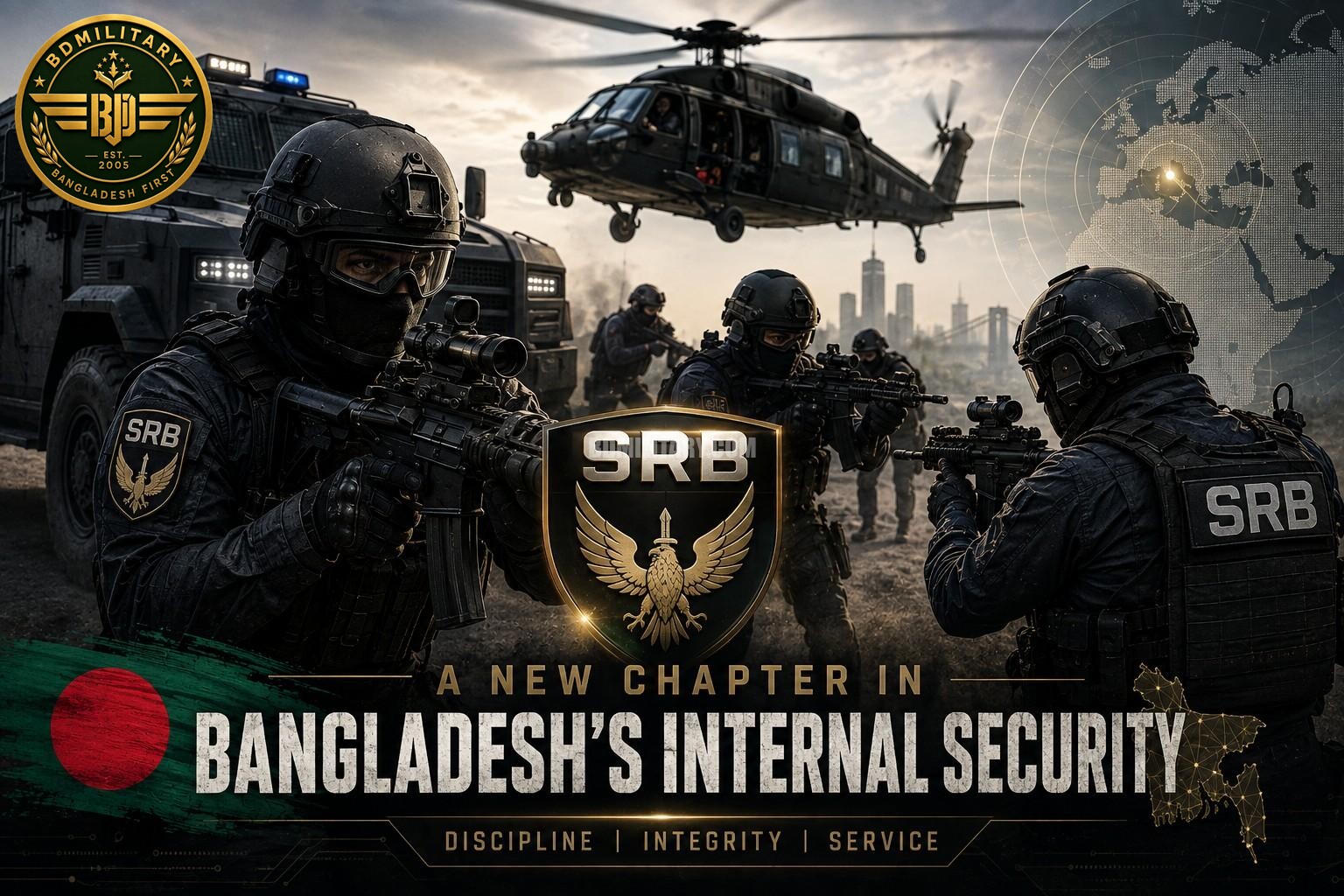
The Government of Bangladesh has initiated a major restructuring of its internal security apparatus, moving to dissolve the Rapid Action Battalion (RAB) and replace it with a new formation, the Special Response Battalion (SRB), under draft legislation released for public consultation by the Ministry of Home Affairs.
The proposed Special Response Battalion (SRB) Act, 2026 establishes a comprehensive legal and operational framework for the new unit, which will function as a specialised formation within the Bangladesh Police. The reform represents a significant shift in the country’s approach to internal security, combining continuity of capability with a revised institutional structure and enhanced legal oversight.
Legislative Process And Transition
Officials indicate that the draft legislation will be circulated among relevant ministries and divisions before submission to the Cabinet. Subject to approval, it is expected to be placed before Parliament for enactment.
Upon entry into force, the law will repeal the existing legal framework governing RAB. All assets, personnel, liabilities, ongoing cases and agreements will be transferred to the SRB in order to ensure continuity of operations. Interim regulations will remain in effect until a new regulatory framework is formally established.
Structure And Organisation
Under the draft framework, the SRB will be headed by a Director General holding the rank of Additional Inspector General of Police. The headquarters will be located in Dhaka, with authority granted to establish units nationwide based on operational requirements.
The force will adopt a modular structure designed to support scalable deployment across multiple operational environments. It is expected to comprise battalion-level formations supported by subordinate units, enabling flexibility in both urban and rural operations.
Provision is also made for personnel from other law enforcement agencies to serve on deputation for a minimum period of two years. This approach is intended to preserve the multi-agency character of the existing force while improving integration and professional standardisation.
Although official figures have not been disclosed, the transfer of RAB’s existing manpower suggests that the SRB will initially field several thousand personnel, maintaining a nationwide rapid-response footprint.
Operational Mandate
The SRB is designed as a multi-role internal security force with a broad mandate encompassing counter-terrorism, organised crime suppression and intelligence-led operations. Its responsibilities will include the recovery of illegal arms and explosives, anti-narcotics enforcement, and the investigation of cybercrime and human trafficking networks.
The unit will also provide operational support to other law enforcement agencies where required, reflecting its role as a specialised intervention force within the national security framework.
Under the proposed legislation, the SRB will be authorised to initiate and investigate cases on the direction of courts, the government or the Inspector General of Police. Its personnel will retain powers of arrest, search and seizure in accordance with the Code of Criminal Procedure.
Dedicated infrastructure, including detention facilities, interrogation rooms and evidence storage systems, will be established to support operational requirements and ensure procedural compliance.
Accountability And Oversight
A central feature of the proposed reform is the introduction of a structured accountability mechanism intended to strengthen oversight and institutional legitimacy.
The draft law provides for the establishment of an independent complaints redress committee empowered to investigate allegations against SRB personnel. The committee will include representatives from the Ministry of Home Affairs, Police Headquarters and internal SRB branches, alongside a government-nominated member with at least ten years’ experience in human rights, law or judicial administration.
The committee will have the authority to initiate inquiries, constitute investigation teams and recommend disciplinary or legal action where necessary. In parallel, the legislation outlines formal disciplinary provisions addressing misconduct, including abuse of authority, corruption, negligence and misuse of government equipment.
Doctrinal Shift And Training Model
Officials indicate that SRB personnel will undergo retraining aligned with European gendarmerie models, particularly those of France and Turkey. This approach combines military-grade discipline with civilian law enforcement authority, reflecting a hybrid model designed to operate across both policing and high-intensity internal security roles.
The adoption of this framework emphasises centralised command structures, intelligence-led operations, rapid deployment capability and codified legal oversight. It represents a deliberate move towards a more professionalised and standardised internal security force aligned with international best practice.
Analysis
The transition from RAB to SRB represents a substantive institutional recalibration rather than a nominal rebranding. While RAB, established in 2004, operated as a hybrid force drawing personnel from multiple services, the SRB introduces a clearer statutory basis, a more formalised command hierarchy and enhanced oversight mechanisms under the Bangladesh Police.
The incorporation of a gendarmerie-style model aligns Bangladesh with a number of international internal security frameworks, where paramilitary-capable forces operate under civilian authority. Comparable structures can be observed in specialised counter-terrorism and internal security units in South Asia and Europe, where rapid-response capability is combined with defined legal mandates.
From an operational perspective, the reform is likely to preserve much of RAB’s capability while improving coordination and accountability. The formalisation of oversight mechanisms may also contribute to greater institutional credibility.
However, several risks remain. The effectiveness of the reform will depend on the depth and consistency of retraining programmes, the operational independence of oversight mechanisms and the extent to which organisational culture evolves beyond legacy practices. Maintaining operational continuity during the transition phase will also be critical to avoiding capability gaps.
Outlook
If enacted, the SRB will constitute one of the most significant reforms of Bangladesh’s internal security forces in over two decades.
In the near term, the transition is expected to proceed in phases, with existing personnel and infrastructure forming the foundation of the new force. Over the longer term, the success of the SRB will depend on the institutionalisation of accountability mechanisms, doctrinal adaptation and sustained investment in training and capability development.
References
Ministry of Home Affairs (Bangladesh), Draft Special Response Battalion (SRB) Act, 2026, Dhaka, 2026
The Business Standard, “RAB to be dissolved, new Special Response Battalion planned”, 2026
Government of Bangladesh, official briefings on internal security reform, 2026

Khaled Ahmed is a seasoned former intelligence analyst and military expert from the Netherlands, bringing over 15 years of specialised experience in operational intelligence, threat analysis, and strategic defence planning. Having served in high-level, classified roles within Dutch military intelligence, he possesses rare expertise in European security architecture, NATO doctrine, and asymmetric warfare. Khaled’s deep operational insight and international perspective enable him to deliver precision-driven intelligence analysis and forward-looking strategic forecasts. A trusted contributor to high-level risk assessments and security briefings, he offers readers clarity on complex defence and security challenges. Khaled leads the National Security and Fact Analysis sections at BDMilitary. He holds a Master’s degree in International Relations from the University of Groningen, The Netherlands, and is fluent in Dutch, French, and Arabic — combining linguistic dexterity with operational expertise to analyse security issues across cultures and regions.