
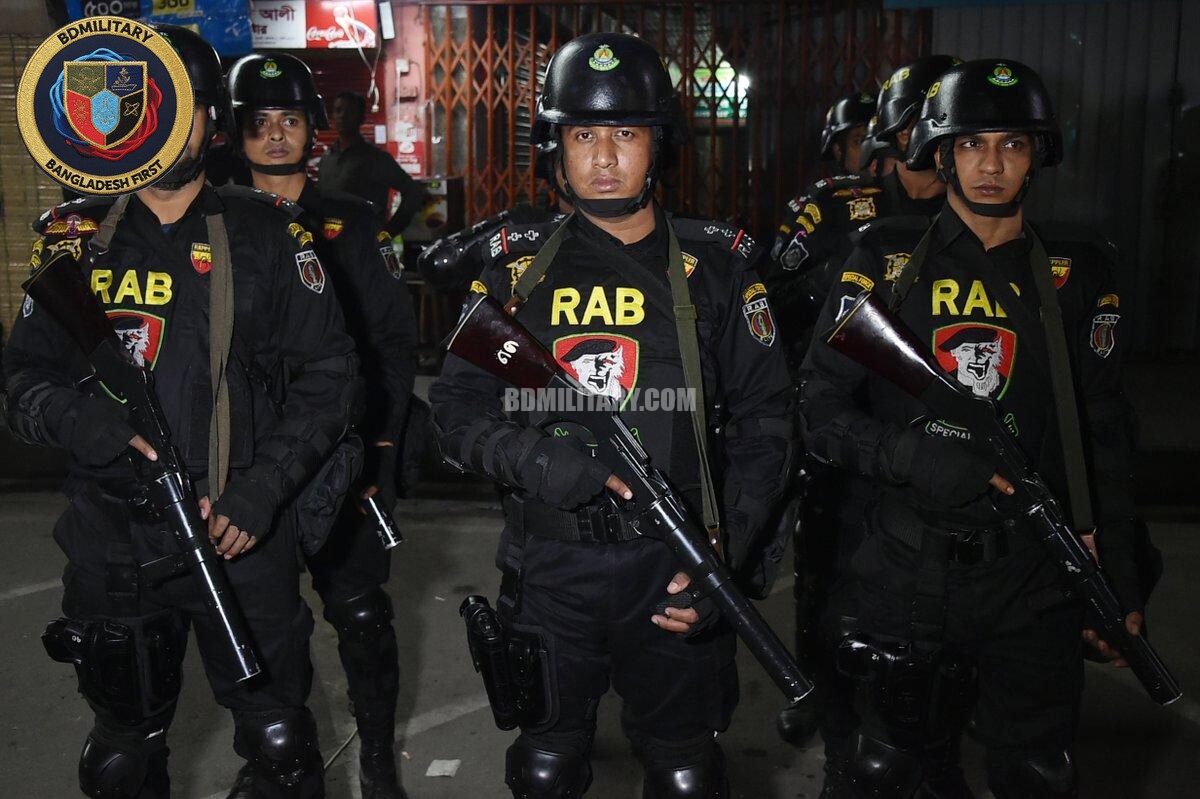
The government is preparing to dissolve the Rapid Action Battalion (RAB) and establish a new specialised force under a separate legal framework, according to a draft law currently being finalised by the Ministry of Home Affairs.
Under the proposed legislation, the new organisation will inherit RAB’s personnel, assets and ongoing operations, ensuring continuity in its operational responsibilities while introducing a revised structure intended to strengthen accountability and oversight.
Although the final name has yet to be decided, two options currently under consideration are Special Response Battalion (SRB) and People’s Protection Forces (PPF). Earlier reports had indicated that the name Special Intervention Force (SIF) was also being considered, and officials say the designation could still change before the law receives final approval.
Transition Plan
According to the draft legislation, RAB will formally cease to exist once the new law comes into force. However, the transition is designed to preserve the force’s operational capabilities through the complete transfer of its existing structure.
Key provisions of the proposal include:
- Transfer of all movable and immovable assets, including vehicles, weapons, equipment and financial resources, to the new organisation.
- Automatic integration of all RAB officers, personnel and employees into the successor force.
- Retention of existing salaries, benefits and service conditions.
- Continuation of ongoing investigations, duties, contracts and operational responsibilities.
- Preservation of current administrative regulations until new rules are introduced.
The draft preamble states that the objective is to enhance internal security and maintain law and order through a specialised auxiliary force operating under Bangladesh Police, replacing RAB, which was originally established under the Armed Police Battalion Ordinance of 1979.
Officials involved in the process have indicated that the reforms are intended to provide a clearer legal framework and stronger mechanisms for accountability.
Proposed Responsibilities
The new formation is expected to continue functioning as an elite law enforcement unit, with responsibilities largely mirroring those currently performed by RAB.
Its anticipated duties include:
- Preventing drug trafficking and recovering narcotics.
- Seizing illegal firearms and explosives.
- Combating terrorism and violent extremism.
- Assisting other law enforcement agencies.
- Conducting investigations when directed by the courts or the government.
- Undertaking special operations.
Members of the force would retain powers to enter premises, conduct searches, detain suspects and make arrests. However, the draft legislation stipulates that local police stations must be notified promptly following arrests or seizures, accompanied by written reports.
Background and Controversy
Established in 2004 during the BNP-led government, the Rapid Action Battalion quickly became one of Bangladesh’s most prominent security organisations, earning recognition for operations targeting organised crime and militant networks.
Over the years, however, the force has faced persistent allegations of enforced disappearances, extrajudicial killings and so-called “crossfire” deaths, attracting criticism from domestic and international human rights organisations.
Among the most notable cases was the Narayanganj seven-murder incident of April 2014, in which investigators concluded that 11 RAB personnel, including then RAB-11 commander Lt Col Tareque Sayeed, were involved after allegedly accepting bribes.
According to the Commission of Inquiry on Enforced Disappearances, whose report was published on 5 January 2026, approximately one-quarter of documented disappearance cases involved RAB. The commission also identified 40 alleged secret detention facilities across the country, with 22 to 23 reportedly linked to the force.
Data from the Police Special Branch further showed that between 2015 and 2021, 1,293 people were killed in 1,007 alleged crossfire incidents. Police were involved in 651 cases, while RAB was involved in 293, with the remainder occurring during joint operations involving multiple agencies.
Human Rights Watch and other rights organisations have repeatedly called for either major reforms or the abolition of the force. In 2021, the United States imposed sanctions on seven current and former RAB officials over alleged human rights violations.
Following the July mass uprising, the Commission of Inquiry on Enforced Disappearances formally recommended the dissolution of RAB, a recommendation that has since been incorporated into the government’s broader legal reform efforts.
Government Seeks Greater Accountability
Officials have emphasised that the initiative is intended to be more than a simple rebranding exercise. The proposed legislation includes provisions aimed at improving transparency, internal discipline and oversight mechanisms while establishing a more rights-sensitive specialised unit.
The draft also specifies that personnel accused of misconduct will remain subject to prosecution under the laws governing their respective parent services.
The legislation is currently undergoing final review at the Ministry of Home Affairs. Once approved by the Cabinet, it will proceed through legal vetting and parliamentary procedures. Upon enactment, the Rapid Action Battalion will be formally dissolved and replaced by the new force.
While the name of the organisation remains undecided, the proposed reforms represent one of the most significant restructurings of Bangladesh’s internal security architecture since the creation of RAB more than two decades ago.

Khaled Ahmed is a seasoned former intelligence analyst and military expert from the Netherlands, bringing over 15 years of specialised experience in operational intelligence, threat analysis, and strategic defence planning. Having served in high-level, classified roles within Dutch military intelligence, he possesses rare expertise in European security architecture, NATO doctrine, and asymmetric warfare. Khaled’s deep operational insight and international perspective enable him to deliver precision-driven intelligence analysis and forward-looking strategic forecasts. A trusted contributor to high-level risk assessments and security briefings, he offers readers clarity on complex defence and security challenges. Khaled leads the National Security and Fact Analysis sections at BDMilitary. He holds a Master’s degree in International Relations from the University of Groningen, The Netherlands, and is fluent in Dutch, French, and Arabic — combining linguistic dexterity with operational expertise to analyse security issues across cultures and regions.