Fleet Renewal, Maritime Surveillance, Offshore Capability And Indigenous Maintenance Infrastructure Are Reshaping Bangladesh’s Maritime Security Force
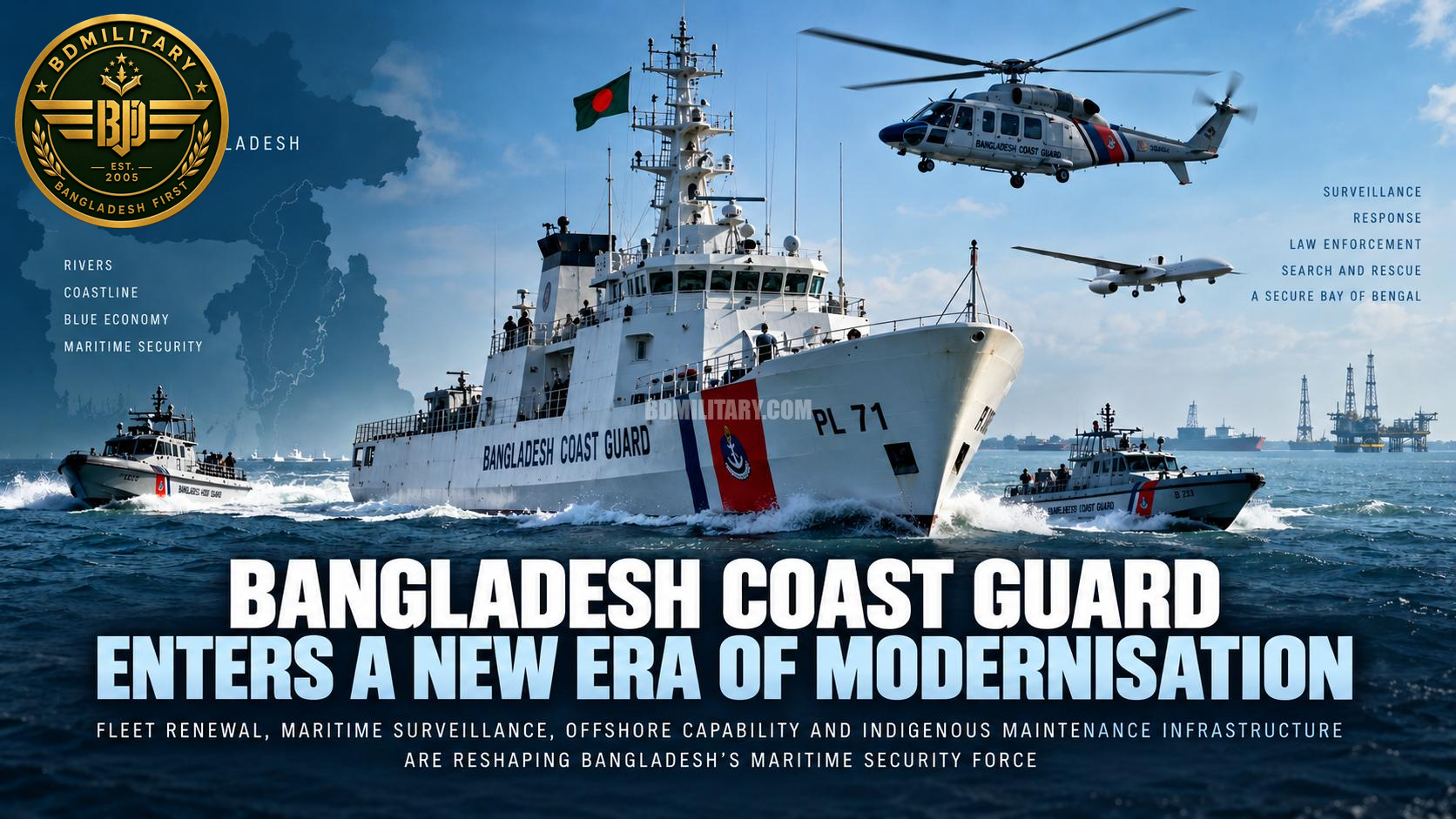
Bangladesh Coast Guard is entering a major modernisation cycle that extends well beyond the replacement of ageing patrol vessels. During 2026–27, the force is progressing a multi-year programme covering nine replacement patrol vessels, additional high-speed craft, JICA-supported offshore vessels, unmanned surveillance, a national coastal surveillance system and substantial investment in fleet-maintenance infrastructure. The government is also pursuing a major increase in Coast Guard manpower and has identified maritime helicopters as a future capability requirement.
The modernisation is significant because these programmes are beginning to form an integrated maritime-security architecture. New vessels will expand physical presence across Bangladesh’s rivers, coastline and offshore waters, while UAVs and coastal surveillance infrastructure can provide greater maritime-domain awareness. At the same time, investment in Gazaria and other maintenance facilities should improve fleet availability and reduce dependence on external repair capacity.
The principal remaining gap is maritime aviation, where helicopters remain planned rather than contracted. If the current programmes are implemented broadly as scheduled and the resulting assets are effectively integrated through communications, command-and-control, training and maintenance, Bangladesh Coast Guard could emerge by the end of the decade as a substantially more capable and persistent maritime-security force.
Replacing The Riverine And Coastal Fleet
At the centre of the modernisation programme is the replacement of nine patrol vessels comprising five Riverine Patrol Vessels and four Coastal Patrol Vessels.
The Riverine Patrol Vessel component has already reached the contract stage. Bangladesh Coast Guard signed a contract in June 2026 for five RPVs at a value of approximately Tk1,211.95 crore. Completion is scheduled for February 2029.
The remaining four Coastal Patrol Vessels have subsequently entered competitive procurement. A tender issued in August 2026 seeks the construction and delivery of four CPVs, with completion expected within approximately 36 months of contract signature. The procurement documentation requires prospective shipbuilders to demonstrate substantial experience in the construction and delivery of patrol or combat vessels.
The nine-vessel programme is therefore no longer merely an aspirational replacement requirement. Five vessels have entered the contractual stage, while the remaining four have reached competitive tendering.
The significance of the programme extends beyond the nine hulls themselves. Bangladesh Coast Guard operates in an unusually complex maritime environment, where riverine security, coastal patrol, fisheries protection, anti-smuggling operations, search and rescue and offshore security all fall within the same organisation’s responsibilities.
The replacement programme should provide the foundation for a more sustainable division of responsibilities between riverine and coastal units while releasing larger vessels to concentrate on missions further offshore.
Expansion Of High-Speed Response Capability
The Coast Guard is also increasing its ability to respond rapidly to incidents.
In February 2026, a contract was signed for two large high-speed boats to be constructed by Khulna Shipyard at a reported cost of Tk89.50 crore. Delivery is scheduled for April 2028.
A separate development project provides for five additional large high-speed boats, with an estimated project cost of Tk642.30 crore and an implementation period running from July 2025 until June 2028.
The Coast Guard has also initiated procurement of bulletproof high-speed boats. Details concerning their final number, configuration and cost have not been publicly disclosed, but the requirement suggests an increasing emphasis on protected interception capability for higher-risk maritime law-enforcement operations.
Fast craft occupy an important niche within the Coast Guard fleet. They can respond much more quickly than larger patrol vessels and are particularly useful for interception, boarding, anti-smuggling operations, fisheries enforcement and rapid response to incidents close to the coastline and within riverine areas.
Their value will increase as the Coast Guard develops a more comprehensive surveillance network. Detecting a suspicious vessel is only useful if an enforcement unit can reach it quickly enough to act.
Building An Offshore Capability
The modernisation programme is simultaneously extending the Coast Guard’s ability to operate offshore.
Two Offshore Patrol Vessels and one Multi-Role Response Vessel are being constructed under a JICA-supported programme.
The OPVs are expected to provide substantially greater endurance and offshore patrol capability than the Coast Guard’s smaller coastal vessels. Their eventual role is likely to include maritime security patrols, surveillance, law enforcement and search-and-rescue operations in the wider Bay of Bengal.
The MRRV is intended to provide a broader response capability, including search and rescue, disaster response and other maritime emergency missions.
For Bangladesh, this is particularly important because the country’s maritime interests extend well beyond the immediate coastline. The Bay of Bengal is increasingly important to Bangladesh’s trade, fisheries, energy interests and maritime economy, while the country’s large maritime jurisdiction requires persistent surveillance and a credible state presence.
A Coast Guard that can remain offshore for extended periods provides a different level of maritime presence from one primarily dependent on short-duration coastal patrols.
From Patrol Force To Maritime Security Force
The most important feature of the current programme is the way the individual acquisitions complement one another.
The emerging force structure places different platforms at different points along the maritime-security spectrum. OPVs provide endurance and offshore presence. CPVs are suited to coastal operations. RPVs provide a more specialised riverine capability. Fast boats provide rapid interception, while hovercraft can operate in particularly shallow or difficult areas.
This creates the basis for a layered maritime-security force rather than a fleet in which every vessel is expected to perform the same task.
The distinction is important for Bangladesh. The country possesses one of the world’s largest and most complicated river networks, a heavily populated coastline, extensive estuarine areas and a maritime domain extending into the Bay of Bengal.
No single class of vessel can efficiently cover all of these environments.
The modernisation programme is therefore moving towards specialisation while simultaneously increasing the Coast Guard’s overall reach.
Hovercraft For Bangladesh’s Shallow Waters
Another noteworthy element of the modernisation programme is the planned acquisition of two hovercraft.
The hovercraft are part of a wider Tk1,090.49 crore project that also includes one Inshore Patrol Vessel and one Fast Patrol Boat. The project is scheduled for implementation between July 2025 and June 2029.
Hovercraft could provide particular value in Bangladesh because of the country’s extensive network of shallow rivers, tidal channels, mudflats, chars and coastal islands.
Conventional patrol vessels cannot operate efficiently in every part of this environment. A hovercraft capability would give the Coast Guard greater flexibility in shallow and difficult terrain, particularly for rapid response, surveillance, rescue and law-enforcement missions.
Surveillance Is Becoming Central To The Force
Perhaps the most important qualitative change in the Coast Guard’s modernisation programme is the growing emphasis on maritime surveillance.
Government statements confirm that three maritime surveillance drones equipped with ground-control equipment have been inducted into Coast Guard service.
Earlier reporting also referred to 12 surveillance UAVs donated by the Australian Border Force. The two figures should not be combined without further confirmation from the Coast Guard because publicly available information does not establish whether they represent separate acquisitions, different reporting periods or different classifications of the UAV fleet.
Regardless of the precise inventory, the introduction of UAVs represents a significant change in how the Coast Guard can conduct surveillance.
A patrol vessel is constrained by its location, endurance and line of sight. An unmanned aircraft can provide commanders with an aerial view of a much larger area and can be redirected rapidly towards suspicious activity or an emerging incident.
This capability becomes considerably more valuable when combined with a wider maritime surveillance network.
National Coastal Surveillance System
Bangladesh is developing a dedicated Coastal Surveillance System for the Coast Guard under a project valued at approximately Tk300 crore.
The project has an implementation period extending from July 2025 to June 2028.
The system has the potential to become one of the most important elements of the Coast Guard’s future command and surveillance architecture. Instead of relying primarily on individual ships and shore stations to identify maritime activity, a networked surveillance system could provide a more persistent picture of vessel movements along Bangladesh’s coastline.
The strategic value lies in the integration of surveillance rather than in any individual sensor.
A coastal sensor can detect a vessel. A UAV can investigate it. A command centre can correlate the information with other maritime data. A patrol vessel can then be directed towards the contact.
If these components are successfully integrated, the Coast Guard could move from predominantly patrol-based detection towards a more persistent maritime-domain-awareness model.
This would be a qualitative improvement in operational effectiveness.
Maritime Aviation Remains The Missing Component
The Coast Guard has also identified maritime helicopters as a future requirement.
Government statements during 2026 confirmed that Bangladesh intends to introduce helicopters into the Coast Guard’s capabilities. Earlier planning had referred to two maritime helicopters, although no current contract, aircraft type or final quantity has been publicly verified.
The helicopter programme should therefore be regarded as planned rather than an acquisition already under contract.
If implemented, however, maritime aviation would significantly strengthen the Coast Guard’s ability to monitor distant areas of the Bay of Bengal and respond rapidly to incidents.
Helicopters would also complement the emerging UAV fleet. While UAVs are well suited to persistent surveillance, a manned helicopter provides greater flexibility for search and rescue, medical evacuation, rapid deployment of personnel and direct support to maritime law-enforcement operations.
The absence of an established organic helicopter capability remains one of the principal gaps in the Coast Guard’s emerging force structure.
Infrastructure May Prove As Important As The Ships
One of the least visible but potentially most consequential elements of the modernisation programme is the investment in maintenance and logistics infrastructure.
The government has placed substantial emphasis on the development of Coast Guard fleet-support and maintenance facilities, including the major infrastructure programme associated with Gazaria.
The latest reported estimate for the wider logistics and fleet-maintenance programme is approximately Tk7,576.22 crore.
The scale of the programme is already becoming evident through individual procurement contracts. During 2026, Coast Guard-related procurement included a slipway portal crane valued at Tk34.99 crore, a 15-ton overhead crane valued at Tk8.61 crore, machine-workshop equipment and specialised equipment for hull and engineering workshops.
These purchases may appear less significant than the acquisition of new ships, but they are essential to the long-term sustainability of the fleet.
A larger fleet is only useful if sufficient numbers of vessels can remain operational. Maintenance delays, limited repair capacity and dependence on external facilities can significantly reduce availability.
The development of domestic maintenance and repair infrastructure could therefore allow Bangladesh to keep more vessels at sea while reducing turnaround times and dependence on external shipyards.
Gazaria is consequently important not simply as a construction or engineering project, but as part of the Coast Guard’s attempt to develop a more self-sufficient fleet-support system.
Manpower Expansion Accompanies The Hardware Programme
The government is also seeking to expand Coast Guard manpower from approximately 5,000 personnel towards a target of around 10,000.
Such an expansion is necessary if the planned equipment is to translate into meaningful operational capacity.
Every additional patrol vessel requires trained crews and engineers. A growing UAV fleet requires operators and intelligence personnel. A coastal surveillance network requires communications specialists, analysts and command-and-control personnel. Maritime aviation would create additional requirements for pilots, aircrew and aviation technicians.
The Coast Guard is consequently developing accommodation and supporting infrastructure alongside its equipment programmes.
A project for personnel accommodation at Gazaria has been estimated at Tk955.67 crore, while a separate project involving land and accommodation in the Dhaka region has an estimated value of Tk645.02 crore.
The manpower programme therefore forms an integral part of the wider force-expansion effort.
The Financial Scale Of Modernisation
The Coast Guard’s annual budget should not be confused with the value of its multi-year development programmes.
For FY2026–27, the organisation has approximately Tk1,125 crore available, including Tk406 crore for development expenditure. The larger project figures represent programmes extending across several financial years.
| Programme | Reported Value | Principal Capability |
|---|---|---|
| Replacement Vessels | Tk23,148.29 crore | Nine-vessel fleet renewal |
| Logistics And Fleet Maintenance | Tk7,576.22 crore | Dockyard and sustainment |
| Five RPVs | Tk1,211.95 crore | Riverine patrol |
| Five Large High-Speed Boats | Tk642.30 crore | Rapid response |
| Coastal Surveillance System | Tk300 crore | Maritime-domain awareness |
| IPV, FPB And Two Hovercraft | Tk1,090.49 crore | Coastal and shallow-water operations |
| FY2026–27 Coast Guard Allocation | Tk1,125 crore | Annual operating and development budget |
The figures demonstrate why the modernisation should be viewed over a multi-year horizon. The annual budget provides the funding mechanism, but the force is being reshaped through a portfolio of projects whose implementation extends well beyond FY2026–27.
The 2029 Coast Guard
If the current procurement and infrastructure programmes proceed broadly according to schedule, Bangladesh Coast Guard should enter the end of the decade with a substantially different force structure.
The five contracted RPVs should be approaching completion, while the four CPVs are expected to follow within the wider replacement programme. The JICA-supported OPVs and MRRV should provide greater offshore endurance and response capability, while additional high-speed craft should strengthen rapid interception.
The coastal surveillance system should also be approaching operational maturity, providing a foundation for increasingly persistent maritime-domain awareness.
The development of Gazaria and associated maintenance infrastructure could prove equally important by providing the engineering capacity required to sustain the enlarged fleet.
The result would be a Coast Guard capable of distributing its forces more efficiently across Bangladesh’s rivers, coast and offshore maritime domain.
This should not be interpreted as a prediction that every planned programme will be delivered on schedule. Bangladesh’s defence and security procurement programmes have historically been subject to financing, tendering, industrial and implementation delays.
The 2029 outlook is therefore best regarded as a force-development trajectory rather than a guaranteed order of battle.
Remaining Capability Gaps
Despite the scale of the modernisation programme, several important gaps remain.
Maritime aviation is the clearest. Until helicopters are actually contracted and delivered, the Coast Guard will remain heavily dependent on surface vessels and UAVs for maritime surveillance and response.
Long-endurance surveillance is another area requiring attention. UAVs can substantially increase coverage, but their effectiveness depends on endurance, sensor quality, communications and the ability to operate in conjunction with surface and shore-based systems.
Command-and-control integration will also become increasingly important. A larger number of vessels and sensors will produce little additional value if information remains fragmented between platforms and headquarters.
The Coast Guard will therefore need to develop not merely more equipment, but the doctrine, communications architecture, training and technical personnel required to connect that equipment into a coherent operational system.
Finally, the enlarged fleet will require reliable lifecycle funding. The investment in Gazaria and maintenance infrastructure is encouraging, but sustaining a substantially larger fleet over decades will require recurring expenditure on engines, sensors, electronics, hull maintenance and training.
Strategic Significance
The modernisation has implications beyond conventional maritime law enforcement.
Bangladesh’s economic future is closely connected to the Bay of Bengal. Commercial shipping, fisheries, offshore resources, maritime trade routes and coastal infrastructure all depend upon a secure maritime environment.
A stronger Coast Guard gives the government an additional instrument for protecting these interests without relying exclusively on the Bangladesh Navy for routine maritime-security missions.
This distinction is important.
The Coast Guard is not intended to duplicate the Navy’s role. Instead, a stronger Coast Guard can assume a greater share of day-to-day maritime security, law enforcement, search and rescue and resource-protection responsibilities, allowing the Navy to concentrate more heavily on national defence and higher-end maritime security.
The result could be a more efficient division of responsibilities across Bangladesh’s maritime security architecture.
Assessment
Bangladesh Coast Guard’s 2026–27 modernisation programme represents a significant change in direction.
The programme is replacing ageing vessels while simultaneously expanding rapid-response capability, offshore endurance, maritime surveillance and domestic fleet-support infrastructure. The planned manpower expansion provides the personnel foundation required to operate the enlarged force.
Most importantly, the programmes are beginning to reinforce one another.
New patrol vessels increase physical presence. High-speed craft provide rapid response. UAVs extend surveillance coverage. The coastal surveillance system can provide persistent monitoring. Offshore vessels increase endurance. Maintenance infrastructure improves fleet availability. Additional personnel provide the human capacity to operate and sustain the system.
This is why the programme should not be viewed simply as a procurement of additional Coast Guard vessels.
It represents an attempt to establish a more persistent and integrated maritime-security capability spanning Bangladesh’s rivers, coastline and offshore waters.
The principal question now is whether implementation can keep pace with ambition.
If the major programmes are delivered broadly as planned, and if the Coast Guard succeeds in integrating its vessels, UAVs, surveillance infrastructure, communications, maintenance facilities and personnel into a coherent operating system, Bangladesh could enter the end of the decade with a Coast Guard qualitatively different from the force it operates today.
The eventual addition of maritime helicopters would strengthen that transformation further.
For Bangladesh, the strategic objective is therefore becoming increasingly clear: not simply a larger Coast Guard, but a more persistent, sustainable and technologically enabled maritime-security force capable of protecting the country’s interests from its rivers to the Bay of Bengal.

Amit Bhattacharya is a leading defence procurement expert with deep expertise in modern weapon systems and military hardware acquisition. Over more than a decade, he has collaborated with top defence contractors and strategic research institutions, delivering incisive analysis on procurement frameworks, capability development, and technology integration for armed forces worldwide. Amit bridges the gap between operational requirements and industrial capacity, providing authoritative evaluations of modernisation programmes, defence budgets, and acquisition reforms in both established and emerging defence markets. He leads the Defence Procurement and Defence Industry sections at BDMilitary, shaping strategic discourse on defence innovation. Amit earned his Master of Policy and Governance (MPAG) from the University of Canterbury, New Zealand, complementing his practical expertise with advanced policy and governance insight.