Dhaka is advancing towards the procurement of 20 J-10CE multirole combat aircraft from China under a proposed package valued at approximately US$2.302 billion, as the Bangladesh Air Force accelerates a broader modernisation programme aimed at strengthening the country’s air-defence and combat capabilities.
US$2.302 Billion Procurement Package
The proposed acquisition has entered the final stages of the inter-governmental approval process, according to Information and Broadcasting Adviser Zaheed Ur Rahman.
An 11-member inter-ministerial committee established to oversee the programme has prepared a draft agreement, which has been circulated to relevant ministries, including the Armed Forces Division, for approval.
The agreement is expected to be concluded with China National Aero-Technology Import & Export Corporation (CATIC) through a government-to-government arrangement during fiscal year 2026–27.
The reported total cost of the programme is approximately US$2.302 billion, equivalent to around BDT 283.14 billion (BDT 28,314 crore) at an exchange rate of BDT 123 to the US dollar.
While the reported baseline price of a J-10CE is approximately US$62.7 million per aircraft, the overall programme cost rises significantly once training, technical assistance, logistics, infrastructure, insurance, taxation and other support requirements are incorporated.
According to the figures provided by the authorities, the package includes:
- US$1.254 billion for 20 aircraft, based on the reported unit price;
- US$888 million for pilot and engineer training, technical assistance, operational equipment, logistics and freight;
- US$158 million for VAT, insurance and ancillary infrastructure;
- US$2.28 million for additional fuel tanks.
The resulting programme expenditure equates to an effective cost of approximately US$115 million per aircraft when the wider support and infrastructure package is included.
Force Structure And Financing
The procurement plan reportedly envisages 10 aircraft being incorporated directly into the Bangladesh Air Force’s Table of Organisation and Equipment (TO&E), with the remaining 10 aircraft positioned outside the formal TO&E structure.
Financing is expected to be supported through a special bulk allocation arranged by the Ministry of Finance, with expenditure spread over a ten-year period extending to fiscal year 2035–36.
The structure would allow Bangladesh to distribute the financial burden of the acquisition over a prolonged period while establishing the infrastructure, training and logistical capacity required to support the fleet.
J-10CE Selected For Multirole Capability
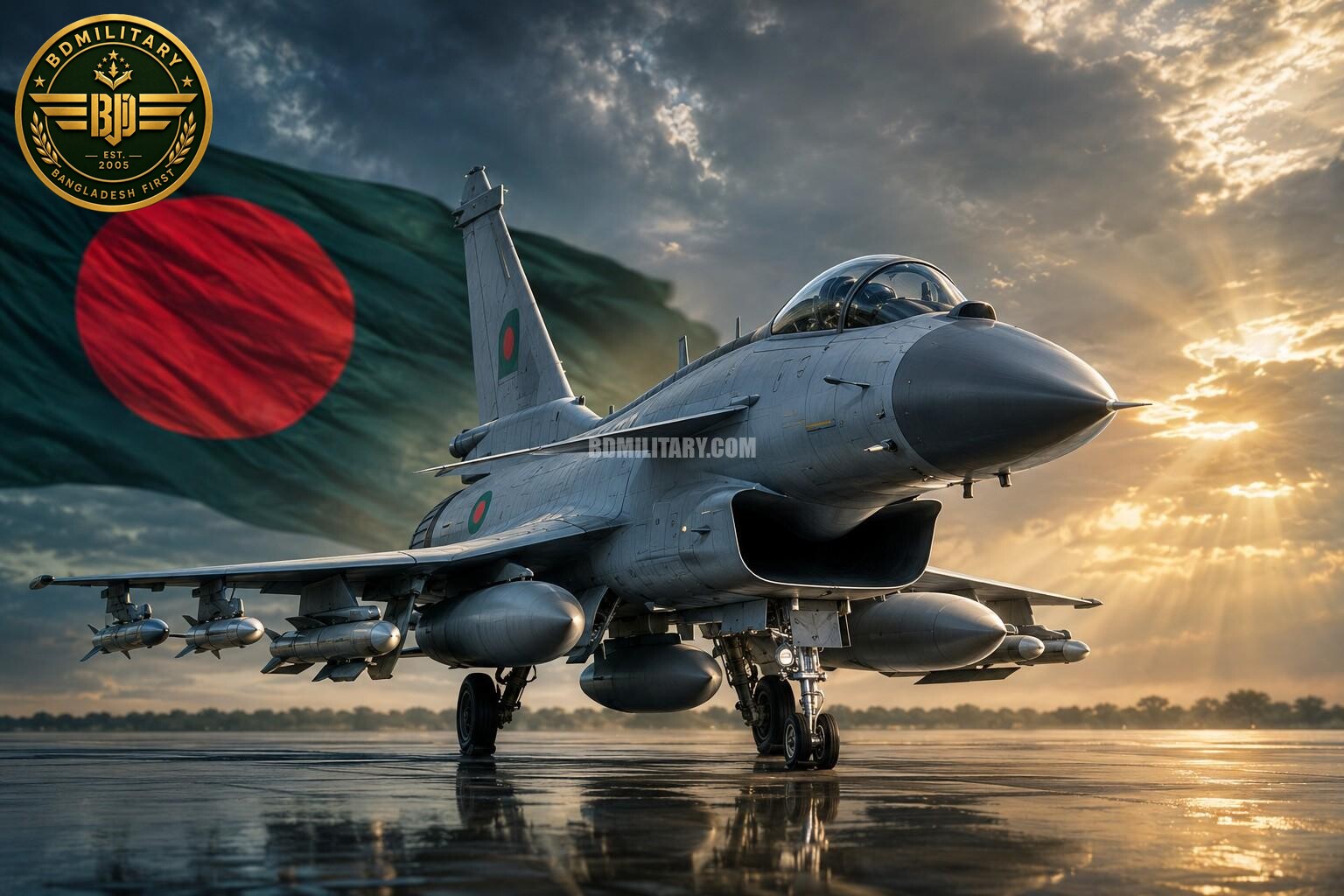
The J-10CE is the export variant of China’s J-10C single-engine, single-seat multirole fighter.
The aircraft is designed to undertake a range of missions, including air-to-air combat, precision strikes against land and maritime targets, reconnaissance and suppression of enemy air-defence systems.
The platform incorporates modern avionics and a digital flight-control architecture and is designed to employ a range of air-to-air and air-to-surface weapons.
The aircraft is also capable of operating as part of a networked force, including coordinated operations involving unmanned aerial systems.
Bangladesh’s decision to pursue the J-10CE reflects the requirement for a modern multirole combat aircraft while maintaining tighter control over acquisition and life-cycle costs than would generally be associated with comparable Western platforms.
Information and Broadcasting Adviser Zaheed Ur Rahman cited the aircraft’s reported performance against advanced Western fighters, including the Rafale, as well as its comparatively lower acquisition cost, among the factors behind the selection.
Procurement Process Accelerated After 2025 Discussions
The current procurement process can be traced to discussions surrounding Bangladesh’s requirement for new multirole combat aircraft during former Chief Adviser Professor Muhammad Yunus’s visit to China in March 2025, when the issue was reportedly raised during discussions with the Chinese leadership.
Momentum subsequently increased following the establishment of an 11-member inter-ministerial committee headed by the Chief of Air Staff.
A high-level Chinese delegation later travelled to Dhaka in June, ahead of Prime Minister Tariq Rahman’s visit to China, for further discussions concerning the proposed acquisition.
Following negotiations, a draft agreement was prepared and submitted to the relevant Bangladeshi authorities for examination and approval.
The next major milestone will be the completion of the inter-governmental agreement and associated financial, contractual and regulatory approvals.
Part Of A Wider Bangladesh Air Force Modernisation Programme
The J-10CE acquisition is being pursued as part of a broader effort to modernise the Bangladesh Air Force’s combat and support fleet.
According to the government, procurement initiatives are also underway for attack helicopters, VIP helicopters and unmanned aerial vehicle systems.
The fighter acquisition would therefore represent one component of a wider capability-development programme involving combat aircraft, rotary-wing aviation, unmanned systems, training, infrastructure and supporting logistics.
For Bangladesh, the significance of the programme extends beyond the acquisition of 20 aircraft. Establishing the associated training, maintenance, weapons, logistics and infrastructure ecosystem will be critical to generating sustainable combat capability from the new fleet.
If concluded, the J-10CE programme would represent a significant expansion of Bangladesh’s modern fighter capability and another major step in the Bangladesh Air Force’s transition towards a more capable, networked and multirole force.

Amit Bhattacharya is a leading defence procurement expert with deep expertise in modern weapon systems and military hardware acquisition. Over more than a decade, he has collaborated with top defence contractors and strategic research institutions, delivering incisive analysis on procurement frameworks, capability development, and technology integration for armed forces worldwide. Amit bridges the gap between operational requirements and industrial capacity, providing authoritative evaluations of modernisation programmes, defence budgets, and acquisition reforms in both established and emerging defence markets. He leads the Defence Procurement and Defence Industry sections at BDMilitary, shaping strategic discourse on defence innovation. Amit earned his Master of Policy and Governance (MPAG) from the University of Canterbury, New Zealand, complementing his practical expertise with advanced policy and governance insight.