Bangladesh is preparing a substantial deployment of specialised police capabilities to Haiti as the United Nations authorised Gang Suppression Force (GSF) moves towards full operational strength ahead of the country’s planned December 2026 elections.
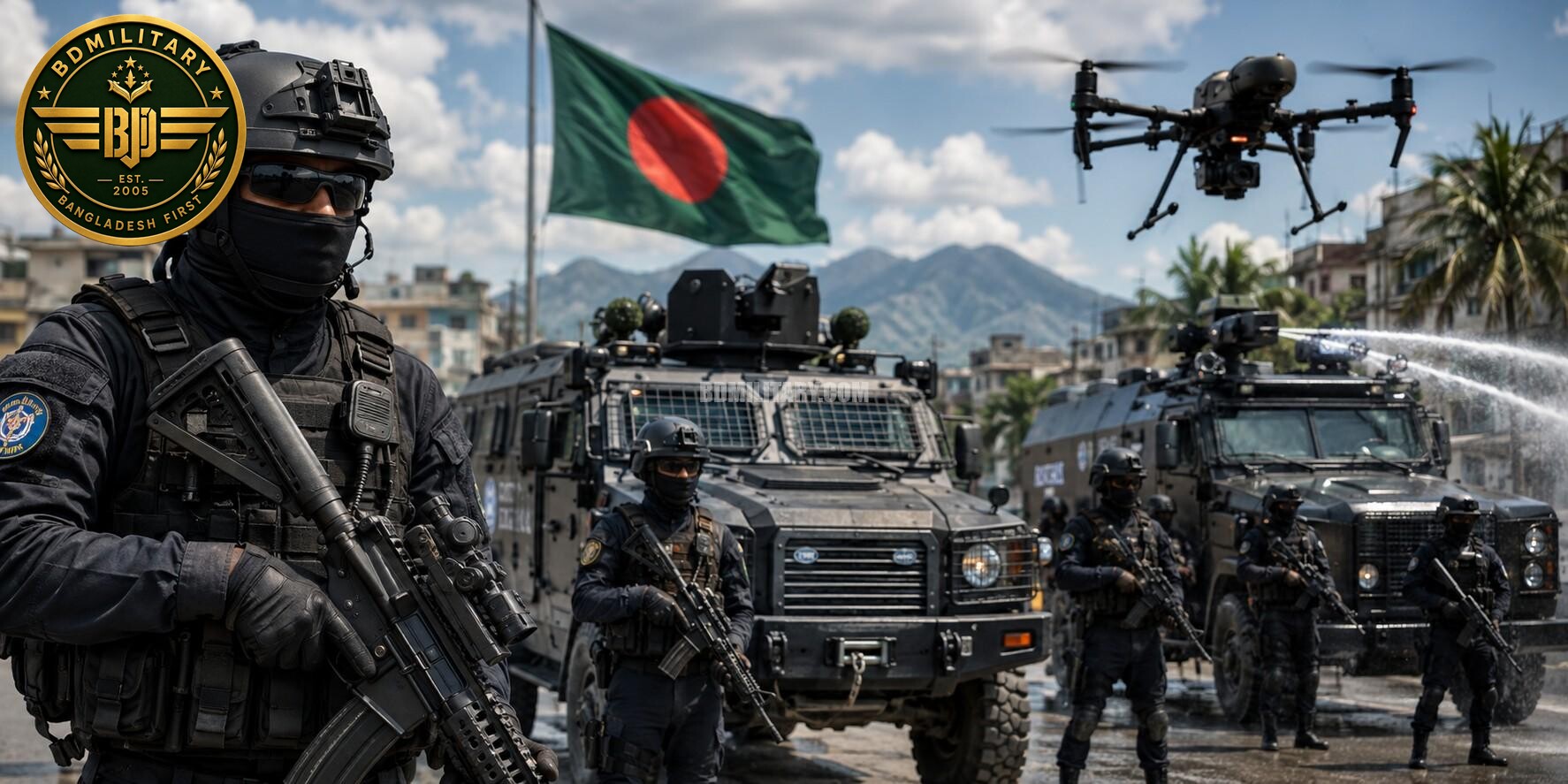
The Bangladesh Police contribution is emerging as one of the most heavily equipped police deployments within the multinational force. Video footage and photographic evidence now confirm that Bangladeshi personnel deploying for the GSF are equipped with armoured vehicles, unmanned aerial systems, counter-IED equipment, sophisticated tactical communications systems, heavy machine guns, armoured anti-riot vehicles and water-cannon platforms.
The equipment profile indicates that Bangladesh is preparing its personnel for a high-threat operating environment substantially different from conventional UN peacekeeping missions.
Dhaka has already prepared three specialised Formed Police Units (FPUs) for deployment to Haiti, with capabilities spanning tactical intervention, explosive ordnance disposal, organised-crime investigation, cybercrime, forensic work and rapid response.
Bangladesh’s Specialised Police Package
The Bangladeshi contingent is equipped for a broad spectrum of security missions ranging from conventional public-order duties to high-risk counter-gang operations.
Visual evidence from the deployment confirms the presence of:
- Armoured vehicles for protected troop movement and operations in high-threat areas
- Unmanned aerial systems (drones) for surveillance and situational awareness
- Counter-IED equipment for detecting and dealing with explosive threats
- Advanced tactical communications equipment for command, control and coordination
- Heavy machine guns providing enhanced firepower for defensive and security operations
- Armoured anti-riot vehicles for protected public-order operations
- Water-cannon vehicles for crowd-control and riot-control missions
- Specialised tactical and protective equipment for personnel operating in contested urban environments
The combination of these capabilities gives the Bangladeshi contingent a considerably broader operational profile than a conventional police formation.
The presence of heavy weapons and protected vehicles is particularly significant given the increasingly militarised nature of Haiti’s armed gangs, many of which possess assault rifles, machine guns, improvised explosive devices and the ability to establish roadblocks and conduct coordinated attacks.
July MoU Negotiations Mark Key Step
A major step towards the Bangladeshi deployment took place in July.
Senior Bangladesh Police officials travelled to the United States for MoU negotiations concerning the GSF deployment from 15–17 July 2026. The discussions were intended to finalise arrangements governing Bangladesh’s contribution, including personnel, equipment, logistics and operational responsibilities.
The negotiations followed high-level discussions between Bangladeshi and United Nations officials concerning Dhaka’s proposed specialised contribution to Haiti.
The July engagement represents an important milestone in transforming Bangladesh’s commitment into an operational deployment.
GSF Moves Towards A 5,500-Person Force
The GSF is being established as a significantly larger and more capable international security force than the previous Multinational Security Support Mission.
The United Nations Security Council has authorised a force structure of approximately 5,500 military and police personnel, supported by 50 civilian personnel.
The mission’s responsibilities include intelligence-led operations against armed gangs, protection of critical infrastructure, securing humanitarian access, supporting the Haitian National Police and creating the security conditions necessary for the restoration of state authority.
Major General Erdenebat Batsuuri of Mongolia serves as Force Commander.
The multinational force is expected to build towards full operational strength through a phased deployment during August, September and October.
August — Consolidation And Road Security
The immediate objective is to reach an intermediate strength of approximately 2,000–2,500 personnel on the ground.
The August phase is centred on consolidating existing positions, improving road security and expanding joint patrols with the Haitian National Police (PNH).
Operational priorities include major transport routes and areas around Tabarre, Liancourt and Petite-Rivière.
Additional Chadian personnel are expected to reinforce the initial contingent, while specialised units from Sri Lanka are also scheduled to join the force.
September — Geographic Expansion
September is expected to mark a major expansion of GSF operations beyond the immediate Port-au-Prince area.
Additional combat and security personnel from countries including Guatemala, El Salvador and Côte d’Ivoire are expected to increase the force’s ability to operate across a wider geographical area.
A particular priority will be the Artibonite department, where armed gangs have established significant influence and where control of roads and humanitarian routes is strategically important.
The GSF is expected to increasingly conduct intelligence-led operations while strengthening protection for humanitarian corridors and critical infrastructure.
October — Full Force Deployment
October is scheduled to mark the completion of the principal force build-up, taking the GSF towards its authorised ceiling of 5,500 operational military and police personnel, supported by 50 civilian personnel.
The main Bangladeshi contingent is expected to arrive during this phase, alongside additional police personnel from countries including the Bahamas and Jamaica.
The objective is to establish a comprehensive multinational security network capable of operating across Haiti rather than remaining concentrated around the capital.
Bangladesh’s Role In The GSF
Bangladesh’s contribution is particularly significant because of the specialised capabilities being brought into the mission.
The confirmed equipment profile shows that Bangladeshi personnel are being prepared to operate in an environment where the distinction between conventional policing and paramilitary-style security operations is increasingly blurred.
Armoured mobility provides protection against small-arms fire and attacks on convoys. Drones provide commanders with additional surveillance and situational awareness. Counter-IED capabilities address one of the most serious threats to personnel movement, while protected anti-riot vehicles and water cannons provide the means to conduct public-order operations without immediately resorting to lethal force.
The deployment of heavy machine guns also reflects the threat environment faced by the GSF. Their presence provides a significant increase in the contingent’s defensive firepower and its ability to protect positions, convoys and personnel in high-threat areas.
Importantly, the Bangladeshi contingent is not simply a combat formation. Its specialised policing capabilities remain central to the mission, including tactical intervention, EOD, forensic investigation, organised-crime investigation and other law-enforcement functions.
A Different Kind Of UN Security Mission
Haiti presents a substantially different operating environment from the traditional peacekeeping missions in which Bangladesh has accumulated decades of experience.
The country’s armed gangs have evolved into heavily armed territorial organisations capable of controlling neighbourhoods, disrupting major roads, attacking state institutions and challenging the authority of the Haitian government.
The GSF therefore requires a hybrid approach combining policing, intelligence, protected mobility, public-order capabilities and military-grade force protection.
Bangladesh’s contribution appears particularly suited to this model.
The combination of specialist police personnel and a substantial equipment package allows the Bangladeshi units to perform both security and law-enforcement functions while remaining integrated into the wider GSF command structure.
Electoral Deadline Adds Urgency
The expansion of the GSF is taking place against a highly compressed electoral timetable.
Haiti’s electoral authorities have scheduled the first round of presidential and legislative elections for 13 December 2026, with a second round scheduled for February 2027.
The voter-registration process is also scheduled to take place during the period in which the GSF is expanding towards full strength.
This creates a narrow window for the international force to improve security sufficiently to protect registration centres, electoral personnel, transport routes and political activity.
The October target for full GSF deployment is therefore strategically important. By that point, the force is expected to have moved beyond its initial concentration around Port-au-Prince and towards a broader nationwide security network.
Assessment
Bangladesh’s Haiti deployment represents a significant evolution in the international role of the Bangladesh Police.
The confirmed presence of armoured vehicles, drones, counter-IED systems, advanced communications equipment, heavy machine guns, protected anti-riot vehicles and water cannons demonstrates that Dhaka is preparing its personnel for considerably more demanding operations than conventional UN peacekeeping.
The equipment also reflects the nature of the Haitian threat. The GSF is confronting armed organisations capable of employing military-style weapons and tactics, making protected mobility, surveillance, explosive-threat response and enhanced force protection essential.
For Bangladesh, the mission provides an opportunity to demonstrate the operational versatility of its police forces while strengthening the country’s position as a major contributor to international security operations.
The ultimate measure of success, however, will not simply be the number of operations conducted or territory recovered. The strategic objective is to restore freedom of movement, protect civilians and critical infrastructure, rebuild Haitian state authority and create a sufficiently secure environment for credible elections.
With the first round of elections scheduled for December, the next three months will be decisive.
For the GSF, the arrival of the main Bangladeshi contingent in October could therefore represent one of the most important stages in the transition from an initial multinational deployment into a genuinely nationwide security force.

Khaled Ahmed is a seasoned former intelligence analyst and military expert from the Netherlands, bringing over 15 years of specialised experience in operational intelligence, threat analysis, and strategic defence planning. Having served in high-level, classified roles within Dutch military intelligence, he possesses rare expertise in European security architecture, NATO doctrine, and asymmetric warfare. Khaled’s deep operational insight and international perspective enable him to deliver precision-driven intelligence analysis and forward-looking strategic forecasts. A trusted contributor to high-level risk assessments and security briefings, he offers readers clarity on complex defence and security challenges. Khaled leads the National Security and Fact Analysis sections at BDMilitary. He holds a Master’s degree in International Relations from the University of Groningen, The Netherlands, and is fluent in Dutch, French, and Arabic — combining linguistic dexterity with operational expertise to analyse security issues across cultures and regions.