
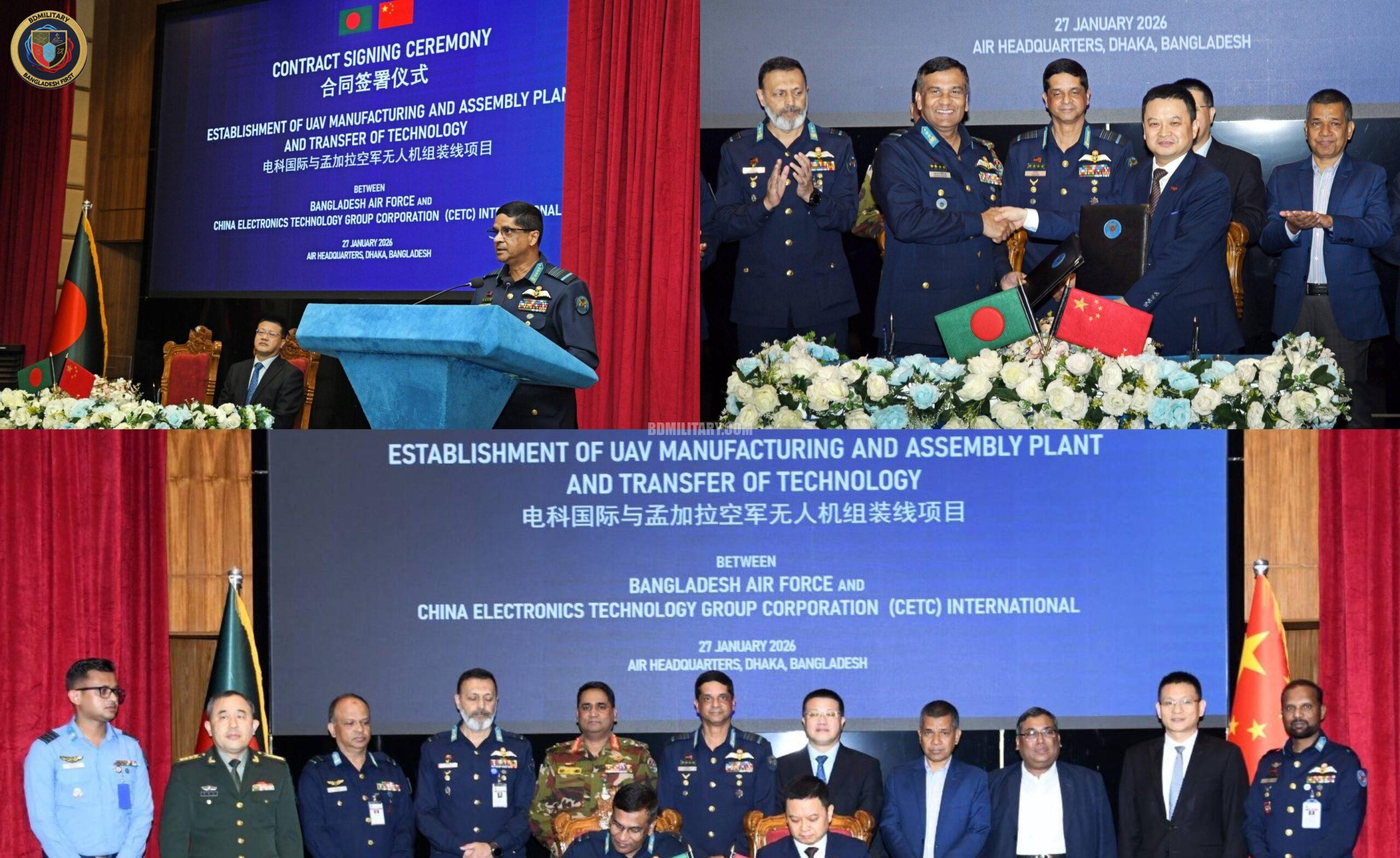
In a significant milestone for Bangladesh’s defence and aerospace sector, the Bangladesh Air Force (BAF) today signed a comprehensive Government-to-Government (G2G) agreement with China Electronics Technology Group Corporation International (CETC International) to establish a Unmanned Aerial Vehicle (UAV) manufacturing and assembly plant in Bangladesh, coupled with a far-reaching Technology Transfer (ToT) framework.
The agreement was formally signed at Bangladesh Air Force Headquarters on Tuesday in the presence of the Chief of Air Staff, Air Chief Marshal Hasan Mahmud Khan, BBP, OSP, GUP, NSWC, PSC, who attended the ceremony as the chief guest. Senior civil and military officials from Bangladesh and representatives of the Chinese government and CETC International were also present, underscoring the strategic importance of the initiative.
The project, officially titled the Unmanned Aerial Vehicle (UAV) Production, Assembly and Technology Transfer (ToT) Programme, is designed to strengthen Bangladesh’s indigenous capability in advanced aerospace manufacturing and unmanned systems. It reflects the Bangladesh Air Force’s long-term vision of reducing dependency on foreign suppliers while building a sustainable domestic defence-industrial base.
Joint Production and Technology Transfer
Under the terms of the agreement, the Bangladesh Air Force and CETC International will jointly establish a modern, state-of-the-art UAV production and assembly facility within Bangladesh. The facility will be developed with advanced manufacturing infrastructure, testing and evaluation capabilities, and quality assurance systems in line with international aerospace standards.
A core component of the agreement is the structured transfer of technology from CETC International to the Bangladesh Air Force. This will include the sharing of design knowledge, production processes, system integration techniques, maintenance methodologies, and lifecycle support expertise. The ToT arrangement is intended not only to enable assembly of UAVs but also to progressively build local design, modification and innovation capacity.
In the initial phase, the Bangladesh Air Force will gain the capability to manufacture and assemble various types of Medium Altitude Long Endurance (MALE) UAVs, as well as Vertical Take-Off and Landing (VTOL) UAVs. These platforms are widely recognised for their versatility, endurance and suitability for a range of operational environments.
Indigenous UAV Capability
In addition to licensed production and assembly, the project will enable the development and manufacture of indigenous UAV platforms by the Bangladesh Air Force. This marks a critical step towards achieving full-spectrum capability in unmanned systems, from concept and design through production, deployment and sustainment.
According to officials, these UAVs will significantly enhance the operational effectiveness of the Bangladesh Air Force by providing improved intelligence, surveillance and reconnaissance (ISR) capabilities, enhanced situational awareness, and rapid response options across diverse operational scenarios.
Beyond military applications, the UAVs produced under this programme are expected to play an increasingly important role in humanitarian assistance and disaster management. Bangladesh, being highly vulnerable to natural disasters such as cyclones, floods and landslides, stands to benefit from UAV-enabled rapid damage assessment, search and rescue coordination, and delivery of critical supplies to hard-to-reach areas.
Capacity Building and Workforce Development
A key objective of the agreement is long-term capacity building within Bangladesh’s aerospace and defence ecosystem. The programme includes comprehensive training initiatives for Bangladesh Air Force personnel, engineers and technicians, both locally and through overseas exposure where necessary.
These initiatives will focus on developing a skilled aerospace workforce capable of supporting UAV production, system integration, maintenance, repair and overhaul (MRO), and future research and development activities. Knowledge exchange programmes, joint technical workshops and on-the-job training will form an integral part of the collaboration.
Officials emphasised that the project will also contribute to broader industrial skill development by fostering expertise in electronics, avionics, composite materials, propulsion systems and software integration — sectors that have applications beyond defence and into civilian high-technology industries.
Strategic and Economic Significance
The agreement is widely viewed as a strategic move towards achieving self-reliance in UAV manufacturing. By developing domestic production capacity, Bangladesh aims to reduce procurement lead times, enhance operational readiness and maintain greater control over sensitive technologies.
In the longer term, the expansion of indigenous UAV manufacturing capability is expected to position Bangladesh as a potential supplier to friendly nations, subject to government policy and international regulations. This could open new avenues for defence exports and contribute to national economic growth.
The initiative is also aligned with Bangladesh’s broader national goals of technological advancement, industrial modernisation and the development of a knowledge-based economy. By investing in high-technology defence manufacturing, the country seeks to create a multiplier effect across related sectors.
Distinguished Attendance
The signing ceremony was attended by the Chinese Ambassador to Bangladesh, His Excellency Yao Wen, highlighting the strong bilateral defence and technological cooperation between Bangladesh and China. Also present were the Principal Staff Officer of the Armed Forces Division, Lieutenant General SM Kamrul Hasan, BSP, NDC, HDMC, PSC, PhD; Secretary of the Chief Adviser’s Office, Md Saifullah Panna; and Secretary of the Legislative and Parliamentary Affairs Division, Dr Hafiz Ahmed Chowdhury.
Senior Bangladesh Air Force officers, representatives of CETC International, officials from the Armed Forces Division, senior representatives from various ministries, and other distinguished guests were also in attendance.
Looking Ahead
The Bangladesh Air Force has described the agreement as a transformative step towards building a robust, self-sustaining UAV ecosystem in the country. Through sustained collaboration, technology transfer and human capital development, the programme is expected to significantly enhance national defence capability while contributing to humanitarian resilience and technological progress.
As the project moves from agreement to implementation, it is anticipated that the UAV manufacturing and assembly facility will become a cornerstone of Bangladesh’s future aerospace ambitions, reinforcing the Bangladesh Air Force’s role as a modern, technologically advanced service capable of meeting both national security and non-traditional challenges in the years ahead.

Amit Bhattacharya is a leading defence procurement expert with deep expertise in modern weapon systems and military hardware acquisition. Over more than a decade, he has collaborated with top defence contractors and strategic research institutions, delivering incisive analysis on procurement frameworks, capability development, and technology integration for armed forces worldwide. Amit bridges the gap between operational requirements and industrial capacity, providing authoritative evaluations of modernisation programmes, defence budgets, and acquisition reforms in both established and emerging defence markets. He leads the Defence Procurement and Defence Industry sections at BDMilitary, shaping strategic discourse on defence innovation. Amit earned his Master of Policy and Governance (MPAG) from the University of Canterbury, New Zealand, complementing his practical expertise with advanced policy and governance insight.