
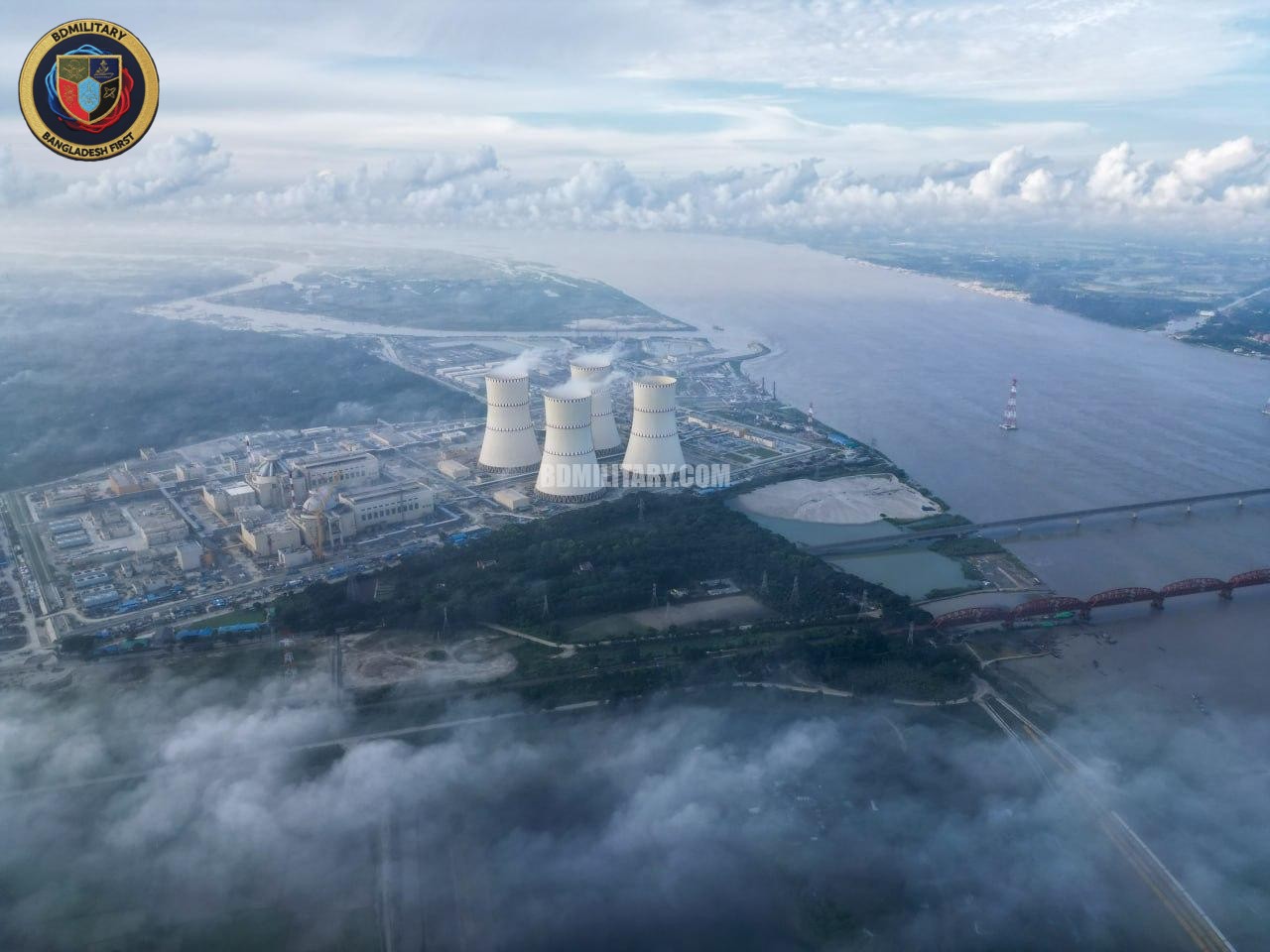
The Bangladesh Army is set to assume full responsibility for the security of the country’s only nuclear power facility, the Rooppur Nuclear Power Plant (RNPP) in Pabna district, amid heightened efforts to strengthen its physical protection system ahead of the plant’s commissioning.
According to documents of the Armed Forces Division (AFD), a four-member delegation led by the Chief of General Staff, Lieutenant General Mizanur Rahman Shamim, recently visited Austria and France from 30 October to 4 November to hold high-level consultations on nuclear security. The team included Bangladesh’s Defence Adviser in Vienna, Brigadier Rubaiyat Mahmud Hasib, and two officers of the rank of major.
During their visit to Vienna, the delegation held extensive meetings with senior officials at the headquarters of the International Atomic Energy Agency (IAEA). Discussions reportedly centred on expanding the scope of Bangladesh’s “nuclear security regime” and upgrading security protocols in line with international standards.
The move to place the RNPP under direct military security comes in line with the interim government’s objective to significantly enhance protection at the strategically vital installation. Until now, security at the plant has been provided by a special cell of the Bangladesh Army, supported by law-enforcement agencies and other stakeholders under the RNPP’s Nuclear Security and Physical Protection System (PPS) Cell.
However, with RNPP’s Reactor-1 nearing commissioning, authorities have decided to institutionalise a broader and more robust military-led security framework. The enhanced system is expected to integrate layered physical protection, access control, armed response, surveillance, cyber-security coordination and emergency response capabilities, all under the Army’s direct command.
Officials view the transition to full military control as essential given the sensitive nature of nuclear infrastructure and growing regional and global security concerns. The Bangladesh Army is expected to play a central role in deterrence, counter-sabotage operations, and protection against both conventional and asymmetric threats.
Following the IAEA consultations in Vienna, the Bangladeshi military delegation travelled to France, where they met senior officials of the French Ministry of Defence. While details of those discussions remain undisclosed, defence analysts believe the talks likely involved advanced security technologies, nuclear facility protection models and military-to-military cooperation on strategic infrastructure defence.
The Rooppur Nuclear Power Plant is a civilian project under the Bangladesh Atomic Energy Commission and is being constructed with technical support from Russia’s state-owned nuclear company, Rosatom. Once fully operational, the two VVER-1200 reactors will generate a combined 2,400 megawatts of electricity, significantly bolstering Bangladesh’s national grid.
Construction of the two units began in 2017 and 2018 respectively, though commercial operation of the first reactor has been delayed beyond its original 2025 target. The project, valued at approximately USD 12.65 billion, was signed in December 2015. Bangladesh has also received training support from India to develop the specialised workforce required for the plant’s operation and maintenance.
The arrival of the first batch of fresh uranium fuel for Reactor-1 in September 2023 marked a critical milestone, further underlining the urgency of placing the plant under a strengthened, military-led security structure.
With the Bangladesh Army now poised to take over complete security control, the RNPP is set to become one of the most heavily guarded strategic installations in the country, reflecting its growing importance to national security and energy sovereignty.

Khaled Ahmed is a seasoned former intelligence analyst and military expert from the Netherlands, bringing over 15 years of specialised experience in operational intelligence, threat analysis, and strategic defence planning. Having served in high-level, classified roles within Dutch military intelligence, he possesses rare expertise in European security architecture, NATO doctrine, and asymmetric warfare. Khaled’s deep operational insight and international perspective enable him to deliver precision-driven intelligence analysis and forward-looking strategic forecasts. A trusted contributor to high-level risk assessments and security briefings, he offers readers clarity on complex defence and security challenges. Khaled leads the National Security and Fact Analysis sections at BDMilitary. He holds a Master’s degree in International Relations from the University of Groningen, The Netherlands, and is fluent in Dutch, French, and Arabic — combining linguistic dexterity with operational expertise to analyse security issues across cultures and regions.