In a landmark development signalling a rare thaw in military-to-military relations, Air Chief Marshal Zaheer Ahmed Baber Sidhu, Chief of the Air Staff of the Pakistan Air Force (PAF), held a high-level meeting with his Bangladeshi counterpart, Air Chief Marshal Hasan Mahmood Khan, on the sidelines of the Dubai Airshow. This is the first such engagement between serving air chiefs of the two nations since Bangladesh’s independence in 1971, marking a moment of considerable symbolic and strategic importance.
This report originates from Pakistani media outlets. Notably, neither the Bangladesh Air Force (BAF) nor the Inter-Services Public Relations (ISPR) Directorate in Dhaka has issued any official confirmation regarding the meeting or the discussions purportedly held.
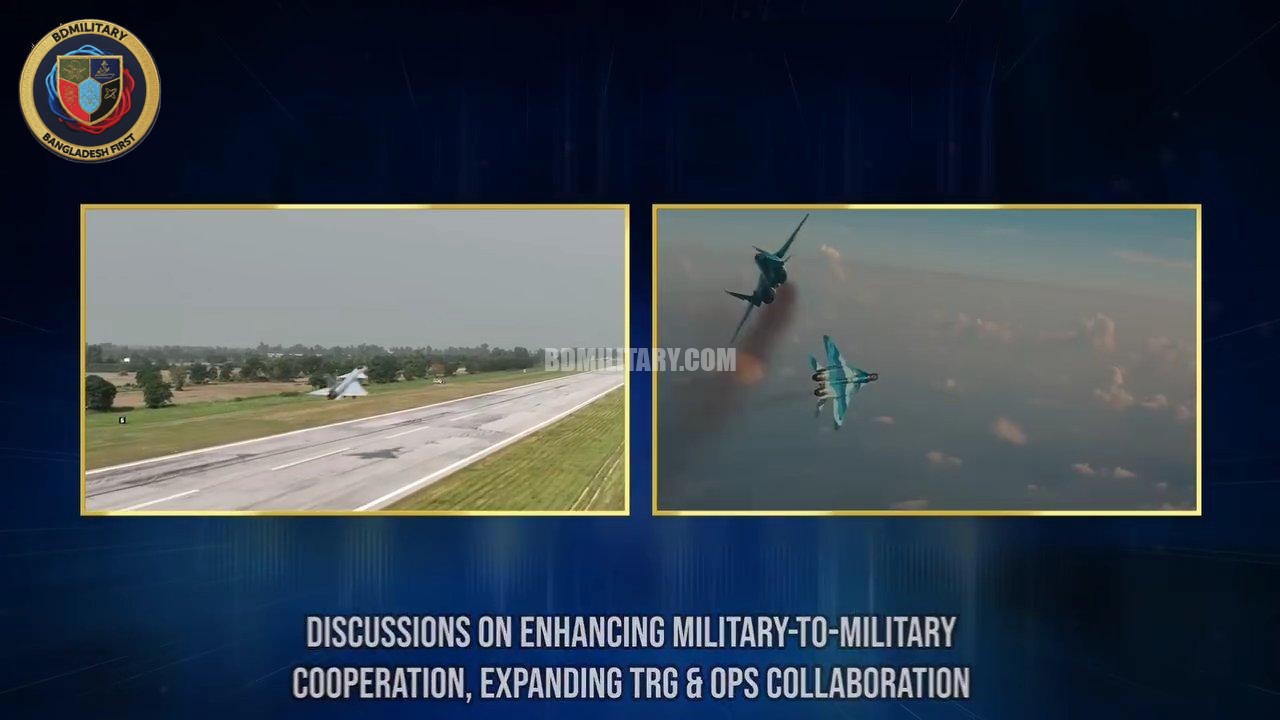
According to Pakistani reporting, the meeting centred on expanding defence cooperation, exchanging operational experience, and enhancing professional training programmes. Pakistani sources described the dialogue as “constructive, forward-looking and mutually beneficial”, though no official statement from Dhaka has corroborated these accounts. The Pakistan Air Force’s media wing however confirmed discussions were held to enhance military-to-military relations as well as training and operations collaboration between between the Bangladesh Air Force and its Pakistani counterpart.
Bangladesh Reportedly Requests Pilot and Technical Training from Pakistan
Pakistani media claims that the Bangladesh Air Force formally sought training assistance from Pakistan for its pilots and technical personnel. Under this reported arrangement, PAF instructors would conduct specialised courses for BAF aircrew, including fighter conversion training, aerial tactics and advanced maintenance disciplines.
If accurate, this would mark a notable shift, given that BAF pilots currently receive training across a wide array of partner nations, including China, the United Kingdom, Türkiye and several NATO-affiliated institutions. Pakistan’s inclusion—particularly its experience with the J-10CE and legacy platforms—would add a new training dimension.
However, in the absence of any confirmation from BAF or ISPR, these claims remain unverified and should be treated with caution.
BAF’s Modernisation and Advanced Training Ecosystem
These Pakistani claims emerge at a time when the Bangladesh Air Force is undergoing its most ambitious modernisation drive in history. Dhaka is acquiring the J-10CE as its future frontline multi-role fighter, while also progressing towards the purchase of JF-17 variants. These acquisitions—especially the JF-17—could lend some credibility to the idea of targeted training cooperation with Pakistan, given Islamabad’s operational familiarity with the aircraft.
However, the BAF already maintains one of the most advanced and self-sufficient pilot training ecosystems in South Asia. Unlike the Pakistan Air Force, Bangladesh operates the Yak-130 advanced jet trainer—a highly sophisticated lead-in fighter trainer capable of simulating fourth- and fifth-generation aircraft performance. The PAF, by contrast, possesses no equivalent AJT.
The BAF also flies the most advanced variant of the K-8W, featuring upgraded avionics and enhanced weapon-training capacity.
At the foundational level, Bangladesh operates state-of-the-art German primary trainers, specifically the Grob G 120TP. These aircraft feature modern digital cockpits, advanced flight control systems and high-performance turboprop engines, providing BAF cadets with a Western-standard pilot training environment from day one.
Together, the Yak-130, the upgraded K-8W and the Grob G 120TP create a comprehensive, multi-layered training pipeline that is technologically superior to many regional counterparts. Any cooperation with Pakistan—if it indeed occurs—would therefore be selective and narrow, likely focusing on aircraft-specific conversion or tactical development rather than fundamental pilot training.
Training Modules Said to Be Under Development
Pakistani outlets further report that Islamabad-based defence channels expect training modules to be finalised shortly and that the first batch of Bangladeshi pilots could arrive at PAF training institutions within the current fiscal year. Institutions such as the Airpower Centre of Excellence (PACE), the Combat Commanders School (CCS) and specialised engineering wings are being mentioned as possible venues.
For Pakistan, the initiation of such cooperation would offer an opportunity to rebuild long-dormant defence ties with Dhaka. For Bangladesh, it would provide specific access to PAF expertise in select tactical or aircraft-specific fields—if the reports hold true.
Again, none of this has been officially confirmed by Bangladesh.
Backdrop of Quiet Diplomatic Exchanges
Pakistan’s reporting asserts that this breakthrough is the result of discreet diplomatic engagement since late 2024. Shifting regional alignments, Dhaka’s expanding defence partnerships, and the BAF’s fighter modernisation trajectory may have created conditions for new dialogues—even if still tentative or exploratory.
Defence analysts note that while these developments could fit within a broader pattern of regional recalibration, the lack of statements from Bangladeshi authorities raises legitimate questions about the accuracy of the Pakistani narrative.
A Turning Point or Premature Reporting?
If true, the meeting would carry significant symbolic weight as the first documented interaction between serving Pakistan and Bangladesh air chiefs since 1971. It could lay the foundation for further cooperation in training, simulation exchanges and participation in multinational exercises.
However, with no confirmation from the BAF or ISPR, the narrative relies solely on Pakistani media reporting. Whether the meeting occurred exactly as described—or if the training proposals are preliminary rather than formal—remains unknown.
Should Dhaka eventually confirm any aspect of the reported engagement, it would represent a noteworthy shift in South Asian defence diplomacy. For now, the claims remain unverified, and caution is warranted.

Ayesha Farid is a regional security specialist focusing on South Asia, with over a decade of experience analysing inter-state tensions, cross-border insurgency, and regional power dynamics. She has worked with leading policy think tanks and academic institutions, offering nuanced insights into the complex security challenges shaping the subcontinent. Ayesha’s expertise spans military doctrines, border disputes, and regional cooperation frameworks, making her a vital contributor to BDMilitary’s coverage of South Asian strategic affairs. She leads the Geopolitics & Diplomacy section at BDMilitary. Ayesha holds a dual master’s degree — a Master in International Relations from the IE School of Politics, Economics & Global Affairs, Spain, and a Master of Public Policy from the Munk School of Global Affairs, University of Toronto, Canada — combining deep academic insight with practical policy expertise.