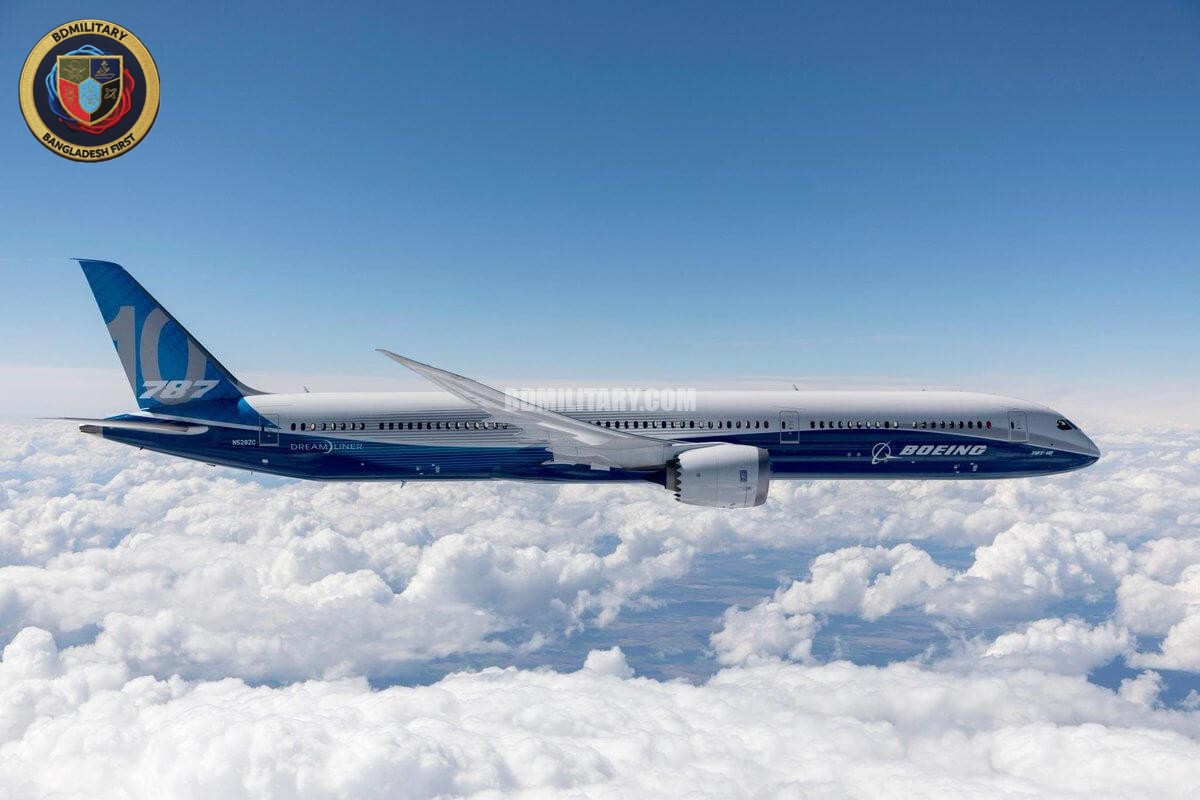
Biman Bangladesh Airlines has approved in principle the purchase of 14 aircraft from US-based manufacturer Boeing, marking a significant move in the national flag carrier’s fleet expansion and modernisation plans.
The decision was taken at Biman’s Annual General Meeting held on Tuesday (30 December), chaired by Aviation and Tourism Adviser Sheikh Bashir Uddin, who is also Chairman of the airline’s Board of Directors.
Biman General Manager (Public Relations) Bosra Islam said the Board of Directors granted policy-level approval to proceed with negotiations with Boeing in line with recommendations of Biman’s techno-finance committee.
“The approval allows Biman to begin formal negotiations regarding pricing, delivery schedules and other terms and conditions. No financial or legal obligation will arise until a final contract is signed,” she said.
Aircraft types approved
According to officials, the approved purchase includes:
- Eight Boeing 787-10 Dreamliners
- Two Boeing 787-9 Dreamliners
- Four Boeing 737-8 MAX aircraft
The Boeing 787 Dreamliners are wide-body aircraft designed for long-haul international routes, while the Boeing 737-8 MAX is a narrow-body aircraft typically used for short- and medium-haul regional operations.
Background to the decision
Earlier, in August, the government committed to procuring aircraft from Boeing as part of broader trade discussions with the United States. Commerce Secretary Mahbubur Rahman recently told the media that aircraft purchases were included in efforts to address reciprocal tariff issues and reduce Bangladesh’s trade deficit with Washington.
Sources at Biman said the Board reviewed Boeing’s aircraft sales proposal dated 24 November 2025, along with a revised draft agreement submitted on 20 December 2025, before granting in-principle approval.
Officials clarified that the approval marks the formal initiation of negotiations and does not bind the airline financially or legally until a final agreement is concluded and approved through the required government procedures.
Airbus efforts
Following public remarks by the Commerce Secretary regarding the Boeing purchase, European diplomats and Airbus representatives increased efforts to promote Airbus aircraft to Bangladesh.
Discussions over the possible acquisition of Airbus aircraft date back to the previous government. After a meeting with then prime minister Sheikh Hasina in Dhaka in September 2023, French President Emmanuel Macron publicly thanked Bangladesh for its commitment to acquiring Airbus aircraft.
Despite renewed diplomatic and commercial engagement, Biman ultimately proceeded with Boeing.
Current fleet and expansion
Biman Bangladesh Airlines currently operates a fleet of 19 aircraft, of which 14 are Boeing-manufactured. Officials said fleet expansion is required to meet growing passenger and cargo demand in Bangladesh’s rapidly expanding aviation market, where Bangladeshi carriers currently hold about 25 per cent of international market share.
Once the new aircraft are inducted, Biman is expected to expand its route network and increase flight frequencies on existing international and regional routes.
Sources said the final contract with Boeing will be signed following the completion of negotiations, financial arrangements and regulatory approvals, after which aircraft deliveries will take place in phases.
Annex A
Biman Bangladesh Airlines – Current Fleet Overview (2025-)
| Aircraft Type | Number in Service | Typical Seat Capacity | Maximum Range | Role |
|---|---|---|---|---|
| Boeing 787-8 Dreamliner | 4 | 256–271 | ~13,620 km | Long-haul international |
| Boeing 787-9 Dreamliner | 2 | 285–298 | ~14,140 km | Long-haul international |
| Boeing 737-800 | 6 | 162–189 | ~5,765 km | Regional & medium-haul |
| Dash 8-Q400 | 7 | 74–78 | ~2,520 km | Domestic & short regional |
| Total | 19 aircraft | — | — | — |
Seating capacity varies depending on configuration.
Annex B
Biman Bangladesh Airlines – Approved Upcoming Aircraft from Boeing
The following aircraft have received in-principle approval from Biman’s Board of Directors, subject to successful price negotiations and contractual completion.
| Aircraft Type | Quantity Approved | Typical Seat Capacity | Maximum Range | Intended Role |
|---|---|---|---|---|
| Boeing 787-10 Dreamliner | 8 | 320–336 | ~11,910 km | Long-haul international |
| Boeing 787-9 Dreamliner | 2 | 285–298 | ~14,140 km | Long-haul international |
| Boeing 737-8 MAX | 4 | 162–178 | ~6,570 km | Regional & medium-haul |
| Total Approved | 14 aircraft | — | — | — |
Specifications are based on standard manufacturer data and may vary depending on final configuration.
Boeing 787-10 Dreamliner
The Boeing 787-10 Dreamliner is the largest member of the 787 family and is designed for high-capacity long-haul operations. It features an advanced composite airframe and modern high-bypass turbofan engines, allowing it to carry more passengers while consuming significantly less fuel than older wide-body aircraft such as the Boeing 767 and early Boeing 777 variants. With a typical two-class seating capacity of more than 320 passengers, the aircraft is intended for high-demand international routes.
Compared with previous-generation long-haul jets, the 787-10 offers notable efficiency improvements. The extensive use of lightweight composite materials reduces overall aircraft weight, while refined aerodynamics and advanced engine technology contribute to lower fuel burn, reduced emissions and a smaller noise footprint. These improvements translate into lower operating costs per seat and improved environmental performance.
Passenger comfort has also been enhanced over earlier wide-body designs. The aircraft is equipped with systems that allow for higher cabin humidity and a lower effective cabin altitude, helping to reduce fatigue on long flights. Larger windows, quieter engines and modern cabin interiors further distinguish the 787-10 from older aircraft types.
Boeing 787-9 Dreamliner
The Boeing 787-9 Dreamliner is a mid-size wide-body aircraft designed to combine long range with flexible capacity. It typically carries around 290 to 300 passengers in a two-class configuration and is capable of operating long-haul routes exceeding 14,000 kilometres. The aircraft offers increased range and payload compared with the smaller 787-8, making it suitable for a wide variety of intercontinental services.
In comparison with earlier wide-body aircraft such as the Boeing 767 and early-generation Boeing 777s, the 787-9 delivers significantly lower fuel consumption per seat. Its composite airframe, advanced wing design and efficient engines reduce operating costs and carbon emissions, allowing airlines to operate long-distance routes more economically than was previously possible.
The passenger environment on the 787-9 represents a clear improvement over older aircraft. Features such as lower cabin noise levels, higher humidity and improved air quality contribute to a more comfortable journey on long-haul flights. These enhancements have made the aircraft popular on international routes where passenger comfort is a key consideration.
Boeing 737-8 MAX
The Boeing 737-8 MAX is the latest generation of Boeing’s widely used single-aisle aircraft family. It incorporates new-generation CFM LEAP-1B engines, advanced winglets and aerodynamic refinements, offering improved performance compared with the Boeing 737-800 and other earlier 737 variants. The aircraft is designed for short- and medium-haul routes, with increased efficiency and extended range.
Compared with previous generations of the 737, the 737-8 MAX achieves substantially lower fuel burn and reduced emissions, alongside a smaller noise footprint. These improvements allow airlines to lower operating costs while maintaining flexibility across regional and international networks. Enhanced commonality within the 737 family also simplifies pilot training and maintenance operations.
Passenger comfort has been improved through quieter engines and updated cabin systems. Although it remains a narrow-body aircraft, the 737-8 MAX offers a more modern and efficient platform than older 737 models, supporting higher utilisation and improved operational performance.

M.Z. Rahman is a distinguished defence and aerospace industry veteran turned strategist, with over two decades of experience in regional security, military modernisation, and strategic policy. Holding a Master of Arts in International Relations and Security Studies from Waikato University, New Zealand, he has contributed extensively to leading think tanks and defence journals worldwide. As Chief Editor of BDMilitary, Rahman drives the editorial vision, delivering authoritative, rigorously researched insights that reflect the latest trends in defence and geopolitics. His work integrates industry expertise with strategic foresight, establishing him as a respected voice in global defence strategy.