
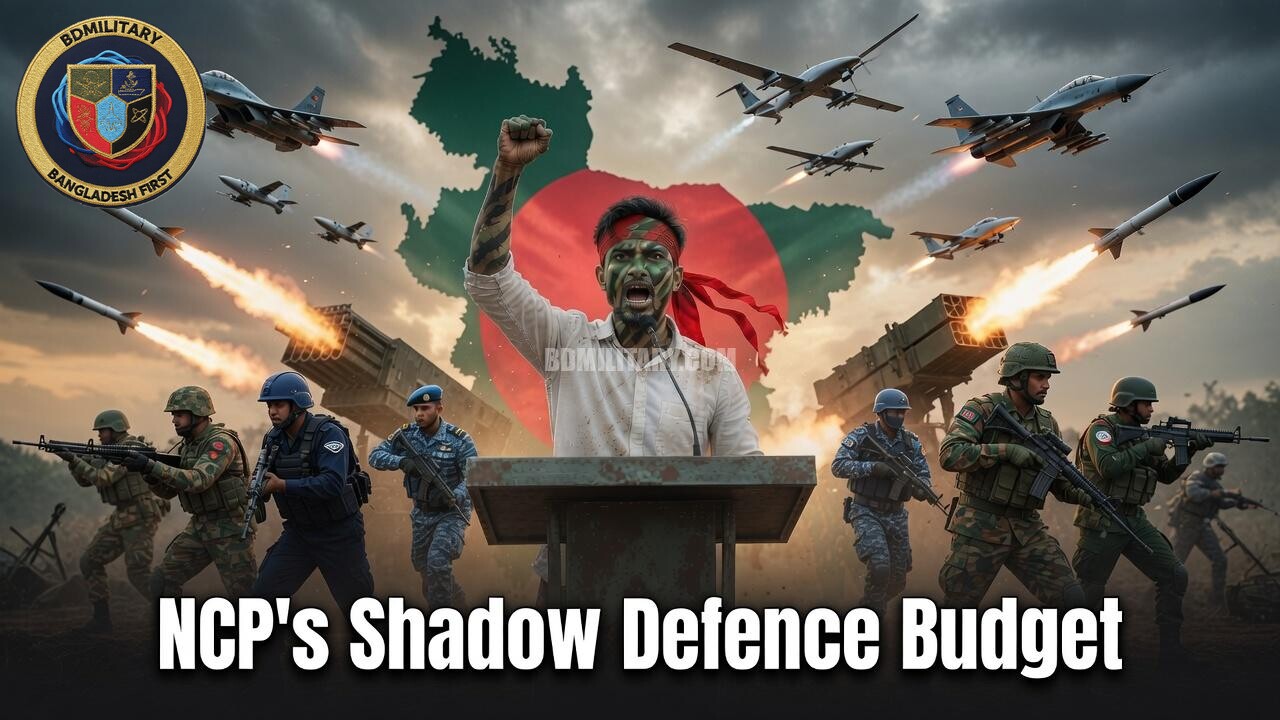
The National Citizen Party’s shadow budget, “Bangladesh 2.0: Sustainable Growth through Reform, Employment and Investment”, contains several commendable proposals aimed at boosting employment, improving education, attracting investment, and controlling inflation. These are undoubtedly important priorities for Bangladesh’s future prosperity.
However, the proposed defence allocation of Tk39,745 crore raises serious concerns regarding the country’s long-term security preparedness and strategic outlook.
At a time when Bangladesh faces an increasingly complex security environment, characterised by heightened regional tensions, rapid military modernisation across Asia, and the emergence of new domains of warfare, the proposed allocation appears insufficient even to support the ambitions outlined within the budget itself.
The NCP has pledged to procure modern air defence systems, establish UAV drone brigades, and train 30,000 reservists annually. Yet these objectives are difficult to reconcile with the financial resources allocated. Modern air defence systems require substantial investment not only in launchers and missiles, but also in radar networks, command-and-control infrastructure, maintenance, training, logistics, and stockpiles of munitions. Likewise, effective UAV formations require sophisticated communications systems, intelligence integration, electronic warfare support, and a highly skilled workforce.
The proposal to train 30,000 reservists each year also warrants greater scrutiny. Modern warfare has evolved dramatically. It is no longer sufficient to provide a few weeks of basic military instruction and expect meaningful battlefield effectiveness. Contemporary conflicts increasingly revolve around drones, cyber operations, electronic warfare, intelligence analysis, autonomous systems, and precision-strike capabilities.
Bangladesh possesses one of the largest youth populations in the world. Rather than focusing solely on traditional reserve formations, the country should establish specialised cyber warfare, electronic warfare, drone operations, and critical infrastructure protection units capable of harnessing the technical skills of the next generation.
A credible national defence strategy must be built around deterrence. The objective should not be to match larger regional powers platform for platform, but rather to develop the capability to impose unacceptable costs on any potential aggressor.
To achieve this, Bangladesh should consider a long-term defence budget target of approximately US$7 billion annually, accompanied by structural reforms and a comprehensive defence industrial strategy.
Key priorities should include:
• Development of an integrated, layered air defence network capable of protecting major cities, ports, military installations, and critical infrastructure.
• Acquisition of Medium Altitude Long Endurance (MALE) and High Altitude Long Endurance (HALE) unmanned aerial vehicles for maritime surveillance, intelligence gathering, and persistent reconnaissance.
• Modernisation of combat aviation and expansion of precision-strike capabilities.
• Procurement of conventional diesel-electric submarines and midget submarines to strengthen maritime deterrence in the Bay of Bengal.
• Expansion and modernisation of special operations forces capable of conducting counter-terrorism, strategic reconnaissance, and maritime security missions.
• Acquisition of lightweight artillery systems, long-range guided rocket systems, and modern battlefield surveillance assets.
Most importantly, Bangladesh must invest seriously in indigenous defence production.
An annual allocation of Tk5,000 crore should be dedicated to expanding domestic defence manufacturing capacity, including ammunition production, military maintenance and overhaul facilities, shipbuilding infrastructure, electronics manufacturing, missile integration capabilities, and indigenous UAV development programmes.
Strategic autonomy cannot be achieved through imports alone.
The Bangladesh Navy should pursue a sustained shipbuilding strategy that gradually expands domestic industrial capacity. The long-term objective should be the indigenous construction of major surface combatants, supported by modern shipyards, local supply chains, and a skilled workforce. Such investments would strengthen national security whilst simultaneously creating employment, facilitating technology transfer, and reducing long-term procurement costs.
National security and economic development are not competing priorities. They are mutually reinforcing pillars of national resilience.
A prosperous nation must also be capable of protecting its sovereignty, maritime interests, critical infrastructure, and economic lifelines. Defence should therefore be regarded not as an afterthought, but as an essential component of Bangladesh’s long-term development strategy.
The NCP deserves credit for presenting a comprehensive alternative budget. Nevertheless, its defence proposals require substantial reconsideration if they are to provide the credible deterrent capability that Bangladesh will require in an increasingly uncertain strategic environment.

Khaled Ahmed is a seasoned former intelligence analyst and military expert from the Netherlands, bringing over 15 years of specialised experience in operational intelligence, threat analysis, and strategic defence planning. Having served in high-level, classified roles within Dutch military intelligence, he possesses rare expertise in European security architecture, NATO doctrine, and asymmetric warfare. Khaled’s deep operational insight and international perspective enable him to deliver precision-driven intelligence analysis and forward-looking strategic forecasts. A trusted contributor to high-level risk assessments and security briefings, he offers readers clarity on complex defence and security challenges. Khaled leads the National Security and Fact Analysis sections at BDMilitary. He holds a Master’s degree in International Relations from the University of Groningen, The Netherlands, and is fluent in Dutch, French, and Arabic — combining linguistic dexterity with operational expertise to analyse security issues across cultures and regions.