
Myanmar Junta Courts Pakistan Amid Civil War, Diplomatic Isolation and Genocide Allegations
Myanmar’s military junta has intensified efforts to revive and expand ties with Pakistan, signalling a renewed defence and diplomatic outreach at a time when the Tatmadaw faces mounting battlefield losses, deepening international isolation and ongoing genocide proceedings related to atrocities against the Rohingya Muslim population.
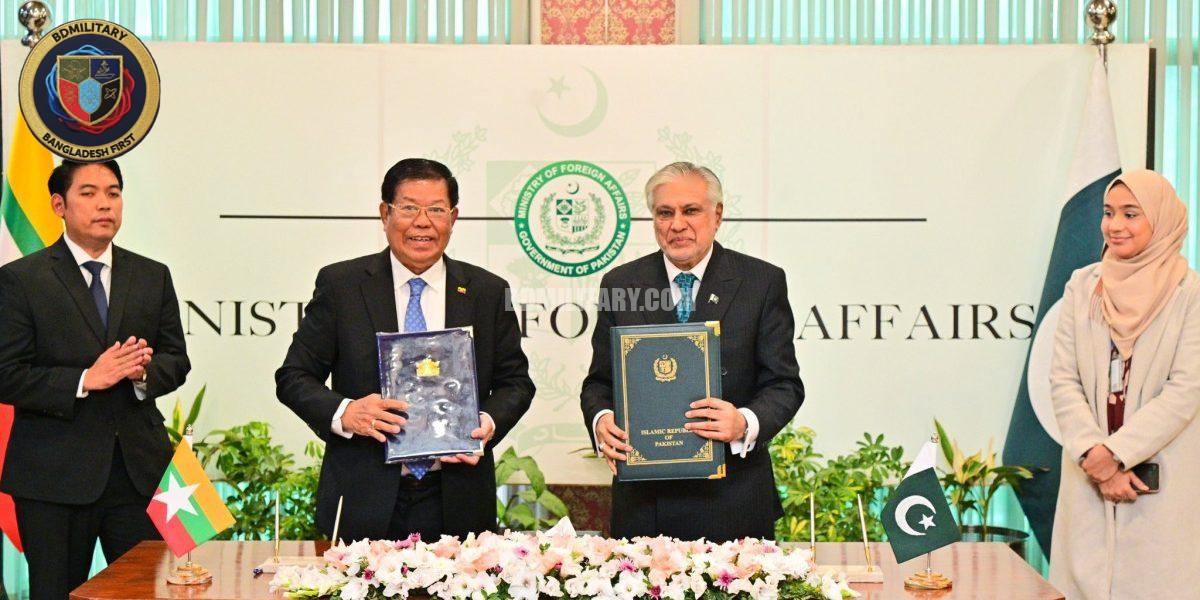
A recent high-level visit to Islamabad by Myanmar’s foreign minister marked the most significant bilateral engagement between the two countries in over a decade. Publicly framed around “regional reconciliation” and broader cooperation, the visit nonetheless underscores Naypyidaw’s urgent search for external partners willing to engage despite sanctions and reputational risks.
Reviving a Dormant Relationship
The ministerial visit, the first of its kind since 2015, resulted in agreements to revitalise bilateral relations through a structured political consultation mechanism between the two foreign ministries. Discussions also covered trade, education, cultural exchanges and people-to-people contacts. While these elements were highlighted diplomatically, defence cooperation remains the most strategically consequential dimension of the engagement.
Pakistan was among the first states to recognise Myanmar’s independence in 1948 and has, over successive decades, maintained working relations with its military rulers. Islamabad has previously supplied weapons, munitions, spare parts and training support, often at times when Western or regional actors were reluctant to do so. The current overture suggests a return to this longstanding pattern.
JF-17 Fighters and Operational Gaps
Central to Myanmar’s defence interests is its small fleet of JF-17 Block I fighter aircraft, jointly developed by Pakistan and China. Myanmar operates a single squadron of the type, but these aircraft have reportedly remained largely grounded due to shortages of spare parts, technical failures and sustainment challenges. Sanctions, disrupted supply chains and the erosion of technical expertise have compounded these problems.
The junta is believed to be seeking Pakistani assistance to restore the JF-17s to flightworthy status. This would likely involve access to spares, technical support and maintenance expertise, as well as potential upgrades. Beyond basic airworthiness, Naypyidaw may also be pursuing compatible air-to-air and air-to-ground munitions to replenish depleted stocks.
For the Tatmadaw, reviving even a limited fast-jet capability would be significant. Air power has become increasingly central to its counter-insurgency strategy as ground forces suffer heavy losses, defections and territorial reversals. However, air operations are constrained not only by aircraft availability but also by the growing vulnerability of air bases to sabotage, drones and indirect fire.
Factories Captured, Stockpiles Lost
Myanmar’s outreach to Pakistan must also be viewed against the collapse of its domestic arms production capacity. Over the course of the civil war, multiple weapons factories, ammunition depots and military bases have been captured by resistance forces or destroyed. This has deprived the junta of reliable supplies of small arms, artillery ammunition and rockets, forcing greater reliance on imports and dwindling reserves.
Pakistan’s defence industry, with its prior experience supplying Myanmar, is well positioned to provide short-term solutions, particularly in ammunition and spare parts. Such assistance would help the Tatmadaw sustain operations but is unlikely to reverse its broader structural decline in manpower, morale and control of territory.
Diplomacy and the Rohingya Factor
The timing of the visit is also notable in the context of ongoing proceedings at the International Court of Justice, where Myanmar faces allegations of genocide against the Rohingya. By engaging Pakistan — a key member of the Organisation of Islamic Cooperation — Naypyidaw may be seeking to soften opposition or cultivate diplomatic space in forums where Rohingya issues remain prominent.
This outreach coincides with Myanmar’s recent military-managed elections, widely dismissed by the United Nations and international observers as illegitimate and designed to entrench military rule. With legitimacy deficits deepening, the junta appears increasingly reliant on a narrow circle of partners willing to prioritise strategic interests over normative concerns.
Pakistan’s Strategic Calculus
For Islamabad, renewed engagement with Myanmar offers several advantages. It provides an opportunity to reassert relevance in Southeast Asian affairs, expand defence exports and counter India’s longstanding influence in Naypyidaw. India has invested heavily in infrastructure, connectivity projects and limited security cooperation with Myanmar, viewing it as a strategic bridge to Southeast Asia and a buffer along its north-eastern frontier.
By positioning itself as a willing defence and diplomatic partner, Pakistan can regain leverage and visibility in a region where its footprint has diminished in recent years. Defence cooperation, even if limited, also brings economic and political dividends.
Regional Implications and Bangladesh’s Concerns
Bangladesh has reportedly observed the Pakistan–Myanmar engagement with close interest. Dhaka remains directly affected by developments in Myanmar due to the presence of over a million Rohingya refugees who fled violence in Rakhine State. Any move that enhances the junta’s military capabilities — particularly in air power and munitions — risks prolonging the conflict and hardening Naypyidaw’s resistance to international pressure and repatriation efforts.
For Bangladesh and other regional stakeholders, the revival of Pakistan–Myanmar ties highlights the evolving external support networks sustaining the junta. While such engagement may offer Myanmar short-term relief, it is unlikely to alter the underlying trajectory of the conflict, which continues to erode the Tatmadaw’s control and deepen regional instability.
The courtship of Pakistan thus reflects both the junta’s desperation and Islamabad’s opportunism — a convergence that warrants sustained attention from regional security planners, particularly in Dhaka.

Khaled Ahmed is a seasoned former intelligence analyst and military expert from the Netherlands, bringing over 15 years of specialised experience in operational intelligence, threat analysis, and strategic defence planning. Having served in high-level, classified roles within Dutch military intelligence, he possesses rare expertise in European security architecture, NATO doctrine, and asymmetric warfare. Khaled’s deep operational insight and international perspective enable him to deliver precision-driven intelligence analysis and forward-looking strategic forecasts. A trusted contributor to high-level risk assessments and security briefings, he offers readers clarity on complex defence and security challenges. Khaled leads the National Security and Fact Analysis sections at BDMilitary. He holds a Master’s degree in International Relations from the University of Groningen, The Netherlands, and is fluent in Dutch, French, and Arabic — combining linguistic dexterity with operational expertise to analyse security issues across cultures and regions.