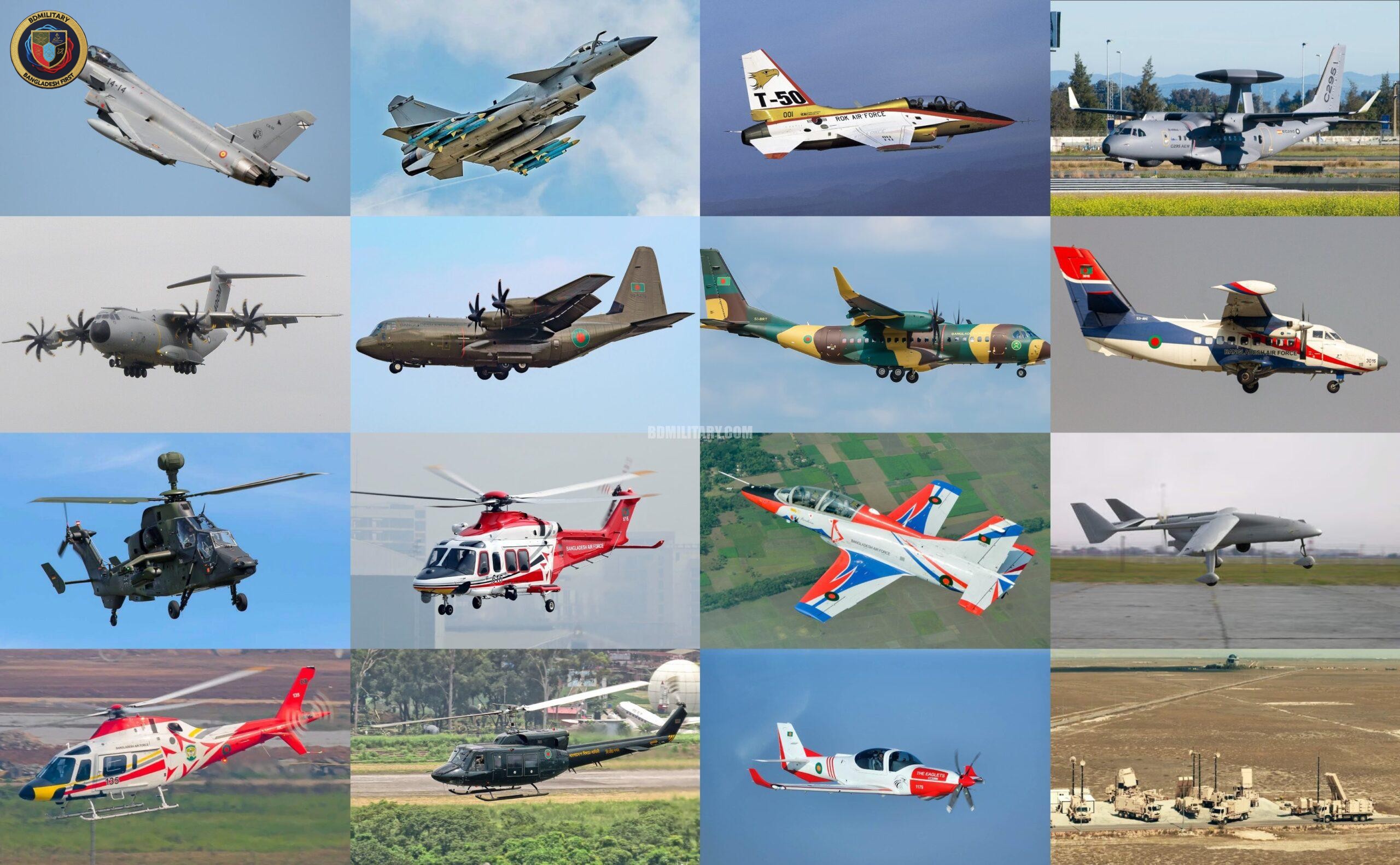
The Bangladesh Air Force (BAF) is entering a new era of strategic capability. The evolving security environment of the Indo-Pacific, marked by growing maritime and aerial activity and increased regional competition, demands a modern, flexible, and combat-ready air force. The BAF’s ongoing modernisation programme, which deliberately excludes rotary-wing aircraft, emphasises fixed-wing combat aircraft, intelligence, surveillance and reconnaissance (ISR), airborne early warning and control (AEW&C), strategic airlift, aerial refuelling, advanced training and doctrine reform, and cyber and electronic warfare integration.
Crucially, the BAF is implementing a hi-low combat aircraft strategy, combining high-end Eurofighter Typhoon TR4s with mid-tier J-10CEs. This configuration, alongside ISR, AEW&C, and strategic support assets, will allow the BAF to conduct sustained, extended-range operations across its area of responsibility, replace legacy MiG-29BM/UB and F-7BG/BG1 aircraft, and establish a credible deterrent against regional threats. Drawing on lessons from middle-power air forces, this policy outlines the roadmap, operational implications, and performance metrics necessary to realise a modern and capable BAF.
Strategic Context and Rationale
Bangladesh occupies a geostrategically sensitive location at the northern Bay of Bengal, near major maritime trade routes and emerging regional military capabilities. Historically, the BAF has focused on airspace defence and internal security support with a mix of legacy platforms that offered limited operational reach. In the modern battlespace, airpower is defined by sustainability, networked operations, and extended-range capability rather than simple platform numbers.
Helicopters, while valuable in limited tactical roles, are inherently constrained by endurance, speed, and survivability in contested environments. The current focus on fixed-wing modernisation addresses these limitations by enabling long-range combat, persistent ISR coverage, rapid deployment, and flexible response options. The hi-low fighter mix, with high-end Eurofighters supported by mid-tier J-10CEs, allows the BAF to optimise resources while maintaining operational readiness. This strategy aligns with Forces Goal 2030, enhancing both defensive and deterrent capabilities in the Indo-Pacific theatre.
Core Modernisation Pillars
The BAF’s modernisation framework rests on seven interrelated pillars:
- Combat Aircraft Modernisation
- Intelligence, Surveillance, and Reconnaissance (ISR)
- Airborne Early Warning & Control (AEW&C)
- Strategic Airlift and Support Infrastructure
- Aerial Refuelling Capability
- Training, Doctrine, and Simulation
- Cyber, Electronic Warfare, and Integrated Air Defence
These pillars collectively enable sustained, extended-range operations without reliance on rotary-wing aircraft, ensuring operational flexibility, scalability, and interoperability with regional and international partners.
Combat Aircraft Modernisation
The cornerstone of BAF modernisation is its hi-low combat aircraft fleet. The BAF is acquiring 10 Eurofighter Typhoon TR4s, forming two squadrons of high-end, multirole fighters, and 20 Chengdu J-10CEs, organised into four squadrons as mid-tier platforms. This fleet is designed to replace legacy aircraft, including MiG-29BM/UBs and F-7BG/BG1s, providing a significant upgrade in capability, range, and survivability.
The Eurofighter Typhoon TR4 will serve as the flagship platform, excelling in beyond-visual-range air-to-air engagements, precision strike, and suppression of enemy air defences. Its advanced avionics and networked systems enable integration with ISR and AEW&C assets, providing force multiplication in high-intensity scenarios. The J-10CE, by contrast, offers cost-effective multirole flexibility, performing air defence, maritime strike, and defensive patrol roles. The combination of these two platforms allows the BAF to maintain a high operational tempo while optimising sustainment costs.
The hi-low doctrine maximises both coverage and efficiency. Eurofighter squadrons can be deployed for high-priority missions, including regional deterrence, strategic strike, and SEAD/DEAD operations, while J-10CE squadrons handle routine airspace patrols, maritime interdiction, and joint-force integration tasks. By tiering combat assets, the BAF can maintain readiness across multiple operational scenarios without overstretching personnel or logistics.
| Platform | Number | Role | Replacement of |
|---|---|---|---|
| Eurofighter Typhoon TR4 | 10 | High-end multirole, air superiority, long-range strike | N/A (new capability) |
| J-10CE | 20 | Mid-tier multirole, defensive patrol, maritime strike | MiG-29BM/UB, F-7BG/BG1 |
| Legacy Jets (MiG-29BM/UB, F-7BG/BG1) | Phased out | N/A | Replaced by Eurofighter/J-10CE |
Strategic Implications:
The hi-low configuration enhances sortie generation, allows mission-specific allocation of assets, and ensures a credible deterrent against both conventional and asymmetric threats. It also provides flexibility for integration with AEW&C and ISR networks, enabling coordinated, network-centric operations across extended ranges.
Intelligence, Surveillance, and Reconnaissance (ISR)
Sustained operations require a robust ISR architecture capable of persistent maritime and territorial coverage. The BAF’s ISR framework will integrate manned fixed-wing ISR aircraft, MALE UAVs, and ground-based radar networks. Maritime patrol aircraft will monitor the Bay of Bengal and critical shipping lanes, while signals intelligence aircraft gather electronic order-of-battle data. MALE UAVs will provide persistent surveillance, especially in regions where manned aircraft cannot be continuously deployed.
The Kenya Air Force offers a relevant example. Kenya integrates King Air 350i ISR aircraft, upgraded F-5E Tiger IIs with targeting pods, and C-27J Spartan transports for ISR support, maintaining persistent domain awareness across vast operational areas. A similar approach in Bangladesh will enable continuous coverage, facilitate precision targeting, and provide actionable intelligence for both defensive and offensive operations.
| ISR Component | Operational Capability |
|---|---|
| King Air 350i ISR | Enhanced border and maritime surveillance |
| Upgraded F-5E Tiger II | Multi-role ISR and strike |
| C-27J Spartan | Transport and ISR support |
The BAF should also explore emerging ISR technologies, including UAV swarms and electronic intelligence payloads, to maintain operational advantage and complement manned surveillance platforms.
Airborne Early Warning & Control (AEW&C)
AEW&C assets extend radar coverage and act as airborne command-and-control nodes, vital for coordinating dispersed combat operations. The BAF should acquire 2-3 AEW&C aircraft based on commercial airframes equipped with modern AESA radar and integrated communications systems, enabling effective airspace monitoring and networked command for both high-end Eurofighter missions and mid-tier J-10CE operations.
Australia’s RAAF demonstrates the utility of AEW&C platforms, with E-7 Wedgetails providing persistent surveillance and acting as force multipliers in regional airspace. Similarly, the Republic of Korea Air Force leverages E-7 aircraft for peninsula-wide air defence, illustrating how middle-power air forces can maximise operational impact with limited AEW&C fleets.
| Air Force | Number of AEW&C | Key Role |
|---|---|---|
| Royal Australian Air Force | 6 | Regional air control and C2 |
| Republic of Korea Air Force | 4 | Peninsula defence and ISR coordination |
| Turkish Air Force | 4 | Strategic airspace management |
Integrating AEW&C with Eurofighter and J-10CE squadrons enhances network-centric operations, enabling real-time coordination between combat, ISR, and air defence assets.
Strategic Airlift and Support
Strategic airlift ensures rapid deployment of personnel, equipment, and humanitarian aid. The BAF’s current fleet includes C-130J Super Hercules aircraft, but expansion to 6-8 aircraft is recommended to sustain high-tempo operations across riverine, coastal, and regional theatres. Airlift assets should feature modular cargo systems to support both combat and disaster-relief roles. Forward logistics hubs integrated with ISR and AEW&C networks will facilitate rapid response and sustained operations. The air force also do well to acquire A-400Ms to support major brigade-level land and Special Forces warfare activity.
Aerial Refuelling Capability
Aerial refuelling enhances operational range, endurance, and sortie generation, allowing combat and ISR aircraft to remain on station longer without reliance on forward basing. The BAF should acquire 1-2 medium-sized tanker aircraft, compatible with both Eurofighter and J-10CE platforms. Refuelling capability multiplies the impact of the hi-low fighter fleet and allows sustained operations over the Bay of Bengal and extended border areas.
| Benefit | Operational Effect |
|---|---|
| Increased Range | Extended reach over maritime and border regions |
| Greater Endurance | Longer on-station ISR and strike time |
| Force Multiplier | Higher sortie generation and operational flexibility |
Training, Doctrine, and Simulation
Modernisation requires parallel investment in personnel. Advanced simulators and mission rehearsal environments enable pilots and crews to practice integrated operations, networked combat, and hi-low deployment strategies without risking live assets. Doctrine should emphasise network-centric warfare, multi-axis engagement, and AEW&C-guided operations, ensuring all elements of the air force operate cohesively. International exercises with middle-power air forces can accelerate proficiency and foster interoperability.
Cyber, Electronic Warfare, and Integrated Air Defence
The modern battlespace is defined by electronic and cyber threats as much as kinetic ones. The BAF must develop cyber and electronic warfare capabilities to protect networks, degrade adversary communications, and support both offensive and defensive operations. Integrated air defence systems, linked to AEW&C and ISR assets, will provide layered protection against aircraft, UAVs, and precision-guided munitions, ensuring high survivability for both high-end and mid-tier platforms.
Implementation Roadmap
The BAF’s modernisation programme should be implemented in three overlapping phases:
- Phase One (Years 1-3): Procure Eurofighter TR4s and J-10CEs, establish AEW&C fleet, expand ISR coverage, and upgrade strategic airlift.
- Phase Two (Years 4-7): Introduce aerial refuelling, integrate ISR and AEW&C with combat squadrons, institutionalise updated doctrine and training.
- Phase Three (Years 8-10+): Sustain capabilities, implement platform upgrades, expand international interoperability, and incorporate emerging technologies such as UAV swarms and electronic warfare enhancements.
| Phase | Timeline | Key Deliverables |
|---|---|---|
| Phase One | 1-3 years | 10 Eurofighters, 20 J-10CEs, AEW&C acquisition, ISR network foundation |
| Phase Two | 4-7 years | Aerial refuelling, integrated operations, doctrinal implementation |
| Phase Three | 8-10+ years | Sustainment, upgrades, interoperability exercises, emerging tech integration |
Performance Metrics and Evaluation
Performance must be measurable. Metrics include sortie generation rates, ISR coverage hours, AEW&C network uptime, logistic deployment times, and simulator hours per crew. Targets include 85-90% combat readiness, 168 ISR hours per week, and 95% AEW&C network uptime, ensuring the BAF’s transformation is both accountable and results-driven.
| Metric Category | Key Performance Indicator |
|---|---|
| Combat Readiness | Sortie generation rate (85-90%) |
| ISR Coverage | Hours on station/week (168 hrs) |
| AEW&C Efficiency | Network uptime (95%) |
| Logistic Mobility | Deployment time <48 hrs |
| Training Proficiency | Simulator hours/crew (120 hrs/year) |
Case Studies: Middle-Power Air Forces
- Singapore: F-16V upgrade and planned F-35B acquisition illustrate tiered capability and high operational readiness with limited aircraft.
- Australia: E-7 Wedgetail AEW&C demonstrates force multiplication through airborne command and control.
- Morocco: F-16 Block 70/72 upgrades and UAV integration show cost-effective modernisation.
- Nigeria: A-29 Super Tucano demonstrates how flexible, low-cost aircraft can generate operational impact.
- Kenya: ISR integration shows how persistent coverage enhances both defensive and offensive operations.
Conclusion
The BAF is poised to become a modern, hi-low, combat-ready air force capable of sustained, extended-range operations. By integrating Eurofighter Typhoon TR4s and J-10CEs, alongside ISR, AEW&C, strategic airlift, aerial refuelling, training, doctrine reform, and cyber/EW capabilities, the BAF will achieve a credible deterrent and enhanced regional influence. Immediate focus should be on combat aircraft induction, AEW&C integration, ISR network expansion, and doctrinal adaptation, ensuring operational readiness and flexibility by 2035.
This modernisation approach positions Bangladesh to protect national interests, contribute to regional stability, and operate effectively in the evolving Indo-Pacific security environment.
Future Fleet Plan
| Type | Model | Quantity |
| Multi-Role Fighter Aircraft (T/E) | Eurofighter Typhoon TR4 | 24 |
| Multi-Role Fighter Aircraft (S/E) | J-10CE | 48 |
| Lead-In Fighter Trainer (LIFT) | T-50 | 16 |
| Intermediate Jet Trainer | K-8W | 32 |
| Airborne Early Warning & Control Aircraft | C295W AEW&C | 2 |
| Strategic Lift Transport | A400M | 4 |
| Heavy Lift Transport | C-130J | 12 |
| Medium Lift Transport | C295W | 8 |
| Multi-Engine Transport Trainer | L-410 EVP20 | 6 |
| Primary Trainer | G 115 | 6 |
| Primary Trainer | G 120TP | 48 |
| Unmanned Aerial Vehicle (MALE) | Falco (BD) | 48 |
| Total | 254 | |

M.Z. Rahman is a distinguished defence and aerospace industry veteran turned strategist, with over two decades of experience in regional security, military modernisation, and strategic policy. Holding a Master of Arts in International Relations and Security Studies from Waikato University, New Zealand, he has contributed extensively to leading think tanks and defence journals worldwide. As Chief Editor of BDMilitary, Rahman drives the editorial vision, delivering authoritative, rigorously researched insights that reflect the latest trends in defence and geopolitics. His work integrates industry expertise with strategic foresight, establishing him as a respected voice in global defence strategy.

