There is an increasingly predictable pattern in South Asian discourse whenever Bangladesh begins to assert itself strategically. Certain Pakistani analysts, sections of their media, and associated online voices respond not with measured analysis, but with exaggeration, misrepresentation, and a persistent urge to insert themselves into events where their role is, at best, peripheral. This tendency reflects not confidence, but insecurity.
Recent claims that a Pakistani Quick Reaction Force “rescued” Bangladeshi troops exemplify this problem. The facts are unambiguous. The personnel involved were part of a mixed contingent comprising largely non-combat and support staff, a reality confirmed by the list of those martyred and wounded. No Bangladeshi combat unit was rescued, no operational reliance existed, and no factual basis supports the narrative that was subsequently promoted. Yet the claim was circulated regardless, underscoring a willingness to prioritise self-credit over accuracy.
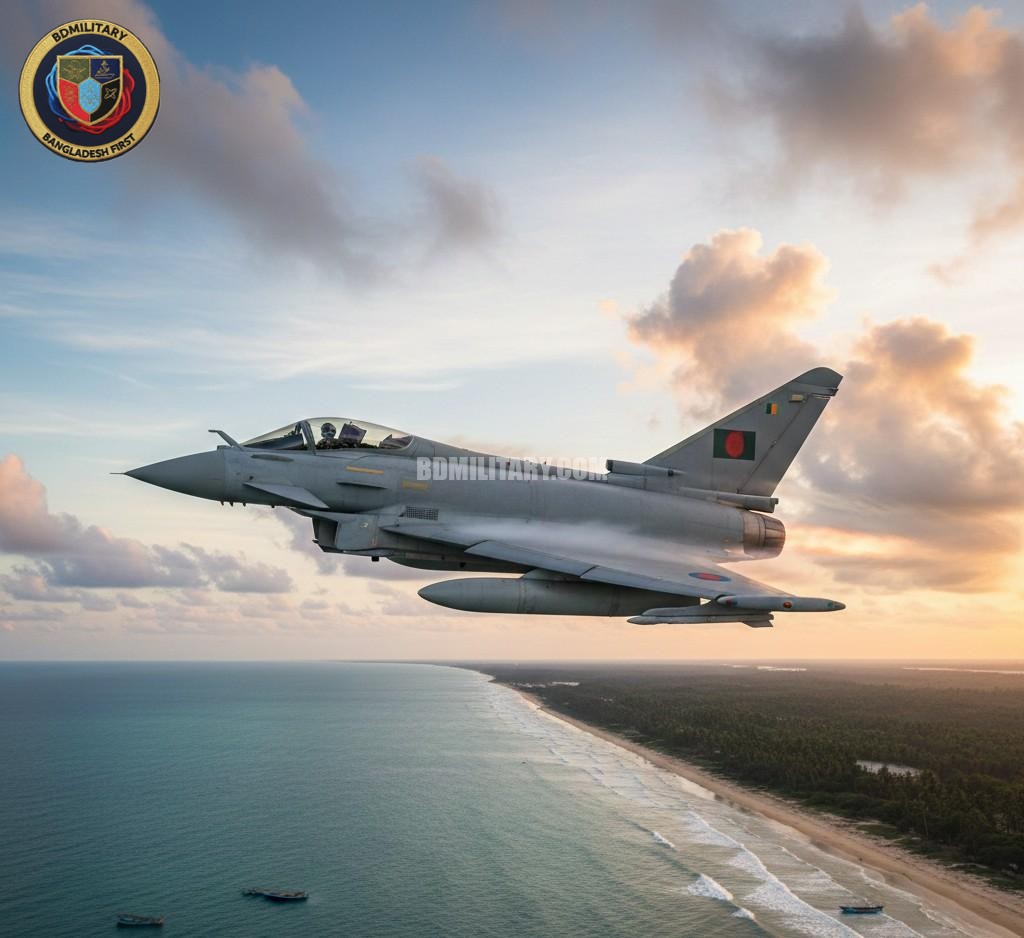
A similar pattern has emerged in response to the Bangladesh Air Force’s evaluation of the Eurofighter Typhoon. Commentators in Pakistan, and in India for different reasons, hastily asserted that Bangladesh was seeking second-hand Tranche 1 or Tranche 2 aircraft, portraying them as inferior even to the JF-17. Such assertions are demonstrably false. The aircraft evaluated were from Tranche 3A, and any eventual production models will be drawn from Tranche 4 or later, subject to final contractual arrangements. The Eurofighter Typhoon remains among Europe’s most capable multirole combat aircraft, with a technological maturity, upgrade path, and operational credibility that cannot be seriously compared to lightweight platforms designed primarily around cost considerations.
Underlying much of this commentary is a refusal to acknowledge Bangladesh’s economic reality. Bangladesh’s economy is now almost twice the size of Pakistan’s. That the country previously exercised restraint in high-end defence procurement reflected policy choice rather than financial limitation. A state capable of sustaining growth, expanding infrastructure, and maintaining export competitiveness can afford limited numbers of advanced combat aircraft when strategic requirements evolve. Bangladesh’s current trajectory reflects intent and agency, not belated ambition.
It is also worth noting that this discussion takes place in December, a month that carries profound historical significance. Bangladesh does not forget attempts to distort its reality, undermine its sovereignty, or project condescension under the guise of analysis. The origin of such narratives, whether in Pakistan or India, is ultimately secondary. What matters is intent, and bad faith will be identified and challenged accordingly.
Bangladesh must therefore engage both India and Pakistan with clear-eyed realism. Neither operates absent self-interest, and neither should be approached with misplaced trust. Cooperation may be necessary, but illusions are not. The contrast between regional actors shaped by insecurity and global or emerging powers such as China and Türkiye is increasingly apparent. The latter engage Bangladesh as a strategic partner; the former too often do so through entitlement and historical nostalgia.
Bangladesh is no longer a peripheral actor in South Asia. It is an emerging power with economic weight, strategic autonomy, and growing defence options. Efforts to diminish or misrepresent this reality reveal far more about the anxieties of those making such claims than about Bangladesh itself. The country will continue to define its own course, without seeking validation from neighbours still constrained by their own contradictions.

Khaled Ahmed is a seasoned former intelligence analyst and military expert from the Netherlands, bringing over 15 years of specialised experience in operational intelligence, threat analysis, and strategic defence planning. Having served in high-level, classified roles within Dutch military intelligence, he possesses rare expertise in European security architecture, NATO doctrine, and asymmetric warfare. Khaled’s deep operational insight and international perspective enable him to deliver precision-driven intelligence analysis and forward-looking strategic forecasts. A trusted contributor to high-level risk assessments and security briefings, he offers readers clarity on complex defence and security challenges. Khaled leads the National Security and Fact Analysis sections at BDMilitary. He holds a Master’s degree in International Relations from the University of Groningen, The Netherlands, and is fluent in Dutch, French, and Arabic — combining linguistic dexterity with operational expertise to analyse security issues across cultures and regions.

